

Commentary
Richard Youngs
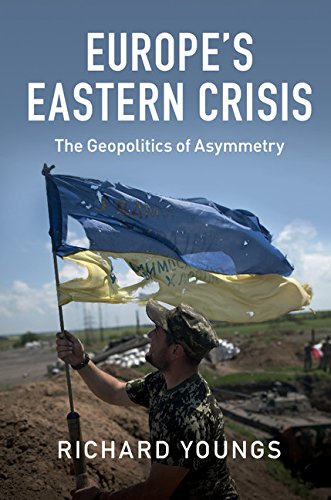
In recent years, a series of crises have erupted on the European Union’s eastern borders. In response, the EU has begun to map its own form of “liberal-redux geopolitics” that combines various strategic logics.
Source: Cambridge University Press
In recent years, a series of crises have erupted on the European Union’s eastern borders. Russia’s annexation of Crimea and the subsequent conflict in eastern Ukraine presented the EU with a major foreign policy challenge, both in Ukraine and across the other countries of the Eastern Partnership. In response, the EU has begun to map its own form of “liberal-redux geopolitics” that combines various strategic logics. This book traces the effect of these crises on the foreign policy of the EU, examining the changes in policies toward the countries on its eastern borders, the EU’s review of the Eastern Partnership, as well as the EU’s relations with Russia overall. It goes on to uncover whether the EU has contained the crisis or if it has set up new conditions for more instability in the future.
“Richard Youngs’s new account of the complex geopolitical context in the Eastern Partnership region provides a nuanced, sophisticated, and empirically rich study that is invaluable in taking into account the opinions of diplomats, policymakers, and civil society in the EaP states themselves.”
—Eka Tkeshelashvili, head of EU Anti-Corruption Initiative in Ukraine, former Georgian foreign minister, and president of the Georgian Institute for Strategic Studies
“Ukraine and other states between these two ‘empires’ feel the heat again, and Richard Youngs’s book expertly maps a complex mosaic of power, ambition, and brinkmanship. Youngs’s engaging and balanced analysis is indispensable reading for everyone trying to comprehend the ongoing geopolitical turn and the evolution of the EU’s foreign and security policy.”
—Jan Zielonka, professor of European Politics, University of Oxford

Senior Fellow, Democracy, Conflict, and Governance Program
Richard Youngs is a senior fellow in the Democracy, Conflict, and Governance Program, based at Carnegie Europe. He works on EU foreign policy and on issues of international democracy.
Recent Work
Richard Youngs


Richard Youngs, Erik Jones, Dan Baer, …
Carnegie does not take institutional positions on public policy issues; the views represented herein are those of the author(s) and do not necessarily reflect the views of Carnegie, its staff, or its trustees.

The aftermath of the Ceuta crisis shows Europe has drawn the wrong lessons. Rather than doubling down on failed migration policies, the EU needs to address the underlying roots of such episodes.
Richard Youngs

Canadian Prime Minister Mark Carney has twice inspired praise for standing up to U.S. President Donald Trump: at the 2026 World Economic Forum in Davos and on Canada-U.S. trade negotiations. Is Carney showing a third way better than the EU has in dealing with the Trump administration?

Rym Momtaz, ed.

The EU’s responses to two recent incidents expose the gulf between European perceptions and capabilities. Unless the union can bridge that gap, it will never become a real geostrategic power.
Rym Momtaz

European states control several Overseas Countries and Territories around the world that carry strategic, economic, and environmental weight. As great powers challenge the rules-based order, defending them is a geopolitical imperative for Europe.

Marc Pierini

In supporting Europe’s far-right, MAGA and Russia both want the same thing: a weaker EU. Europe must defend itself without abandoning the openness these forces exploit.

Armida van Rij