

Commentary
Judy Dempsey
{
  "authors": [
    "Judy Dempsey"
  ],
  "type": "commentary",
  "blog": "Strategic Europe",
  "centerAffiliationAll": "",
  "centers": [
    "Carnegie Endowment for International Peace",
    "Carnegie Europe"
  ],
  "collections": [],
  "englishNewsletterAll": "",
  "nonEnglishNewsletterAll": "",
  "primaryCenter": "Carnegie Europe",
  "programAffiliation": "",
  "programs": [],
  "projects": [],
  "regions": [
    "Asia"
  ],
  "topics": [
    "EU",
    "Security"
  ]
}
Source: Getty
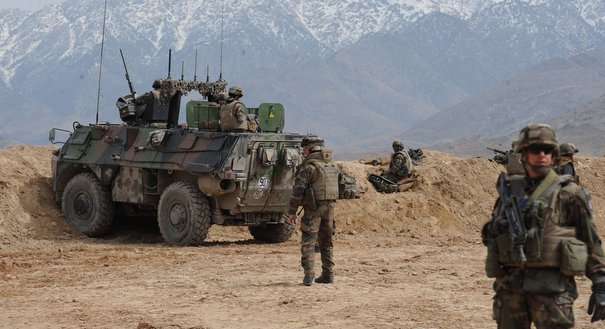
The Europeans have no choice, politically nor militarily, to stay in Afghanistan once the United States withdraws its combat troops from Afghanistan.
The scramble to get out of Afghanistan is well underway.
The Netherlands and Canada pulled out their combat troops in 2010 and 2011.
France will withdraw 1,000 of its 3,500 soldiers before the end of this year, the rest by the end of 2013.
Most recently, Julia Gillard, the Australian Prime Minister, announced plans to end her country’s military mission in Afghanistan in mid-2013, a year earlier than scheduled.
Officially, the NATO summit in May in Chicago will confirm what the U.S. and NATO have said for a while now: Only in 2014 will they withdraw all combat troops and hand over the full responsibility for the country’s security to Afghan forces.
You can bet, however, that outside the formal meeting rooms, there will be nervous mutterings about who will pull out next.
The reason is that Allies have lost faith in their mission in Afghanistan. There just doesn’t seem to be a good reason anymore to keep up a commitment that has proved so expensive in money, lives and good will.
Remember, just for a moment, how high the hopes for the Afghan mission were initially.
It began ten years ago as an extraordinary act of solidarity with the United States after the September 11 attacks. NATO for the first time ever invoked Article Five of the organization’s treaty, which obliges member states of the Alliance to come to the assistance of another member under attack.
Even Gerhard Schröder, then chancellor of Germany, promised the U.S. his country’s “unlimited solidarity”. It is a pledge he fulfilled by promptly sending German troops to Afghanistan. Iraq was a later, different story.
During those first, heady days, when jubilant Afghans cheered Western troops as liberators from the Taliban’s harsh rule, it did not seem to matter how far away Afghanistan was.
Europeans and Americans shared the determination to make it impossible for terrorists to use Afghanistan as a training ground ever again. And both hoped to make the country a more democratic, tolerant, lawful state.
Both goals might have been achievable had there not been so many mistakes made with the U.S. putting most of its attention and armed force into Iraq and the Europeans not pulling their weight with police training in Afghanistan.
As it was, results were mixed. The U.S. had some success in dismantling the Al Qaeda network in Afghanistan and managed to kill Osama bin Laden last June in Pakistan, though networks of Islamist terrorist have regrouped in Yemen and Somalia and elsewhere.
But the enormous number of civilians killed in U.S. and NATO attacks, the lack of respect for Muslim religious traditions, and the scandals over the treatment of prisoners have inflamed Afghan public opinion against Western troops.
And now, NATO has seen an upsurge in attacks precisely as the international forces prepare to quit.
Analysts say the insurgents and the Taliban as well as clans and supporters of the Karzai regime are waiting for the day after.
Ashley J. Tellis, a security and defense expert at Carnegie, is highly skeptical that the Afghan military, police and militia will be capable of independently securing the country against the wide range of terrorist and insurgent groups that will still be present in the region in 2014.
On democratic institutions and state building, the record of our ten years in Afghanistan is even worse.
Of course, there are Afghan girls and women who have now had the freedom to go to school and learn to read and write and pursue opportunities never before available.
But Hamid Karzai’s government is undermining these gains.
“When I heard the government has a law banning women from driving, I asked myself, what are we doing here?" a NATO official said.
Afghanistan still suffers from rampant corruption, the misuse of development assistance and the ruthlessness of drug barons and warlords.
Add to that the fact that most of the time, Mr. Karzai doesn’t even seem to want Western troops around anymore.
It really is no wonder that public opinion in the Europe and the U.S. has turned very hostile to the engagement, making it ever more costly for governments to stay the course.
President Barack Obama who is facing a hard re-election campaign will be sorely tempted to announce further troop reductions in time for November’s poll.
Militarily, the Europeans would be lost without U.S. troops to carry out the most dangerous missions and back up all the other contingents.
Politically, they would also find it impossible to stay even one day longer than the U.S.
The best that can be hoped for, then, is that most of them hold out as long as the United States. If Britain and Germany, the two biggest European contributors, keep to the principle of “in together, out together”, it would be a very good thing for NATO and for transatlantic relations.
And next time, leaders should think harder about what means need to be committed to have a chance to reach such worthy and ambitious goals.

Nonresident Senior Fellow, Carnegie Europe
Judy Dempsey is a nonresident senior fellow at Carnegie Europe
Recent Work
Judy Dempsey
Judy Dempsey
The closure of the Strait of Hormuz has triggered a global energy crisis, but Europe is stuck in reaction mode. Without more strategic foresight, the EU will remain dependent on fossil fuels and will never be truly secure.


Milo McBride, Pauline Gerard
After spending much of 2025 trying to placate Donald Trump, some European leaders are starting to change posture. But is even a hostile Washington still so important to Europe that the U.S. president’s outbursts are worth putting up with?

Rym Momtaz, ed.
European leaders have now not only lost faith in Donald Trump’s U.S. presidency, but also in America’s hegemony as a whole. But short-term challenges make an immediate divorce unwise.
Rym Momtaz
Europe has an interest in supporting Armenian leader Nikol Pashinyan as he tries to make peace with neighbors and loosen ties with Russia. But it is depersonalized support in the long term, not quickfire flash, that will win the day.

Thomas de Waal
Following Ursula von der Leyen’s gaffe equating Turkey to Russia and China, relations with Ankara risk deteriorating even further. Without better, more consistent diplomatic messaging, how can the EU pretend to be a geopolitical power?

Sinan Ülgen