

Commentary
Judy Dempsey
{
  "authors": [
    "Judy Dempsey"
  ],
  "type": "commentary",
  "blog": "Strategic Europe",
  "centerAffiliationAll": "",
  "centers": [
    "Carnegie Endowment for International Peace",
    "Carnegie Europe"
  ],
  "collections": [],
  "englishNewsletterAll": "",
  "nonEnglishNewsletterAll": "",
  "primaryCenter": "Carnegie Europe",
  "programAffiliation": "",
  "programs": [],
  "projects": [],
  "regions": [
    "Europe"
  ],
  "topics": [
    "EU"
  ]
}
Source: Getty
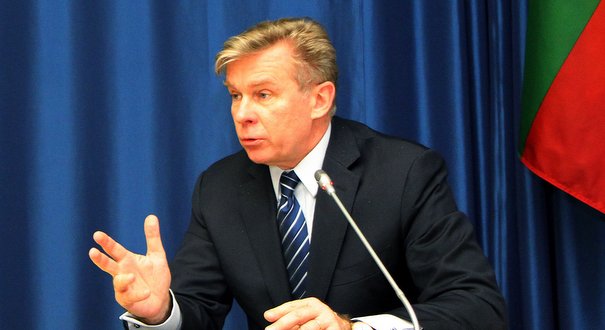
In an interview with Judy Dempsey, Audronius Azubalis, Lithuanian minister of foreign affairs, says that the EU must engage Ukraine, not punish it.
Audronius Azubalis is not a happy man. As more and more EU leaders announce that they will boycott the European Football Championship in Ukraine because of the alleged ill treatment of opposition leader Yulia Tymoshenko, Azubalis disagrees. As foreign minister of Lithuania, he took the opportunity of our interview to launch an urgent appeal to the EU to strengthen, not weaken, its ties to its Eastern neighbors.
If you wonder why, just take a look at the map.
Lithuania shares a border with Belarus. It shares a border with Russia, because of the exclave of Kaliningrad. And although it does not have a frontier with Ukraine, the Lithuanian government has over the past several years taken a special interest in Ukraine. Its goal is to find some way to integrate Ukraine into the EU.
DEMPSEY: Minister, will you be joining the boycott of the football games in Ukraine?
AZUBALIS: No. Boycotting events the football cup, or the Yalta meeting (the annual summit of European leaders) just because Ukraine is considered a bad guy is not the right way to go about things. Despite of our misgivings about the present leadership, we must remain engaged. We have to give some kind of perspective to the citizens.
DEMPSEY: What does mean in practical terms?
AZUBALIS: We should work in two ways: encourage the opposition and talk very openly about Tymoshenko’s situation. And we should ratify the Association Treaty.
DEMPSEY: Why?
AZUBALIS: Because it would mean a tangible result for the society. And to be very frank, the Ukrainian side made a lot of compromises in the negotiations with the EU. It wasn’t easy for them. EU association would also give the business community in Ukraine a perspective.
DEMPSEY: You are hoping that the association agreement will give the business community and the middle class such a stake that they will exert pressure on the leadership to return to the reform process.
AZUBALIS: Yes.
DEMPSEY: Most EU governments don’t seem to see it your way. They don’t want to ratify the treaty unless the human rights situation improves dramatically.
AZUBALIS: Cutting off talks about the association agreement would be a big mistake. It would mean leaving Ukraine to Euro Asia. Look, we also strongly disagree with the human situation in Ukraine, too. My President wanted to go to Kharkiv and visit Tymoshenko and then talk to the Ukraine’s leaders. They were our conditions.
(Dalia Grybauskaite, the Lithuanian President last Friday visited Tymoshenko at a hospital in Kharkiv)
DEMPSEY: It’s clear that it is not going to be easy to reach consensus among all 27 countries concerning Ukraine and the boycott.
AZUBALIS: We are struggling. It will be quite difficult.
DEMPSEY: Apart from Ukraine, there are five other countries in the Eastern partnership, sandwiched between the EU and Russia. None of them are model democracies. What is your view of their future?
AZUBALIS: First of all, the six countries are very different. Secondly, we don’t have a common view within the EU on how to proceed.
DEMPSEY: What do you suggest?
AZUBALIS: We have two advanced countries - Moldova and Georgia. We should support them on their path to Europeanization by putting them in a position that the benefits they will obtain would serve as a good example to the others.
DEMPSEY: For example?
AZUBALIS: We should open negotiations with these two countries for visa liberalization. Anywhere in the Eastern neighborhood, this is one of the most valued things. We should not be afraid of granting that status to Moldova or Georgia. These are small countries. We did the same for Serbia.
DEMPSEY: Perhaps the most unpleasant country of the six is Belarus. What can be done there?
AZUBALIS: I’m really tired of all the plans for supporting the opposition in Belarus. The opposition is divided. It has no clear stance about how to prepare for the next elections.
DEMPSEY: Two opposition leaders who ran against President Lukashenka and were put in prison after the elections in 2010 were recently released
AZUBALIS: It means nothing. It’s an old game in countries like that. We can’t just proceed to observe the next elections. What will they achieve? Nothing, or some violence, some statements.
DEMPSEY: So what can be done?
AZUBALIS: I see only one, quite drastic way. Together with our American friends, we should start thinking about a transitional council. We should create an alternative power center. This kind of parallel structure could have an echo in the country. It is an idea. But so far, I have received no reactions from Brussels.
DEMPSEY: When you look at this whole part of Europe, what is at stake
AZUBALIS: Democracy. What we need is a belt of democracies around Russia. That would influence Russia faster than we think. We have to show Russia that we can offer these countries something. If we succeeded in Ukraine, and if Moldova and Georgia got visa free travel earlier than Russia, that would have an enormous impact on Russian civil society. The main goal of the Russian leadership is to show that these six countries have failed; that they are not real states.
DEMPSEY: Do we need the United States to help the EU?
AZUBALIS: Yes. America is very pragmatic. Also, democracy runs deep in American society. It is absolutely necessary to have America on board.

Nonresident Senior Fellow, Carnegie Europe
Judy Dempsey is a nonresident senior fellow at Carnegie Europe
Recent Work
Judy Dempsey
Judy Dempsey

While the EU and European governments are embracing the much-lauded middle-power moment, this entails three difficult conundrums.

Richard Youngs

Much has been said of the changes Brussels is trying to make to the EU enlargement process. Here’s why gradual integration might—or might not—be the answer.

Dimitar Bechev

The European Commissioner for Trade is headed to China. But after President Xi’s bridge-building visit to Washington, can a more isolated EU overcome Beijing’s stranglehold on critical raw materials? Who will blink first?

Rym Momtaz, ed.

The domestic impacts of how long it is taking to end the war in Ukraine have pushed the French electorate to the political extremes and compromised the country’s diplomatic capacity.
Rym Momtaz

Before the next wave of EU enlargement takes place, the union needs to grapple with thorny questions of how power is distributed among its members.


Emil Sondaj Hansen, Ditte Brasso Sørensen