

Commentary
Are Germany’s economic, industrial, and political struggles becoming a liability for the EU’s ability to rise to the geopolitical moment?
Rym Momtaz, ed.
{
  "authors": [
    "Ulrich Speck"
  ],
  "type": "commentary",
  "blog": "Strategic Europe",
  "centerAffiliationAll": "",
  "centers": [
    "Carnegie Endowment for International Peace",
    "Carnegie Europe"
  ],
  "collections": [],
  "englishNewsletterAll": "",
  "nonEnglishNewsletterAll": "",
  "primaryCenter": "Carnegie Europe",
  "programAffiliation": "",
  "programs": [],
  "projects": [],
  "regions": [
    "Europe"
  ],
  "topics": [
    "Climate Change",
    "EU"
  ]
}
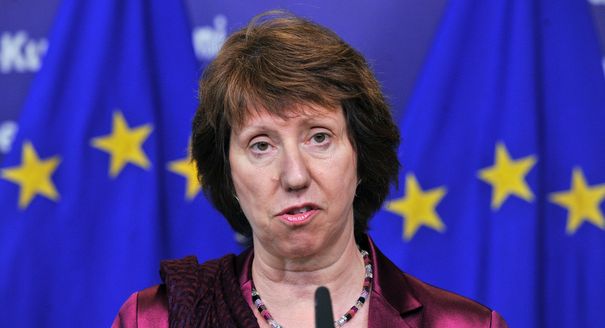
Source: Getty
Europeans should focus on Europe’s role in the world, which could ultimately prove to be a key part of a solution to the euro crisis.
Europeans should get used to the euro crisis, as there is no obvious solution. They should focus on other important things, especially Europe’s role in the world, which could ultimately prove to be a key part of a solution to the crisis.
Europe has been in an apocalyptic mood for two years and there is no end in sight. What we have learned during these years is that two obvious solutions are not going to work.
The eurozone will not become a federal state—which would be the most desirable solution from an economic point of view. Today we live in the European Union that is possible: a close association of states who do much together, but who will not abandon their fundamental independence and sovereignty.
Nor is abandoning the euro an option, as it will likely lead to a complete disintegration, with economic and political costs that would dwarf any bail-out. Decades of European integration are at risk. The Union would not necessarily be abandoned immediately, but member states would feel less and less need to coordinate their policies and would look for their independent way ahead. The EU would, in the best-case scenario, look like the Holy German Empire circa 1800—shortly before Napoleon gave it the final blow and the regional entities that made up the Empire became sovereign states.
It is precisely the fear of such a disintegration that is currently pushing EU leaders to talk about moving towards “fiscal union” or even “political union”. However, this seemingly federalist drive is not genuine, and therefore not effective. It is not built on the political will of the member states—elites and voters—to become a federal union. The driving force is sheer panic; capitals are afraid that they might set forces in motion that could destroy Europe’s post-war achievements, peace and prosperity. EU leaders will promise everything that convinces markets and partners that the euro is not doomed.
If a federal state is not on offer and if failure is not an option, it is likely that the crisis is going to continue and become the new norm. The eurozone, and with it the EU, might simply continue to muddle through, as it has done for the last two years, managing a currency that is, contrary to the basics of economics, not embedded in a state structure.
A European Central Bank intervention here; another EU summit with promises of union, austerity, and/or growth there; the reluctant building of higher firewalls to prevent contagion if something is exploding; and Germany grudgingly accepting higher inflation. Over time, the crisis countries may adopt, with painful internal devaluation, some structural reforms.
If we cannot solve the crisis, if we cannot cut through the Gordian knot with one decisive blow, maybe we should start to get out of crisis mode and focus on other issues: by no longer only looking inwards and by starting to look outside Europe, to a world that is moving ahead, with or without us.
A stronger focus on foreign and security policy would not only be an important goal in and of itself—advancing European interests in the world. It would also be a way to break out of the purely negative crisis mood and to demonstrate to voters what the EU is good for and where it can add value, besides the economy. It would be a way to signal to the world that Europe is dedicated to remaining a strong force to reckon with—in a time when the euro crisis has severely damaged the EU’s soft power.
It would therefore be an excellent tactical and strategic move to put the big foreign dossiers much higher on the agenda of EU leaders, on equal footing with the crisis: relations with the eastern and southern neighborhoods, enlargement, transatlantic relations, European defense, energy and other raw materials, freedom of the seas, and especially the need for much more intense engagement with Asia.
It might also be necessary to review the EU’s institutional arrangements. The Union’s foreign policy is still, despite Lisbon, very fragmented, with 27 governments on one side and at least three key players in Brussels on the other—the President of the European Council, the President of the Commission, and the High Representative for Foreign Affairs and Security Policy with her diplomatic service, the EEAS. In addition, there is the President of the European Parliament, who has just started to pursue his own, independent foreign policy.
Combining these elements is a huge challenge which cannot be done on the level of foreign ministers only. To have only one President for the European Council and the Commission who is also in charge of foreign and security policy would at least make Brussels sing from the same song sheet—and clarify to third parties who to talk to.
The management of the euro crisis is an existential task for the EU. But focusing on the crisis alone could make things worse. If “Europe” equals “crisis”, the EU’s global standing is going to be further diminished, as will its image in the eyes of European citizens. Making sacrifices for the euro is not attractive. But making sacrifices to turn Europe into a strong global player certainly is. Placing the EU’s foreign policy high on the agenda therefore pays off, in every way.
Ulrich Speck
Former Visiting Scholar, Carnegie Europe
Speck was a visiting scholar at Carnegie Europe in Brussels, where his research focuses on the European Union’s foreign policy and Europe’s strategic role in a changing global environment.
Carnegie does not take institutional positions on public policy issues; the views represented herein are those of the author(s) and do not necessarily reflect the views of Carnegie, its staff, or its trustees.

Are Germany’s economic, industrial, and political struggles becoming a liability for the EU’s ability to rise to the geopolitical moment?

Rym Momtaz, ed.

European Commission President Ursula von der Leyen is about to give her annual address on the state of the EU. Here’s what she won’t—but should—say.
Rym Momtaz

The aftermath of the Ceuta crisis shows Europe has drawn the wrong lessons. Rather than doubling down on failed migration policies, the EU needs to address the underlying roots of such episodes.

Richard Youngs

An overwhelming victory by a far-right-wing party in a small state in eastern Germany will have major repercussions for Chancellor Friedrich Merz’s coalition.

Judy Dempsey

Canadian Prime Minister Mark Carney has twice inspired praise for standing up to U.S. President Donald Trump: at the 2026 World Economic Forum in Davos and on Canada-U.S. trade negotiations. Is Carney showing a third way better than the EU has in dealing with the Trump administration?
Rym Momtaz, ed.