

Commentary
Nathalie Tocci, Jan Techau
{
  "authors": [
    "Jan Techau"
  ],
  "type": "commentary",
  "blog": "Strategic Europe",
  "centerAffiliationAll": "",
  "centers": [
    "Carnegie Endowment for International Peace",
    "Carnegie Europe"
  ],
  "collections": [],
  "englishNewsletterAll": "",
  "nonEnglishNewsletterAll": "",
  "primaryCenter": "Carnegie Europe",
  "programAffiliation": "",
  "programs": [],
  "projects": [],
  "regions": [
    "Europe"
  ],
  "topics": [
    "Climate Change"
  ]
}
Source: Getty
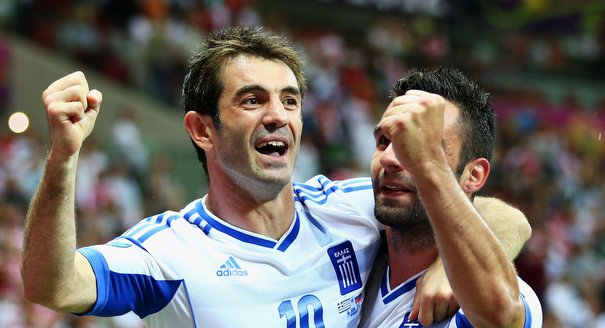
The euro crisis and the worsening political and economic situation in Greece, in combination with a growing anti-austerity sentiment across the continent, have infused the Germany-Greece game with a political undercurrent bordering on the surreal.
“It’s a David and Goliath situation, in so many ways, and that makes it interesting. But, honestly, I can’t be for Greece. They are just a terrible football team”. This is how an esteemed colleague of mine ends the somewhat silly, but strangely intriguing, debate we have in the office about the biggest political football game in recent history, Germany’s upcoming contest with Greece in the quarterfinals of the European football championship (Friday, 20:45CET, on a flat screen near you).
Of course we are debating this issue. It’s just too good to be missed, the symbolism too tempting, the timing too perfect: In the midst of an existential currency crisis, Europe’s model economy, the humorless, machine-like debt dominatrix of the continent, is pitted against the poor but charming victims of brutal budgetary rigor. Yes, the Greek overspent a little, but hey, they know how to live, right? They are the cradle of democracy, and, in any case, no-one deserves to be treated like this. One could laugh at this mingling of sports and politics. It’s just a football game, after all. But nothing is ever just a football game. Nothing is ever just a Eurovision Song Contest either.
People take this stuff seriously, and not just the small-minded jingoists with their warped notion of national superiority. It’s the intellectuals that are now seriously concerned that a football game could have a real profound political meaning. A German newspaper columnist wrote a piece in the New York Times a few days ago in which he argued that it would be better if Germany did not win the championship this year, for obvious reasons. He is a strong proponent of chancellor Merkel’s insistence on reform and budgetary discipline. Does he really believe that austerity will be a little less painful when it is mandated by a country whose Mannschaft has just lost a football match? Apparently so. Others, with pre-emptive Schadenfreude, get excited about a possible post-game headline that could read “Greece kicks Germany out of the Euro.” Sweet revenge, if only on the pitch. George Orwell was right: sports is war minus the shooting, and people everywhere have always, and will always, project into football games and song contests a meaning they don’t have. Sometimes it’s just a small and playful jibe, sometimes it is the suppressed archaic need for violent affirmation of collective identities.
And so spectator sports between nations have a cleansing quality. They allows us to do what is not allowed in the realm of the political or the good-neighborly: to seek victory and dominance over the other, to celebrate triumphalism, to openly establish a pecking-order and to unashamedly and relentlessly stereotype friend and foe alike. And of course it works: England—usually underperforming in Europe, Italy—always charming, always cheating, Russia—a faux giant, propped up by gas money, Denmark—likable but too clumsy, Ireland—lovely, but happy only in misery, Spain—a wonderful football bubble built on enormous debt, Germany—Teutonic tanks traversing tyrannically, Holland—too proud to be lovable, Turkey—must stay out, Belgium—not qualified.
Long before its start, this year’s European football championship was the most heavily politicized sports event since the Beijing Olympics in 2008. Victor Yanukovich saw to that. I myself contributed to that. Now the euro crisis and the worsening political and economic situation in Greece, in combination with a growing anti-austerity sentiment across the continent, have infused the Germany-Greece game with a political undercurrent bordering on the surreal. Is that a sign that the one European currency that really matters, political trust, has been depleted? Trust is certainly not in ample supply these days in the management of the eurozone crisis, but football really can’t tell us too much about this, no matter how tempting that may seem these days. The crisis will still be there when the joy and the sorrow of games lost and won are long gone. And that’s why the political dimension of this game stops here. Football fans should feel guiltlessly free to cheer for the team that is theirs. Tactical cheering for the politically correct team is not only pitifully laughable, it’s also impossible for a real fan. I am German. I will cheer for Lukas Podolski (born in Poland), Mesut Özil (Turkish parents), Sami Khedira (Tunisian father), Jerome Boateng (Ghanaian father), and Mario Gomez (Spanish father). I hope they will win. How could I not? And, by the way, Greece really has a terrible football team…

Director, Europe Team, Eurasia Group
Techau is director with Eurasia Group's Europe team, covering Germany and European security from Berlin. Previously, he was director of Carnegie Europe.
Recent Work

Nathalie Tocci, Jan Techau
Jan Techau
Carnegie does not take institutional positions on public policy issues; the views represented herein are those of the author(s) and do not necessarily reflect the views of Carnegie, its staff, or its trustees.

Russia is testing the waters of NATO’s mutual defense clause. What do strikes in Romanian territorial waters mean for the alliance’s posture toward Moscow?

Dimitar Bechev

With its public finances in shambles, the far right polling at 35 percent ahead of the 2027 presidential election, and a growing protest movement, is France’s crisis a threat to the EU’s geopolitical awakening?

Rym Momtaz, ed.

Ahead of a tough winter for Ukraine, Donald Trump’s swing back toward Russia bodes ill. But instead of panicking, Kyiv’s European allies are focusing on action.
Rym Momtaz

While the EU and European governments are embracing the much-lauded middle-power moment, this entails three difficult conundrums.

Richard Youngs

Much has been said of the changes Brussels is trying to make to the EU enlargement process. Here’s why gradual integration might—or might not—be the answer.
Dimitar Bechev