

Article
Marc Pierini
{
  "authors": [
    "Marc Pierini"
  ],
  "type": "commentary",
  "blog": "Strategic Europe",
  "centerAffiliationAll": "",
  "centers": [
    "Carnegie Endowment for International Peace",
    "Carnegie Europe"
  ],
  "collections": [],
  "englishNewsletterAll": "",
  "nonEnglishNewsletterAll": "",
  "primaryCenter": "Carnegie Endowment for International Peace",
  "programAffiliation": "",
  "programs": [],
  "projects": [],
  "regions": [
    "Middle East"
  ],
  "topics": [
    "EU",
    "Security"
  ]
}
Source: Getty
It seems that dissent is getting ineluctably closer to the core of Bashar Al Assad’s regime and that even the previously untouchable security system is now under threat.
The past few days have witnessed a sudden acceleration of events in Syria and, as a result, Bashar Al Assad’s regime is under dire pressure. It seems that dissent is getting ineluctably closer to the core of the regime and that even the previously untouchable security system is now under threat.
The current phase started with the defection of Manaf Tlass a few days ago. It was almost a year since General Tlass, a close friend to Assad and a commander in the elite Syrian presidential guard, has been pushed to the sidelines.
His defection, however, was a personal blow for the Syrian president. Their fathers, Hafez and Mustafa, had attended military academy together and Mustafa was Hafez’s minister of defense for more than three decades, before he helped Bashar during his first months in office in 2000. Mustafa Tlass had been a solid pillar of the regime.
History was to repeat itself, or to stutter, since Manaf was Bashar’s childhood friend and then companion at military academy when the latter was rushed through military training in preparation for Hafez’s succession after his brother Basel—slated to be his father’s political heir—died in a car accident.
From the first months of Bashar’s tenure, which stated in June 2000, (then colonel) Manaf Tlass became part of the regime’s new elite. His modern looks, his jet-set lifestyle, his receptions for diplomats, and his Cuban cigars conveyed the new image that Bashar was keen to give to the world: modernity, or at least modernity as Assad himself conceived it. This public relations effort did little to change the regime’s main features—a lack of civil liberties, the wide spread torture of opponents, the elite’s iron grip on the economy, and the pre-eminence of the military and intelligence apparatuses—but attempted to put a new gloss on it.
Manaf Tlass is now in Paris and, on July 17, issued a statement calling for a transition “guaranteeing Syria’s unity, stability and security as well as the legitimate aspirations of its people”. He has not only physically defected, but now seems to be profiling himself as a factor of change. Will he have time to forge a new image for himself? Will he be perceived by Syrian citizens as a proponent of change after being, like his father, so closely associated to the regime? It may be too late for him.
The same goes for the Syrian ambassador to Iraq, Nawas al-Fares, who is the highest ranking diplomat to have defected so far. In addition, two other brigadier-generals defected in the past days through Turkey.
On Sunday, July 15, a major campaign was started in Damascus by the Free Syrian Army and seems to be making progress, reaching districts that were previously considered out of their reach.
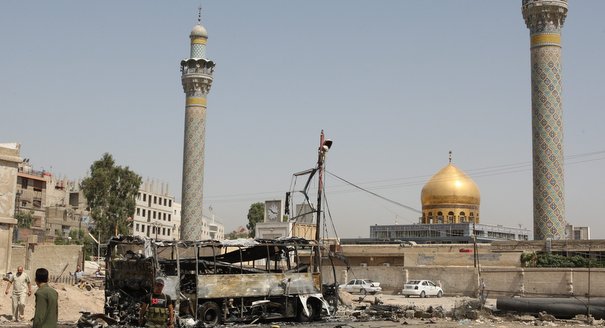
In another major development, maybe a turning point in the Syrian crisis, a major explosion took place yesterday in the control room of the national security building in the Rawda district of Damascus, killing Daoud Rahja, who was the minister of defense, Assef Shawkat, Assad’s own brother-in-law and deputy defense minister, and general Hassan Turkmani, a former minister of defense, while the fate of several other high-ranking security officials, such as Mohammed Ibrahim al-Shaar and Hisham Bekhtiar, is yet unconfirmed.
Whether this was done by explosive device or a suicide bomber makes no difference to the political significance of the event: the rebels struck at the very core of the system, which means they had accomplices within the inner security sanctuary of the regime.
This in turn means that the regime has literally begun to crumble and that Assad will find fewer and fewer supporters amongst his inner circle. It is now questionable whether Assad will be able to retain significant control of his shaken security apparatus or will find himself totally isolated within days or hours. Rumor has it that his own mother has warned him that he will end up “like Qaddafi”.
A collateral effect of yesterday morning’s bombing is the impact it will have on Syria’s Christian minority. The minister of defense was the highest ranking Christian in the Syrian apparatus and therefore, in himself, a symbol of the long-standing alliance between the Alawite and Christian minorities. Although Rahja’s religion might not have been a prime motive for the bombing—which was the decapitation of the regime’s top security entity—his death will send shockwaves amongst Syrian Christians.
All the more so that both the Free Syrian Army and the Islamist group Liwa al-Islam have claimed responsibility for the bombing.
UN efforts to reach a consensus on “transition” are still officially underway, and Russia is still entertaining a political solution. However, it is now unclear if these efforts are any longer meaningful. Syrian regular forces will most probably lash out at rebel forces in districts such as Qabun or Midan, at least to give a sense of their strike capabilities. A massive military buildup was already underway yesterday afternoon.
Undoubtedly, as Information Minister Omran Zoab said today, “this is a decisive battle”.
Marc Pierini, a former EU career diplomat, has served as the EU Ambassador to Turkey, Tunisia, Libya, Syria, and Morocco.

Senior Fellow, Carnegie Europe
Marc Pierini is a senior fellow at Carnegie Europe, where his research focuses on developments in the Middle East and Turkey from a European perspective.
Recent Work
Marc Pierini
Marc Pierini
Carnegie does not take institutional positions on public policy issues; the views represented herein are those of the author(s) and do not necessarily reflect the views of Carnegie, its staff, or its trustees.

Are Germany’s economic, industrial, and political struggles becoming a liability for the EU’s ability to rise to the geopolitical moment?

Rym Momtaz, ed.

European Commission President Ursula von der Leyen is about to give her annual address on the state of the EU. Here’s what she won’t—but should—say.
Rym Momtaz

The aftermath of the Ceuta crisis shows Europe has drawn the wrong lessons. Rather than doubling down on failed migration policies, the EU needs to address the underlying roots of such episodes.

Richard Youngs

An overwhelming victory by a far-right-wing party in a small state in eastern Germany will have major repercussions for Chancellor Friedrich Merz’s coalition.

Judy Dempsey

Canadian Prime Minister Mark Carney has twice inspired praise for standing up to U.S. President Donald Trump: at the 2026 World Economic Forum in Davos and on Canada-U.S. trade negotiations. Is Carney showing a third way better than the EU has in dealing with the Trump administration?
Rym Momtaz, ed.