

Commentary
Judy Dempsey
{
  "authors": [
    "Judy Dempsey"
  ],
  "type": "commentary",
  "blog": "Strategic Europe",
  "centerAffiliationAll": "",
  "centers": [
    "Carnegie Endowment for International Peace",
    "Carnegie Europe"
  ],
  "collections": [],
  "englishNewsletterAll": "",
  "nonEnglishNewsletterAll": "",
  "primaryCenter": "Carnegie Europe",
  "programAffiliation": "",
  "programs": [],
  "projects": [],
  "regions": [
    "Europe",
    "Russia"
  ],
  "topics": [
    "EU",
    "Security"
  ]
}
Source: Getty
Poland is rare among EU countries. It thinks and acts strategically and can reconcile its national interests with Europe's.
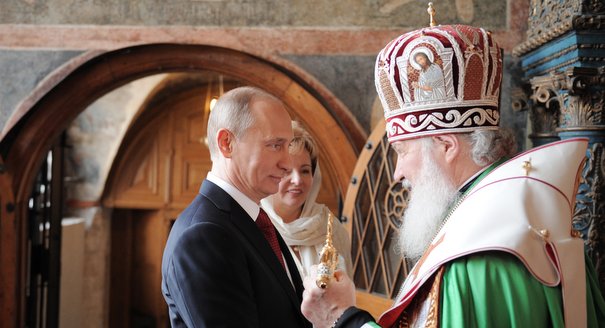
Today, Thursday, the head of the Russian Orthodox Church, Patriarch Kirill I arrived in Poland where he will spend three days.
It’s the first ever rendezvous of a Russian Patriarch with dominantly Catholic Poland. Ostensibly, he is there to meet officials from the 800,000 strong Polish Orthodox Church.
But the real significance of Kirill I’s presence in Poland goes far deeper. It is about two countries coming to terms with a tumultuous relationship wrought by war and occupation, violence and enmity. Inevitably, over the years, religion fed into these tensions.
The Kremlin had repeatedly turned down requests by the former Polish-born Pope John Paul II to visit Russia’s 600,000 Catholics. The majority, mostly ethnic Poles and Lithuanians, live in the western part of the country.
Though it is such a small community, the Kremlin feared the influence and charisma of Pope John Paul II, given how his visit to Poland in 1979, his first as Pontiff, inspired Poles in their struggle against the communist regime. It believed too that the Vatican was on a proselytizing mission.
After John Paul II’s death seven years ago, relations between Moscow and the Vatican slowly began to improve. Soon after Kirill I was appointed Patriarch in February 2009, diplomatic relations were established.
This in turn spurred efforts by the Polish Catholic Church and the Russian Orthodox Church to establish a common language over how to deal with the wartime and communist past.
This Friday, in an unprecedented event, a leading Polish Catholic church official, Archbishop Jozef Michalik, and Kirill I, will sign a joint declaration to the Polish and Russian people.
“The purpose of this document is to resolve painful pages of Polish and Russian history”, according to the Polish Episcopal Conference, the Catholic Church’s leadership.
The Polish Catholic hierarchy may also be hoping that the visit will help revive religion in Poland. But this is not likely to happen. Globalization, the rise of secularism and a string of scandals over pedophile priests have taken their toll. Regular church attendance has fallen to below 40 per cent over the past decade. In that context, Kiril I’s visit has more to do with the Polish-Russian relationship than with religion.
Much of the credit for this visit is due to the center-right Prime Minister Donald Tusk, in power since 2005, and foreign minister Radek Sikorski.
Sikorski, once considered a neo-con for his staunch Atlanticism and anti-Russian views, has concluded that it is in Poland’s national interests to stop sparring with its unpredictable eastern neighbor. As for Russia, it concluded too that it was not in its interests to have Poland as an enemy.
Russia saw how Poland, which joined the EU in 2004, could block, for example, any new trade accord between Brussels and Russia. Poland’s power, growing confidence and influence in the EU was something the Kremlin could not ignore.
So when the then president of Poland, Lech Kaczynski was killed in April 2010 in a plane crash along with 94 other top Polish officials in Smolensk, Russia, near Katyn, there was a genuine outpouring of sympathy by the Russian side, especially from Vladimir Putin, who was Prime Minister at the time.
Both sides made use of the tragedy for further rapprochement even though the Poles are not always convinced of Russia’s commitment. But just consider what happened last month.
Inhabitants of Kaliningrad, the Russian exclave that is surrounded by Lithuania, Poland, and the Baltic Sea, will now be allowed to travel well into Poland without the need of a visa, just a permit issued for two or five years.
Under the terms of this local border traffic agreement, the European Commission agreed that inhabitants of Kaliningrad could travel up to 150 kilometers, way beyond the 30 kilometers normally allowed for this kind of border traffic accord.
If you look at the map, the new regulations (never applied to other border crossings between an EU and non-EU country), will mean that Kaliningraders will be able to go as far as Gdansk.
Russia had long opposed any extension of the border traffic agreement, fearing that Kaliningrad would become economically detached from Russia and thanks to the more relaxed border arrangements, a second Hong Kong. Ultimately, it was afraid that Kaliningrad would strive for autonomy from Russia.
In any case, the deal, agreed and signed, is now in operation. Poland gets a more relaxed border regime with Kaliningrad and the prospect of more economic prosperity in the exclave. Russia, it hopes, gets a more stable Kaliningrad.
Kirill I’s visit and the border accord are two big events that affect not only Polish-Russian relations. They have strategic implications for Europe.
The first is that Poland is one of the few EU countries that is thinking and acting strategically.
Gone are the days of the euro-sceptic and anti-Russian rhetoric that were hallmarks of the nationalist and Catholic Law and Justice Party led by the Kaczynski twins. (Incidentally, Law and Justice is far from happy with Kirill I’s visit, in line with its view that rapprochement with Russia is a sell-out).
Second, the fact that Polish diplomats could persuade the European Commission to change the border traffic rules (and persuade Russia to sign up to them) shows the determination of Warsaw in getting its way. Poland is now ready to articulate and pursue its national interests.
The EU would do well to look carefully, and positively, at how Poland deals with Russia. National interests can be reconciled with Europe’s interests.

Nonresident Senior Fellow, Carnegie Europe
Dempsey is a nonresident senior fellow at Carnegie Europe
Recent Work
Judy Dempsey
Judy Dempsey
Europe isn’t as weak in the new geopolitics of power as many would believe. But to leverage its assets and claim a sphere of influence, Brussels must stop undercutting itself.

Dimitar Bechev
Europe’s reaction to the war in Iran has been disunited and meek, a far cry from its previously leading role in diplomacy with Tehran. To avoid being condemned to the sidelines while escalation continues, Brussels needs to stand up for international law.

Pierre Vimont
France and Germany’s failure to agree on the Future Combat Air System (FCAS) raises questions about European defense. Amid industrial rivalries and competing strategic cultures, what does the future of European military industrial projects look like?

Rym Momtaz, ed.
France has stopped clinging to notions of being a great power and is embracing the middle power moment. But Emmanuel Macron has his work cut out if he is to secure his country’s global standing before his term in office ends.
Rym Momtaz
Integrating AI into the workplace will increase job insecurity, fundamentally reshaping labor markets. To anticipate and manage this transition, the EU must build public trust, provide training infrastructures, and establish social protections.
Amanda Coakley