

Commentary
Judy Dempsey
{
  "authors": [
    "Judy Dempsey"
  ],
  "type": "commentary",
  "blog": "Strategic Europe",
  "centerAffiliationAll": "",
  "centers": [
    "Carnegie Endowment for International Peace",
    "Carnegie Europe"
  ],
  "collections": [],
  "englishNewsletterAll": "",
  "nonEnglishNewsletterAll": "",
  "primaryCenter": "Carnegie Europe",
  "programAffiliation": "",
  "programs": [],
  "projects": [],
  "regions": [
    "Europe"
  ],
  "topics": [
    "EU"
  ]
}
Source: Getty
Turkey is doing itself no favors if it wants to maintain what supporters it has left in the EU.
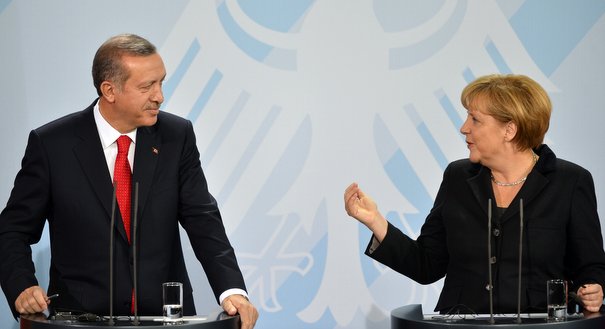
Turkey’s Prime Minister, Recep Tayyip Erdoğan is no stranger to Germany. He visits as often as once a year to give speeches that are both controversial and abrasive.
When he came to Berlin this week to open a new, big embassy in the heart of the capital’s diplomatic quarter, Erdoğan had a particular issue on his mind: Turkey’s relations with the EU.
Erdoğan has an axe to grind with the EU. Brussels has stalled over accession talks with Turkey, and the EU will pay for this, Erdoğan warned during a panel discussion at the Berggruen Institute on Governance.
Erdoğan was asked whether Turkey would be a member of the EU by 2023. That is when Turkey will celebrate the 100th anniversary of the founding of the Turkish Republic that emerged from the ruins of the Ottoman Empire.
Erdoğan replied: “The EU probably won’t string us along that long. But if it does string us along until then, the European Union will lose out and at the very least, it will lose its chance to have a prosperous and desirable member.” Coincidentally, Erdoğan also wants Turkey to be an international economic and political power by 2023.
Egemen Bağış, Turkey’s minister for European Affairs, didn’t pull his punches either. “If the political consensus is there, accession can happen overnight”, he said Wednesday at the Konrad Adenauer Stiftung, a foundation affiliated to the Christian Democrats. “If there is no political consensus, talks will fail even over the size of cucumbers.”
But is it really in Turkey’s interests to be adopting such a tough stance towards the EU at this particular time?
It is still not certain whether Europe will emerge intact from the euro crisis. So far, the impact of that crisis has been utterly damaging to the EU’s interests and values. The EU has become inward looking. Foreign and security policy have been pushed off the agenda. Enlargement is taboo. There is still no long-term strategy for dealing with the aftermath of the Arab Spring. The EU has just been told by its own court of auditors that it cannot even run Kosovo in any efficient way.
In other words, Erdoğan could not have picked a worse moment to try and face down the EU. The only effect his attacks can have at this time is that the EU slams down the shutters.
But Ankara does have a point over the way the EU has conducted accession talks with Turkey.
Soon after the talks began in 2005, they stalled, partly due to Cyprus. Ever since it became an EU member itself, Cyprus has done everything possible to slow down talks with Turkey. They are Nicosia’s only leverage on Ankara to resolve the status of the divided island. Other EU countries, which aren’t enthusiastic about Turkish accession, have either hidden behind Cyprus or raised countless objections, opening more of the 35 policy chapters.
It’s worth looking at Turkey’s foreign ministry web site to understand just how the talks have become so depressingly entangled by the interests of the member states.
Ideologically, Germany, France, Austria, and the Netherlands oppose Turkey joining the EU, even though they agreed in 2004 to start formal accession talks in 2005. Chancellor Angela Merkel told Erdoğan on Wednesday that Berlin would continue to “negotiate in good faith”. But how is that possible if Merkel wants a “privileged partnership” with Turkey instead of full membership? Bağis was right to say that you are a member or you are not.
All of this is bad news for Turkey. Europe, at the moment, is a closed shop. But Turkey is doing itself no favors if it wants to maintain what supporters it has left in the EU.
Recently, Turkey has imprisoned journalists and gone on the offensive against the Kurds. Over 680 prisoners, sentenced for being members of the Kurdish Workers’ Party, or PKK, have been on hunger strike since September 12. They are demanding, among other things, that they be allowed to speak Kurdish in court.
No wonder that Bağis' repeated defense on Wednesday of Turkey’s support of religious and ethnic minorities and other human rights issues carried little weight among his German audience.
Given the political atmosphere in Europe at the moment, Turkey will gain nothing from criticizing the EU. Instead of demanding to be let in now, Erdoğan should use this period in time, when Europe is absorbed by the euro crisis, to prepare Turkey for membership. The crisis is not going to last forever.
Turkey actually needs the EU more than ever to help along major judicial and political reforms. It also needs European solidarity—and Europe should be more forthcoming about giving it—because part of Turkey’s own neighborhood is in turmoil.
No one, least of all Turkey, knows how the Syrian conflict will end, what will happen in Iran, or how stable Georgia will remain. The region is combustible.
This is no time for Turkish bravado. It is time to keep the reform momentum going, primarily for Turks, for the region, and for Europe — once Europe starts looking outwards again. It won’t be wasting time.

Nonresident Senior Fellow, Carnegie Europe
Judy Dempsey is a nonresident senior fellow at Carnegie Europe
Recent Work
Judy Dempsey
Judy Dempsey
Europe has an interest in supporting Armenian leader Nikol Pashinyan as he tries to make peace with neighbors and loosen ties with Russia. But it is depersonalized support in the long term, not quickfire flash, that will win the day.

Thomas de Waal
Following Ursula von der Leyen’s gaffe equating Turkey to Russia and China, relations with Ankara risk deteriorating even further. Without better, more consistent diplomatic messaging, how can the EU pretend to be a geopolitical power?

Sinan Ülgen
Closer EU-UK ties could help address urgent European concerns. But is the EU ready for rapprochement with the United Kingdom?

Rym Momtaz, ed.
Europe has been standing by while its Southern neighborhood is being redrawn by force. To establish a path to peace between Israel and Lebanon, it’s time for Europeans to get involved with hard power.
Rym Momtaz
In Ukraine, Gaza, and Iran, AI warfare has come to dominate, with barely any oversight or accountability. Europe must lead the charge on the responsible use of new military technologies.

Raluca Csernatoni