

Commentary
Judy Dempsey
{
  "authors": [
    "Judy Dempsey"
  ],
  "type": "commentary",
  "blog": "Strategic Europe",
  "centerAffiliationAll": "",
  "centers": [
    "Carnegie Endowment for International Peace",
    "Carnegie Europe"
  ],
  "collections": [],
  "englishNewsletterAll": "",
  "nonEnglishNewsletterAll": "",
  "primaryCenter": "Carnegie Europe",
  "programAffiliation": "",
  "programs": [],
  "projects": [],
  "regions": [
    "Europe",
    "Southern, Eastern, and Western Africa"
  ],
  "topics": [
    "EU"
  ]
}
Source: Getty
It requires a special courage and leadership to address the wrongs of the past and deal with those who want to ignore the it. But without such reflection, the future is marred.
Apologizing for past wrongs is terribly difficult. Europe’s leaders know that. They are constantly being confronted, indeed haunted by their predecessors’ cruelties during war and occupation. Without an apology to those wronged, old wounds fester and resentment remains deep. Bilateral relations can only go so far before hitting a wall.
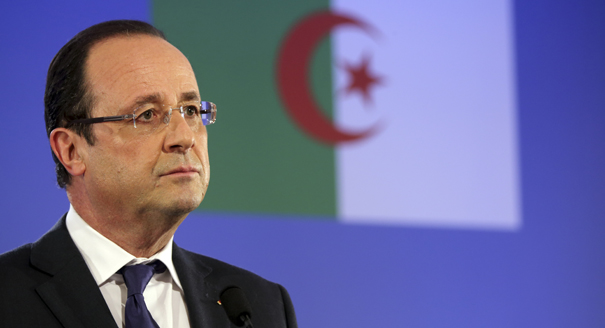
The Algerians have long resented France’s refusal to apologize for its brutal colonial rule over their country from 1830 to 1962 and its violent repression of the Algerian independency movement from 1954 until it finally let go in 1962.
No French president has gone as far as François Hollande to acknowledge the appalling injustice done to the Algerians during colonial rule, particularly the killing of up to 250 Algerian protestors in the streets of Paris on October 17, 1961.
Last October, Hollande, a socialist, broke that silence. “On October 17, 1961, Algerians who were protesting for their right of independence were killed in a brutal repression. Fifty-one years after this tragedy, I pay tribute to the memory of the victims,” he said.
His words enraged the French right and even some in Hollande’s Socialist Party. He was accused of blackening France’s security forces.
Algerians were hoping that Hollande would go one step further by making an official apology during his two-day state visit to Algeria that began on December 19. He didn’t.
After meeting with President Abdelaziz Bouteflika, Hollande said he wanted to establish a new relationship with the country.
Over the years, Algerians have seen how hard it is for any French leader to apologize. And not just for its harsh colonial rule in parts of Africa.
It was only in 1995 that the former president, Jacques Chirac, broke the official silence over the roundup of over 13,000 Jewish men, women, and children in Paris in 1942 and their subsequent deportation to the concentration camps.
Hollande took the acknowledgement further. On July 22, 2012, the seventieth anniversary of the Vel d’Hiv roundup by the French police, he made a powerful, moving speech. Not one German soldier, he admitted, was involved in that event.
France is not alone in finding it extremely difficult to apologize. One reason is the fear that any admission of guilt might lead to huge lawsuits over damages. What weighs even more is a backlash from a public unwilling to face the truth of their history.
After 1945, a defeated, humiliated, and divided Germany had to take stock of the atrocities the Nazis had committed and how Germans had destroyed European Jewry. In September 1951, West Germany’s chancellor, the conservative Konrad Adenauer, spoke about the Holocaust for the first time.
“The government of the Federal Republic of Germany and with it the great majority of the German people are aware of the immeasurable suffering inflicted upon the Jews in Germany and the occupied territories in the era of National Socialism,” Adenauer said. “In the name of the German people, unspeakable crimes were committed which create a duty of moral and material restitution....” His words slowly paved the way for establishing diplomatic relations between West Germany and Israel in May, 1965.
Five years later, on December 7, 1970, Germany’s Social Democratic chancellor, Willy Brandt, stunned his Polish hosts with an extraordinary gesture that was the beginning of a long rapprochement between Germany and Poland.
After Brandt had laid a wreath at the memorial to the victims of the Warsaw Ghetto of 1943, he rearranged the black, red, and gold ribbon and stepped back a few paces. Then, he knelt down in front of the memorial and remained there with his head bowed and his hands folded. He said nothing. He didn’t have to.
Other leaders have said sorry for past crimes. In Britain, Prime Minister David Cameron apologized publicly in June 2010 for the shooting of civilians during a civil rights march in the city of Londonderry in January 1972. "What happened on Bloody Sunday was both unjustified and unjustifiable. It was wrong," Cameron told parliament. "For that, on behalf of the government, and indeed our country, I am deeply sorry."
Queen Elizabeth’s moving speech over the repressive British rule over Ireland before its independence in 1921 struck a special chord with the Irish. “To all those who have suffered as a consequence of our troubled past I extend my sincere thoughts and deep sympathy," the Queen said during a state banquet in Dublin in May 2011. It fell short of an official apology. But the Queen’s words were gracious enough to allow for a closure of that ignominious chapter of Anglo-Irish relations.
There are many other chapters in Europe’s post-1945 history to be closed—especially in the Balkans, not to mention Russia under Stalin. It requires a special courage and leadership to address the wrongs of the past and deal with those who want to ignore it. But without such reflection, the future is marred.

Nonresident Senior Fellow, Carnegie Europe
Judy Dempsey is a nonresident senior fellow at Carnegie Europe
Recent Work
Judy Dempsey
Judy Dempsey
Carnegie does not take institutional positions on public policy issues; the views represented herein are those of the author(s) and do not necessarily reflect the views of Carnegie, its staff, or its trustees.
Europe has an interest in supporting Armenian leader Nikol Pashinyan as he tries to make peace with neighbors and loosen ties with Russia. But it is depersonalized support in the long term, not quickfire flash, that will win the day.

Thomas de Waal
Following Ursula von der Leyen’s gaffe equating Turkey to Russia and China, relations with Ankara risk deteriorating even further. Without better, more consistent diplomatic messaging, how can the EU pretend to be a geopolitical power?

Sinan Ülgen
Closer EU-UK ties could help address urgent European concerns. But is the EU ready for rapprochement with the United Kingdom?

Rym Momtaz, ed.
Europe has been standing by while its Southern neighborhood is being redrawn by force. To establish a path to peace between Israel and Lebanon, it’s time for Europeans to get involved with hard power.
Rym Momtaz
In Ukraine, Gaza, and Iran, AI warfare has come to dominate, with barely any oversight or accountability. Europe must lead the charge on the responsible use of new military technologies.

Raluca Csernatoni