

Commentary
Judy Dempsey
{
  "authors": [
    "Judy Dempsey"
  ],
  "type": "commentary",
  "blog": "Strategic Europe",
  "centerAffiliationAll": "",
  "centers": [
    "Carnegie Endowment for International Peace",
    "Carnegie Europe"
  ],
  "collections": [],
  "englishNewsletterAll": "",
  "nonEnglishNewsletterAll": "",
  "primaryCenter": "Carnegie Europe",
  "programAffiliation": "",
  "programs": [],
  "projects": [],
  "regions": [
    "Europe",
    "Russia",
    "North America"
  ],
  "topics": [
    "EU",
    "Security"
  ]
}
Source: Getty
Russia is stuck in a Cold War mentality, saying "No" to Western efforts to build security in the 21st century.
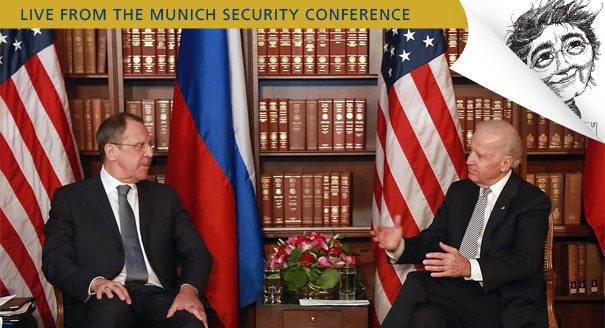
“We have officially abandoned the mind-set of Cold War.” That’s what Sergei Lavrov, Russia’s foreign minister, declared at the Munich Security Conference.
But you wouldn’t think it, judging from the rest of the remarks Lavrov made during Saturday morning’s session, which was devoted to the future of the Euro-Atlantic Security Community.
Take NATO. How scathing he was about the U.S.-led military alliance, with U.S. Vice President Joseph Biden sitting in the front row!
True, NATO is a product of the Cold War. But it has been trying over the past few years to address the new security challenges facing the Western world.
These include dealing with cyber security and protecting the shipping lanes along the east coast of Africa against piracy.
Lavrov didn’t take account of these changes. He continues to see NATO as a threat. “NATO’s actions are different from its words,” he complained.
He harshly criticized the expansion of NATO eastwards, despite the fact that this is really old news. The former communist countries of Eastern and Central Europe joined the Alliance in 1999 and in 2004.
Yet Lavrov still believes their membership in NATO is a threat to Russia. Clearly the idea of missile defense deeply bothers Moscow. The Kremlin sees the shield directed against Russia, not "rogue" states or actors. But Russia doesn’t help its own argument by saying "No" to the U.S. offer of cooperating in missile shield defense.
Clearly, too, the idea that NATO remains open to admitting new members, such as Georgia, irks Russia.
NATO Secretary General Anders Fogh Rasmussen told Carnegie Europe that it is the sovereign right of any country to decide which organization it wanted to join. Russia is not going to be given the right to veto that. Lavrov, however, was in a "No" mood.
Yet another "No" concerned Syria. Russia’s stance is well-known: no military intervention by the United States or NATO. Full stop.
When Lavrov was asked during the session if Russia would at least support the establishment a humanitarian aid corridor, backed by airpower, he answered: "No".
It is easy to see why Russia is opposed to any kind of no-fly zone.
It got its fingers badly burned in 2011 when the UN Security Council, with Germany and Russia abstaining, agreed to impose a no-fly zone over Libya. The mandate was overstretched, to say the least. Responsibility to protect mutated into a policy of regime change.
Lavrov said as much in Munich. And he was right to remind the French, the British, and NATO how badly they abused the mandate. Yet Syria is now paying a high price for the way the UN Security Council’s mandate was implemented.
Lavrov was in no mood to even think about restarting talks to revive the Conventional Forces in Europe Treaty. Russia walked away from the treaty several years ago. It claimed that the United States and NATO were making unreasonable additional demands. These included Russia withdrawing from Abkhazia and South Ossetia and limiting military deployments along its “flanks” or borders.
No way, said Lavrov, would Russia return to the table.
Clearly, with President Vladimir Putin’s and Foreign Minister Lavrov’s Russia, the Cold War mentality is still out there. But a policy of saying "No" will not help either Russia or the West deal with the security challenges this new century is presenting. Let’s see if President Obama, during his second term, can finally bring Russia back to saying "Yes".


Nonresident Senior Fellow, Carnegie Europe
Judy Dempsey is a nonresident senior fellow at Carnegie Europe
Recent Work
Judy Dempsey
Judy Dempsey
Carnegie does not take institutional positions on public policy issues; the views represented herein are those of the author(s) and do not necessarily reflect the views of Carnegie, its staff, or its trustees.

As we close out another season of Strategic Europe, it is worth taking stock of the deep shifts underway.

Rym Momtaz
The EU had to compromise to adopt a twenty-first sanctions package against Russia, exposing growing cracks in the union’s resolve. Is this latest, weaker round worth it to keep pressure on Moscow?
Rym Momtaz, ed.

Trump is distracted and Ukraine wants Europe to step up. The continent’s leaders must find their voice and assert it in talks with Russia.

Alissa de Carbonnel

Mounting economic strain and battlefield losses will not necessarily make the Kremlin less dangerous. They could instead push Moscow toward a more aggressive hybrid campaign designed to test NATO’s Eastern flank, exploit allied hesitation, and fracture European resolve.

Maksym Beznosiuk
Over the past ten years, NATO has held almost as many summits as it did during the entirety of the Cold War. Are they still useful, or is it time to stop holding annual meetings?
Rym Momtaz, ed.