Asked about the foreign-policy legacy of the Obama presidency, future generations might point to the U.S. strategic shift toward Asia announced in 2012. Although the pivot—later renamed “rebalancing”—of resources and political attention from the Atlantic to the Pacific was first proclaimed over a year ago, NATO members still have to come to grips with the implications of this strategic game changer.
First, the new U.S. focus on Asia is not anti-European. Nor is it just a rearrangement of armed forces on the global strategic chessboard. Instead, it is as much a political and economic shift as a military one. It acknowledges the fact that there is less and less “unfinished business” in Europe—which is actually a positive thing.
The U.S. pivot to Asia is not a new development, either. President George W. Bush first opened the American perspective to Asia and established new ties with India, Indonesia, and Vietnam. President Obama just went one step further in explicitly acknowledging the increased importance of the entire Asia-Pacific region.
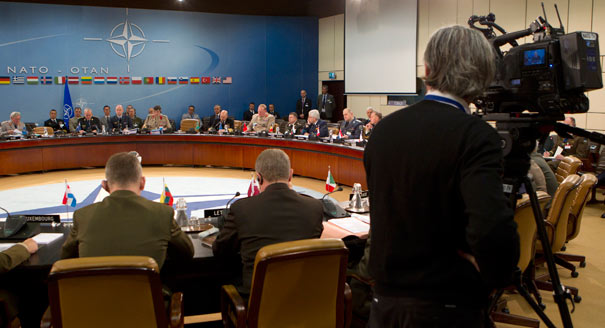
This is where NATO comes in. It is not just that the Alliance cannot remain unaffected if its leading power redefines its strategic priorities. The developments in Asia are highly relevant for NATO’s non-Pacific members as well:
- NATO has already adopted a global outlook, realizing that the security interests of its members are no longer limited to their geographical borders.
- European economies are as dependent on stability in Asia and free lines of communication as the United States and Canada are.
- Close and politically like-minded NATO partners like Japan, Australia, New Zealand, and South Korea are located in the Asian hemisphere.
- China has expressed an interest in cooperation with NATO, and high-ranking NATO generals have already visited Beijing for official talks.
NATO is unlikely to immediately follow the U.S. shift to Asia. The alliance cannot become a serious player in Asia, as only a few of its members have the economic range or the military capabilities to act thousands of miles away from their own territory.
Still, not only does NATO have a vested interest in Asia, it also has a lot to offer for important powers in the region. NATO is a political-military organization based on democratic values and able to act on them—a fact that is very attractive to democracies in the Far East. For these politically like-minded nations, NATO offers a relationship that complements to their bilateral links with the United States.
Moreover, NATO provides an unmatched level of military interoperability among its members, and thereby sets an international “gold standard” for alliance operations. Partners around the globe are keen to profit from this accumulation of expertise in common standards and multilateral planning.
NATO therefore has a role to play in the Asia-Pacific—not by becoming the world’s policeman or initiating defense planning for any Asian theater, but by putting the region on its radar screen and acting in the overall interests of the alliance. This requires three initial steps.
First, NATO has to consider new ways of transatlantic burden-sharing. If Washington focuses more on Asia, and if Europe benefits from America’s stabilizing presence in Asia, then Europeans should take on a greater role in other regions on Europe’s borders. NATO’s war in Libya, where some Europeans shouldered most of the fighting while Washington provided critical but limited support, could be a model for the future.
Second, NATO needs to overhaul its partnership concept. Many NATO partners in the Asia-Pacific are strong democracies, willing and able to contribute to NATO’s military operations. Together with democratic non-NATO members in Europe like Sweden or Finland, they need to be given a special say in NATO’s political deliberations. The alliance needs new partnership formats that include these democracies in its consultations on a wide range of security issues.
Third, if NATO has to act on a global scale, and if the Asia-Pacific region becomes more important, then the role of maritime forces able to deploy thousands of miles from home will increase significantly. Many NATO members need to rethink their plans for long-term military acquisitions to include more naval capabilities.
Those NATO members who still cultivate a Eurocentric view of the world should shift their strategic perspective. They need to stop navel-gazing and start looking toward the Far East.
Karl-Heinz Kamp is the research director of the NATO Defense College in Rome. The views expressed in this article are those of the author.