

Commentary
An overwhelming victory by a far-right-wing party in a small state in eastern Germany will have major repercussions for Chancellor Friedrich Merz’s coalition.
Judy Dempsey
{
  "authors": [],
  "type": "commentary",
  "blog": "Strategic Europe",
  "centerAffiliationAll": "",
  "centers": [
    "Carnegie Endowment for International Peace",
    "Carnegie Europe"
  ],
  "collections": [],
  "englishNewsletterAll": "",
  "nonEnglishNewsletterAll": "",
  "primaryCenter": "Carnegie Endowment for International Peace",
  "programAffiliation": "",
  "programs": [],
  "projects": [],
  "regions": [
    "Southern, Eastern, and Western Africa"
  ],
  "topics": [
    "EU",
    "Security"
  ]
}
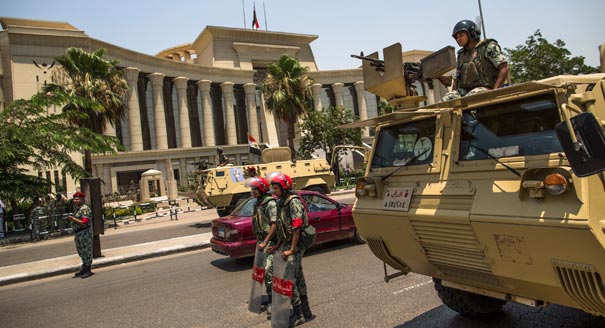
Source: Getty
As the Egyptian economy continues to deteriorate and public dissatisfaction with President Morsi grows, rumors are spreading that the military is preparing a coup d’état.
There once was a country run by a contested ruler. Political parties had lost their reputation, the economy was in distress, and corruption was rampant. No external threat existed that could have occupied the armed forces otherwise. In this situation, the military, feeling humiliated by the regime, intervened and toppled the government. That was Egypt in 1952—though it almost sounds like 2013, too.
Rumors of an impending coup d’état by the Egyptian military have been rife ever since President Mohamed Morsi’s government refused to compromise with the still-active protest movement. Although in this part of the world, military putsches have been out of fashion for decades—the wave of military interventions into Arab politics ended, by and large, in the 1970s—such rumors do not come as a surprise. The Egyptian military has been closely involved in Egyptian politics ever since it ousted King Farouk in 1952. Morsi is the first nonmilitary head of state the country has had in six decades.
Even the departure of former president Hosni Mubarak, himself a former air force officer, was facilitated by the armed forces, further enhancing the military’s role in Egyptian politics. Establishing control over the country’s most important institution was therefore high on Morsi’s list as soon as he was elected. Within two months of assuming power, he dismissed his defense minister and commander in chief, Hussein Tantawi, as well as the chief of staff, Sami Anan, to public acclaim. Now, however, Egyptian demonstrators have reversed their stance and are calling for the military to intervene in a situation of strife and instability.
But how likely are the Egyptian armed forces to stage a coup d’état? Coups are an intriguing political phenomenon and have puzzled social scientists ever since the Arab world became the scene of about 40 of them in the decades between 1945 and 1979. Statistics tell us that Arab coups happen mostly in the summer (July and August); they are typically carried out by colonels, not generals; and they usually do not aim at changing the political system (called a breakthrough coup) but at removing a leadership considered to be corrupt, inefficient, or incompetent (called a guardian coup). Most importantly, coups take place only when motivation and feasibility come together.
Military organizations having a certain mindset, motivations can include self-interested considerations such as economic or political aspects. The military’s corporate outlook emphasizes nationalism and unity. It is the antithesis of political parties, which it tends to see as divisive agents. This explains why coups are always performed by professional armed forces, and never by militias or conscripts. The armed forces can appeal to a popular longing for people to stand together that politics cannot satisfy.
Feasibility, in turn, is a combination of opportunity and capacity. Opportunity arises especially when a government is seen as performing poorly in economic terms, and when it is seen as illegitimate—although legitimacy in this context can be acquired not just by democratic means, but also by an extended stay in power. Capacity, however, consists of the ability of military officers to act and command troops cohesively. This implies a high degree of unity as well as a collective agreement to act outside the constitutional order. Put simply: the armed forces act when they can and want to.
In the case of Egypt, the capacity to act is certainly there. The last two years have clearly shown that for this highly corporate organization, there is no issue of lack of cohesion. At the same time, the military’s motivation for a coup is also growing. Its economic interests were already jeopardized under Mubarak’s regime—which partly explains their action against him in 2011—and continue to be harmed by Egypt’s economic free fall. Furthermore, the army sees itself as an independent political actor regardless of Morsi’s attempts to curb its influence. It has stressed repeatedly its responsibility toward Egypt as a state as opposed to its government.
After demonstrators and security forces clashed in front of the presidential palace last December, Defense Minister Abdel Fattah el-Sissi arguably overstepped his mandate by calling for a political dialogue. One month later, he stressed that “the continuation of the conflict between the different political forces and their differences over how the country should be run could lead to the collapse of the state and threaten future generations.” This quote perfectly reflects the Egyptian officers’ mindset: they feel they are accountable only to the nation, or, as the popular saying goes, “the army and the people are one hand.” It is for this reason that the military, when called on by the president to enforce a curfew in Port Said and Ismailia, played football with the protesters, rather than sending them home.
Egyptian military sources now say that they feel that the population is calling on them to do their duty, although they declare that “the popular call has to be very clear before we act.” The widespread public criticism the military encountered in the months between Mubarak’s forced resignation and Morsi’s election has left this institution, unaccustomed as it is to a rift with the public, bruised.
These same military sources also worry that a coup would lead the EU and the United States to suspend their cooperation programs with Egypt, as happened with Mauritania in 2008. That would endanger Egypt’s fragile economy even further and therefore create even more instability. As motivation and capacity for a coup d’état are clearly growing, the only way to prevent another Egyptian putsch is to decrease its feasibility. The only way to do that, however, is by restarting the economy and bolstering the government’s legitimacy. To achieve this, Morsi is running out of time.
Carnegie does not take institutional positions on public policy issues; the views represented herein are those of the author(s) and do not necessarily reflect the views of Carnegie, its staff, or its trustees.

An overwhelming victory by a far-right-wing party in a small state in eastern Germany will have major repercussions for Chancellor Friedrich Merz’s coalition.

Judy Dempsey

Canadian Prime Minister Mark Carney has twice inspired praise for standing up to U.S. President Donald Trump: at the 2026 World Economic Forum in Davos and on Canada-U.S. trade negotiations. Is Carney showing a third way better than the EU has in dealing with the Trump administration?

Rym Momtaz, ed.

The EU’s responses to two recent incidents expose the gulf between European perceptions and capabilities. Unless the union can bridge that gap, it will never become a real geostrategic power.
Rym Momtaz

In supporting Europe’s far-right, MAGA and Russia both want the same thing: a weaker EU. Europe must defend itself without abandoning the openness these forces exploit.

Armida van Rij

As we close out another season of Strategic Europe, it is worth taking stock of the deep shifts underway.
Rym Momtaz