

Commentary
Judy Dempsey
{
  "authors": [
    "Judy Dempsey"
  ],
  "type": "commentary",
  "blog": "Strategic Europe",
  "centerAffiliationAll": "",
  "centers": [
    "Carnegie Endowment for International Peace",
    "Carnegie Europe"
  ],
  "collections": [],
  "englishNewsletterAll": "",
  "nonEnglishNewsletterAll": "",
  "primaryCenter": "Carnegie Europe",
  "programAffiliation": "",
  "programs": [],
  "projects": [],
  "regions": [
    "Europe"
  ],
  "topics": [
    "EU"
  ]
}
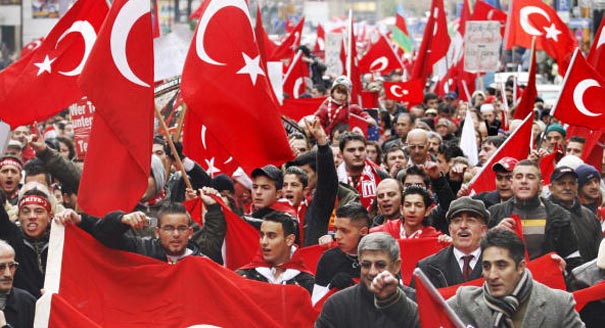
Source: Getty
As a pivotal court case unfolds, it is time for Angela Merkel to speak out in favor of integration and of a Germany that wants its Turks to feel accepted and equal.
A Munich high court is preparing a trial of immense importance not just to Germany and its large immigrant community, but also to relations between Berlin and Ankara.
The accused, Beate Zschäpe, is allegedly the only surviving member of the National Socialist Underground (NSU), a neo-Nazi terrorist cell that between 2000 and 2007 supposedly murdered ten people, most of them of Turkish origin. As of April 17, Zschäpe, 38, will be facing murder charges.
Observers say it will be the trial of the decade. Even after several parliamentary inquiries, the NSU murders remain an inexplicable evil.
Witnesses from national and regional police forces, from secret services, and from interior ministries have all failed to explain how right-wing assassins could commit serial murder with impunity for so many years. A shocking number of the files that could have served to elucidate events were found to have been destroyed.
The NSU murders have cast a dark shadow over Germany’s treatment of its large immigrant community. Leaders of the three-million-strong Turkish community have said that they have lost trust in the German police. After all, the police never followed up any clues leading to the NSU cell, but suggested that the murders might be related to Turkish family disputes, criminal gangs, or even honor killings.
The trial in Munich could have provided a much-needed opportunity to repair some of the damage done to the fabric of this society. The Turkish community in particular might have been relieved to see that justice is finally taking its course. But such hopes are being undermined by yet another inexplicable bureaucratic faux pas.
Last week, Munich’s Higher Regional Court released the list of media organizations that will be granted access to the courtroom. Not one Turkish journalist was included. Not one Turkish community leader was admitted. Nor will any Turkish diplomat have a reserved space.
The court claimed that the media list was selected on a first-come, first-served basis.
Celal Özcan, editor in chief of the European edition of the Turkish daily Hürriyet, said that his newspaper had repeatedly asked the court about the accreditation procedure. He had applied on time.
“It is absolutely unacceptable that the Turkish media has been excluded from the courtroom,” Özcan told Die Tageszeitung. “Many Turks aren’t just disappointed—they are shocked, both in Germany and in Turkey,” he added. Yet if Germany, as Europe’s economically and politically most important country, cannot embrace and integrate its Turkish community, what sort of signal does that send to the rest of Europe?
Several leading politicians, including former president Christian Wulff, his successor Joachim Gauck, and Chancellor Angela Merkel, have tried to reassure Turkish immigrants that they are welcome in Germany. They have also promised that the NSU murders will be completely cleared up—a promise that, so far, they have not been able to keep.
For the court coverage, several compromises have been proposed. One was a bigger courtroom to accommodate more journalists. The court authorities ruled that out because the existing room had already been modernized for the trial. Besides, added Margarete Nötzel, the court’s spokeswoman, this was the only courtroom in Bavaria that had the appropriate security measures for such a trial.
German commentators, the majority of whom support the Turkish cause, also suggested opening an adjacent room to allow more journalists to follow the proceedings by video transmission.
“A video transmission into another room would come across like a show trial and a public viewing, and it would violate the human dignity of the accused,” argued Siegfried Kauder, the Christian Democrat chairman of the German parliament’s legal committee.
Some journalists who have been allotted a seat graciously offered to give their place to a Turkish colleague. No way, said the court.
These insensitive and bureaucratic rules have incensed Germans, the Turkish community, and the Turkish government. Ahmet Davutoğlu, Turkey’s foreign minister, telephoned his German counterpart, Guido Westerwelle, at the weekend, requesting a change of policy by the Munich court.
Ankara also wants Turkish government representatives to be granted access to the trial. Though many migrants of Turkish origin have adopted German citizenship, ties to their old homeland remain strong, and the Turkish government claims a role of guardianship over this expatriate community.
Westerwelle was sympathetic to Davutoğlu’s requests, but said that the executive and legislative powers must be kept separate. Chancellor Angela Merkel remained aloof. The independence of the judiciary has to be respected, she said.
On the surface, Merkel and Westerwelle are right. Of course, the German government cannot interfere with court procedures. Yet relations between Turkish immigrants and wider German society, which were already badly damaged by the NSU murders, have now come under further strain.
It is high time that Germany’s non-immigrant population became aware of how vulnerable migrants have come to feel in this prosperous, powerful country at the center of Europe. And it is high time for Merkel and her government to speak out much more in favor of integration, and of a Germany that wants its Turks to feel accepted and equal.

Nonresident Senior Fellow, Carnegie Europe
Dempsey is a nonresident senior fellow at Carnegie Europe
Recent Work
Judy Dempsey
Judy Dempsey
Europe’s reaction to the war in Iran has been disunited and meek, a far cry from its previously leading role in diplomacy with Tehran. To avoid being condemned to the sidelines while escalation continues, Brussels needs to stand up for international law.

Pierre Vimont
France and Germany’s failure to agree on the Future Combat Air System (FCAS) raises questions about European defense. Amid industrial rivalries and competing strategic cultures, what does the future of European military industrial projects look like?

Rym Momtaz, ed.
France has stopped clinging to notions of being a great power and is embracing the middle power moment. But Emmanuel Macron has his work cut out if he is to secure his country’s global standing before his term in office ends.
Rym Momtaz
Integrating AI into the workplace will increase job insecurity, fundamentally reshaping labor markets. To anticipate and manage this transition, the EU must build public trust, provide training infrastructures, and establish social protections.
Amanda Coakley
Europe’s interests in Syria extend beyond migration management, yet the EU trails behind other players in the country’s post-Assad reconstruction. To boost its influence in Damascus, the union must upgrade its commitment to ensuring regional stability.

Bianka Speidl, Hanga Horváth-Sántha