

Commentary
Nathalie Tocci, Jan Techau
{
  "authors": [
    "Jan Techau"
  ],
  "type": "commentary",
  "blog": "Strategic Europe",
  "centerAffiliationAll": "",
  "centers": [
    "Carnegie Endowment for International Peace",
    "Carnegie Europe",
    "Carnegie China"
  ],
  "collections": [
    "China’s Foreign Relations"
  ],
  "englishNewsletterAll": "",
  "nonEnglishNewsletterAll": "",
  "primaryCenter": "Carnegie Europe",
  "programAffiliation": "",
  "programs": [],
  "projects": [],
  "regions": [
    "Europe",
    "Asia",
    "North America"
  ],
  "topics": [
    "EU"
  ]
}
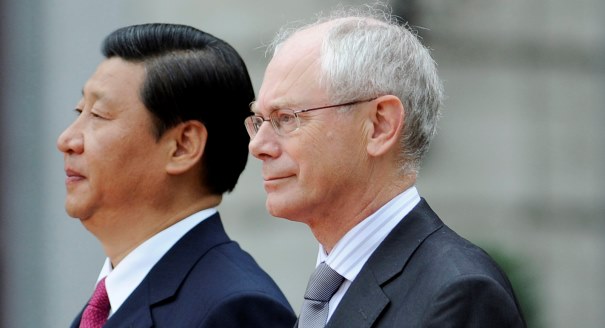
Source: Getty
Both Europe and China are overdependent on the United States as a guarantor of the liberal world order. Both need to wake up and accept their global responsibility.
Could any two global players be more different than China and the EU? Probably not. Their geopolitical, economic, and cultural traits could hardly be less alike, not to mention the very different domestic political psychologies in doubt-ridden Europe and confidence-beaming China. And yet the two are facing the same fundamental dilemma about their place in the world. The closer one looks, the more these two powers look like strategic twins.
Both China and Europe have, for at least a generation, focused on internal affairs and economic development, at the expense of foreign policy. Both are fearful of losing the political stability and wealth that these efforts have created. Both have a small foreign policy footprint relative to their size and economic weight. And both are reluctant to assume a more responsible, active role in international affairs.
Europe’s foreign policy passivity creates a geopolitical vacuum in the European neighborhood and divisions in the relationship with its main ally across the Atlantic. China’s reluctance, coupled with its neurotic scramble for recognition as a great power, creates suspicion both in its own immediate neighborhood and in the United States.
Most importantly, however, both Europe and China rely for their economic well-being on a reasonably well functioning liberal world order that neither has the power to protect. They count on someone else to do that for them: the United States.
Yet the United States has been getting relatively weaker as a world power. It is also becoming less willing to provide the global stability services that China and Europe depend on. Both must now decide whether to shoulder more of that global burden themselves.
European and Chinese leaders find it difficult to make that choice. They shy away from the monetary and political costs that this new role would incur. They fear the global public exposure, opposition, and even hatred that are the price of leadership. They also worry that foreign policy vanity projects could drain away valuable, finite resources, leaving tricky domestic issues unresolved.
These fears are justified. And yet, sustaining the liberal world order—as deficient as it may be—is not a vanity project. It is nothing less than a question of survival, and therefore the number one geopolitical question of our time.
When I tested the idea of Europe and China as strategic twins on a recent trip to Beijing, Xi’an, and Shanghai, neither my Chinese nor my European counterparts much liked the idea. “The Europeans have America, but China rides alone,” one of them said. “Europe’s reluctance only really applies to military affairs, everywhere else it is very active,” said another. A third claimed that China had “zero soft power” and could therefore never be an accepted and legitimate provider of stability to the region or the rest of the world.
Unsurprisingly, the awareness about how much both players tacitly rely on U.S. leadership is much higher in Beijing than in Brussels. Chinese analysts immediately start nodding whenever the issue is brought up, while European audiences often reject the notion of dependence on America. Europeans have become very much used to their comfortable myopia, while China’s elites seem acutely aware of how much work is required if stability is to be enjoyed. They might know it for (the wrong) domestic reasons, but they at least know it.
At some point, the parallels between China and Europe end, not least because one is a unitary actor, while the other is not; and one has an authoritarian, single-party system, while the other constitutes a club of Western liberal democracies.
The fact that important similarities can nevertheless be found illustrates the profound weakness built into the current global order: that it disproportionally relies on one player to sustain it, while free-riders continue to enjoy geopolitical subsidies. This imbalance is unsustainable.
What follows from the strategic twins theory? The good news is that there are two major players out there who “only” need to wake up to play their proper role. The international system has a stability reserve. What is lacking is the willingness to use it.
The bad news is that even if Europe and China should decide to assume greater responsibility in the future, the division of labor between the then three pillars of the international system would be extremely tricky. Mutual mistrust prevails.
Among Europe, China, and the United States, interpretations of sovereignty, the legitimate use of force, good governance, and the usefulness of the UN differ greatly. There would have to be enough of an overlap of interests between the three to bridge that gap.
But what other choice is there? To be sure, preserving and strengthening the liberal world order will be a daunting task, whether Europe and China accept their new responsibilities or not. But it will be infinitely easier if they do. It’s time for the strategic twins to wake up.

Director, Europe Team, Eurasia Group
Techau is director with Eurasia Group's Europe team, covering Germany and European security from Berlin. Previously, he was director of Carnegie Europe.
Recent Work

Nathalie Tocci, Jan Techau
Jan Techau
Carnegie does not take institutional positions on public policy issues; the views represented herein are those of the author(s) and do not necessarily reflect the views of Carnegie, its staff, or its trustees.

The EU can impose sanctions but struggles to enforce them without the United States. With Washington increasingly disinterested in backing European interests, the bloc must now fend for itself.


Nicu Popescu, Tiago Antunes

Russia is testing the waters of NATO’s mutual defense clause. What do strikes in Romanian territorial waters mean for the alliance’s posture toward Moscow?

Dimitar Bechev

With its public finances in shambles, the far right polling at 35 percent ahead of the 2027 presidential election, and a growing protest movement, is France’s crisis a threat to the EU’s geopolitical awakening?

Rym Momtaz, ed.

Ahead of a tough winter for Ukraine, Donald Trump’s swing back toward Russia bodes ill. But instead of panicking, Kyiv’s European allies are focusing on action.
Rym Momtaz

While the EU and European governments are embracing the much-lauded middle-power moment, this entails three difficult conundrums.

Richard Youngs