

Commentary
Nathalie Tocci, Jan Techau
{
  "authors": [
    "Jan Techau"
  ],
  "type": "commentary",
  "blog": "Strategic Europe",
  "centerAffiliationAll": "",
  "centers": [
    "Carnegie Endowment for International Peace",
    "Carnegie Europe"
  ],
  "collections": [],
  "englishNewsletterAll": "",
  "nonEnglishNewsletterAll": "",
  "primaryCenter": "Carnegie Europe",
  "programAffiliation": "",
  "programs": [],
  "projects": [],
  "regions": [
    "Europe"
  ],
  "topics": [
    "Security",
    "EU"
  ]
}
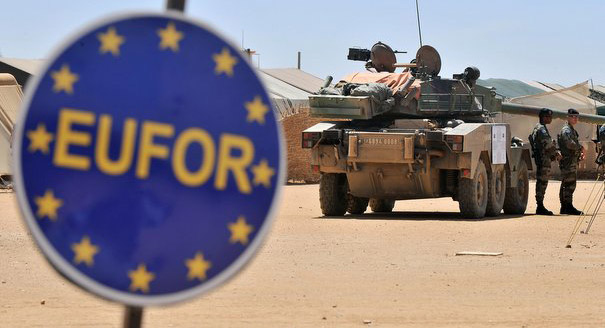
Source: Getty
In December EU leaders will meet to discuss questions of defense. They should focus on improving coordination, but more importantly on creating a shared defense worldview.
Something unusual is going on in Brussels: there is a serious discussion about hard security and defense issues. It is not a huge debate, and it is nowhere near where it should be; but there is no doubt that this December’s EU defense summit has mobilized at least some brainpower in a city that, under normal circumstances, wouldn’t go near this inconvenient subject.
If foreign policy is the stepchild of EU integration, then security and defense is the stepchild’s stepchild. Despite some commendable efforts by a few think tanks and a handful of individuals, the defense debate in the EU’s capital has never really taken off—a true indication that real decisionmaking powers in this field reside elsewhere.
But now, in the run-up to the December meeting, the Brussels crowd has woken up. Even those most averse to the topic have realized that coming out of this highly significant summit empty-handed would be a major embarrassment, if not an outright disaster. Operations in Libya and Mali have made it painfully clear how limited the EU’s military capabilities are, even in small-scale scenarios in Europe’s immediate neighborhood.
Against this backdrop, a typical Brussels mindset has emerged in which people have high hopes and dampened expectations at the same time. Nobody expects much, but everyone knows that something substantial must emerge from the EU leaders’ deliberations.
So what would constitute success at the upcoming defense summit?
“We need one real capability initiative to come out of this, with real money attached to it, otherwise no one will be convinced it was a success,” says Sven Biscop, the tireless security and defense chief at Belgium’s Egmont think tank. “And please, don’t put the EU battle groups on the agenda again. They are the perfect excuse for not doing anything.”
Many observers believe that without a spending commitment of some sort, the EU will once again demonstrate its reckless laziness on defense matters. But most experts admit that such an agreement is a long shot. The level of ambition in the member states is pretty low across the board, perhaps with some exceptions in Central Europe and Scandinavia, where policymakers have realized that the old NATO security guarantee has lost some of its strategic value in recent years.
Many eyes are turned toward Britain, where the resistance to any kind of meaningful defense debate within the despised EU is most intense. London opposes a review of the decade-old European Security Strategy, is firmly against an independent EU military headquarters, and is determined to prevent permanent structured cooperation, an instrument allowing willing EU members to go further on defense than others.
This latter construct is an option provided for in the EU treaty, but European leaders have yet to seriously consider using it. Many observers see it as a complicated but feasible way to make some headway on a divisive issue.
For Daniel Keohane, head of strategic affairs at FRIDE, a Spanish think tank with an office in Brussels, success could mean something else altogether. “They really need to make defense a regular topic at the EU summits every year,” he says, pointing to the fact that the heads of state and government have carefully avoided putting the subject on the agenda at their gatherings for many years.
Regular defense summits could also be an opportunity to reactivate EU defense ministers, who have effectively been sidelined within EU decisionmaking. One way or another, it is clear that only regular attention at the highest level can reinsert some oomph into a stalled European debate.
But perhaps the secret to success lies yet elsewhere. As Nick Witney and Olivier de France have shown in a recent paper for the European Council on Foreign Relations think tank, defense white papers across Europe basically come to the same conclusions. They all name terrorism, failed states, cybersecurity, piracy, tensions in the neighborhood, scarce resources, and WMD proliferation as the current or forthcoming challenges to European security.
Yet despite agreement on the general trends, Europeans neither feel particularly threatened nor see eye to eye on the real, operationally meaningful threats.
That needs to change.
And so, even though it is probably too optimistic a demand, for me the summit would be a success if it took a real stab at streamlining the EU’s scattered resources on risk analysis, intelligence assessment, and situational awareness. From operations centers to strategic foresight, all capacities should be aligned and much better coordinated at EU level.
True, even under the best of circumstances, common EU defense capabilities could not match the more sophisticated intelligence machineries of some member states. But improved coordination could offer the EU the chance to create, for the first time, the key ingredient that must be the starting point for any meaningful cooperation on security and defense: a shared worldview.
And in typical Brussels fashion, this feels both too ambitious and not too much to ask at the same time.
Director, Europe Team, Eurasia Group
Techau is director with Eurasia Group's Europe team, covering Germany and European security from Berlin. Previously, he was director of Carnegie Europe.
Recent Work
Nathalie Tocci, Jan Techau
Jan Techau

Are Germany’s economic, industrial, and political struggles becoming a liability for the EU’s ability to rise to the geopolitical moment?

Rym Momtaz, ed.

European Commission President Ursula von der Leyen is about to give her annual address on the state of the EU. Here’s what she won’t—but should—say.
Rym Momtaz

The aftermath of the Ceuta crisis shows Europe has drawn the wrong lessons. Rather than doubling down on failed migration policies, the EU needs to address the underlying roots of such episodes.

Richard Youngs

An overwhelming victory by a far-right-wing party in a small state in eastern Germany will have major repercussions for Chancellor Friedrich Merz’s coalition.

Judy Dempsey

Canadian Prime Minister Mark Carney has twice inspired praise for standing up to U.S. President Donald Trump: at the 2026 World Economic Forum in Davos and on Canada-U.S. trade negotiations. Is Carney showing a third way better than the EU has in dealing with the Trump administration?
Rym Momtaz, ed.