

Commentary
Before the next wave of EU enlargement takes place, the union needs to grapple with thorny questions of how power is distributed among its members.
Emil Sondaj Hansen, Ditte Brasso Sørensen
{
  "authors": [
    "Jana Kobzová"
  ],
  "type": "commentary",
  "blog": "Strategic Europe",
  "centerAffiliationAll": "",
  "centers": [
    "Carnegie Endowment for International Peace",
    "Carnegie Europe"
  ],
  "collections": [],
  "englishNewsletterAll": "",
  "nonEnglishNewsletterAll": "",
  "primaryCenter": "Carnegie Europe",
  "programAffiliation": "",
  "programs": [],
  "projects": [],
  "regions": [
    "Eastern Europe",
    "Russia",
    "Ukraine"
  ],
  "topics": [
    "Climate Change",
    "Democracy",
    "Security",
    "EU"
  ]
}
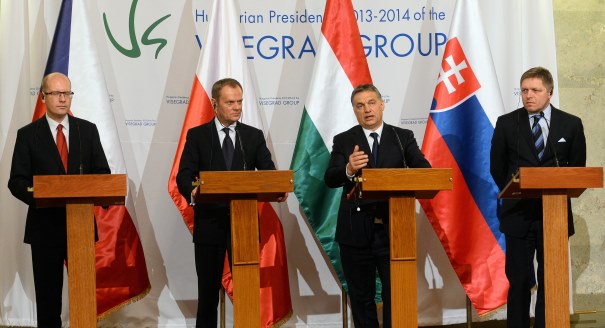
Source: Getty
Addressing Central Europe’s weaknesses vis-à-vis Moscow is tricky. But doing so is vital not only to lessen Russian influence but also to complete the region’s democratic transition.
Before Russia’s annexation of Crimea, debates about sanctioning Russia were mostly reserved for foreign policy experts with a penchant for science fiction. Now, those debates have become a reality—and tougher sanctions are on the cards.
Nowhere in the EU is the potential effect of these measures more actively discussed than in Central Europe, where the Ukraine crisis has brought to the light the region’s vulnerabilities vis-à-vis Moscow. If the EU aims to act in a unified way without undermining solidarity, there needs to be a better understanding of what these vulnerabilities are and how to face them.
Despite some progress, Central Europe remains exposed to Russian pressure in a number of areas. Yet the issues at stake are sometimes opaque and sometimes politically sensitive. To understand the region’s real weaknesses, one needs to set aside two basic misconceptions.
The first is that energy dependency is Central Europe’s key vulnerability vis-à-vis Russia. That is no longer a straightforward matter. Dependency on Russian energy supplies still exists, but it is far from being as critical as some observers (and certain Central European governments) claim.
The Czech Republic and Slovakia still cover the majority of their gas needs, and Poland over 50 percent of its, with Russian deliveries. Yet that does not mean that they have no alternatives if the worst comes to the worst.
A gas standoff between Russia and Ukraine in 2009 provoked a fundamental rethink of Central Europe’s energy security. With the help of the EU and other member states, the countries of the region have invested in enhancing their storage capacity, diversifying their crossborder capacity, and developing new supply routes. They have also operationalized “reverse flows,” which allow gas to flow from west to east. In short, the fact that these countries still receive much of their gas from Russia no longer implies 100 percent vulnerability.
While Central Europe’s nuclear power stations run on Russian fuel, there are ways of addressing this weakness too. After numerous consultations and negotiations, Ukraine (whose plants also rely on Russian fuel) is on the verge of signing a deal with U.S.-based energy company Westinghouse that would reduce Russia’s leverage.
Immediate interruption of supplies would still hurt the region badly, but if the region’s leaders prioritize the search for the alternatives, the situation will look very different in a couple of years—just as in the case of the gas sector after the 2009 crisis.
The second misconception is that the structure of Central Europe’s trade with Russia makes the region more vulnerable to potential trade embargoes than other member states.
During discussions on the EU response to the Crimean annexation, some Central European states used economic arguments to dilute the potential sanctions. Slovakia, among others, argued that its carmakers and other industries would suffer substantial losses. Polish farmers feared that sanctions would substantially reduce their food exports to Russia—a major source of their income.
National leaders cannot exclude these concerns from their political calculations. Indeed, some specific sectors such as the automotive industry or food production would be more heavily affected than others, but the impact of sanctions on these countries’ GDP would not be disastrous if these fears were to materialize. According to the Observatory of Economic Complexity, a data visualization site, Russia is not among the top five export destinations for any of the four Visegrad countries—the Czech Republic, Hungary, Poland, and Slovakia.
Yet Russian influence still has its effects. The region’s air defense systems are, to varying degrees, still reliant on Russian supplies—especially Slovakia’s, but also, to a lesser extent, Poland’s and Romania’s. Moscow’s withdrawal of its supplies would seriously hamper the Central European states’ prospects of using their own military capabilities.
Another means of Russian influence in Central Europe is the web of often-murky links between Russia and the region’s local business and political elites. Czech President Miloš Zeman’s campaign for the country’s 2013 presidential election was plagued by allegations about his close cooperation with representatives of Russian energy giant Lukoil.
Only a year ago, Hungary’s ruling party, Fidesz, held meetings about potential cooperation with the pro-Kremlin United Russia party, while it has been alleged that the Kremlin funds small radical parties such as Hungary’s right-wing Jobbik. What makes these pressure points more valuable for Russia is their opacity—which is exactly what makes them so challenging for the EU and its member states to address.
This should not be an excuse for inaction. Identifying Central Europe’s weak points and addressing them is about more than about decreasing Russian influence in the region—it is about making democracy and transparent politics work. It is about completing the region’s transition from Communist and monopolist economies.
Solving these issues is not a matter of days. Some of the region’s vulnerabilities are more acute than others; and some can be addressed in a short time, while others will take couple of years and substantial resources. But concrete steps should be taken now, starting with identifying the weak spots and drawing up plans for how to mitigate them.
There are good and bad crises—ones that teach us a lesson and ones that don’t. The 2009 gas crisis showed that Central Europe’s inaction on energy security was no longer tenable. Let’s hope that the 2014 Ukraine crisis will have the same effect on other areas.
Jana Kobzová is program officer at the European Endowment for Democracy and associate policy fellow at the European Council on Foreign Relations.
Jana Kobzová
Carnegie does not take institutional positions on public policy issues; the views represented herein are those of the author(s) and do not necessarily reflect the views of Carnegie, its staff, or its trustees.

Before the next wave of EU enlargement takes place, the union needs to grapple with thorny questions of how power is distributed among its members.


Emil Sondaj Hansen, Ditte Brasso Sørensen

A summer of escalation in the Black Sea has hurt Ukraine economically and is exacerbating world food security. A truce is needed—as is a broader reframing of Europe’s Ukraine strategy.

Thomas de Waal

Are Germany’s economic, industrial, and political struggles becoming a liability for the EU’s ability to rise to the geopolitical moment?

Rym Momtaz, ed.

European Commission President Ursula von der Leyen is about to give her annual address on the state of the EU. Here’s what she won’t—but should—say.
Rym Momtaz

The aftermath of the Ceuta crisis shows Europe has drawn the wrong lessons. Rather than doubling down on failed migration policies, the EU needs to address the underlying roots of such episodes.

Richard Youngs