

Commentary
Judy Dempsey
{
  "authors": [
    "Judy Dempsey"
  ],
  "type": "commentary",
  "blog": "Strategic Europe",
  "centerAffiliationAll": "",
  "centers": [
    "Carnegie Endowment for International Peace",
    "Carnegie Europe"
  ],
  "collections": [
    "Europe’s Eastern Neighborhood"
  ],
  "englishNewsletterAll": "",
  "nonEnglishNewsletterAll": "",
  "primaryCenter": "Carnegie Europe",
  "programAffiliation": "",
  "programs": [],
  "projects": [],
  "regions": [
    "Russia",
    "Europe"
  ],
  "topics": [
    "Foreign Policy"
  ]
}
Source: Getty
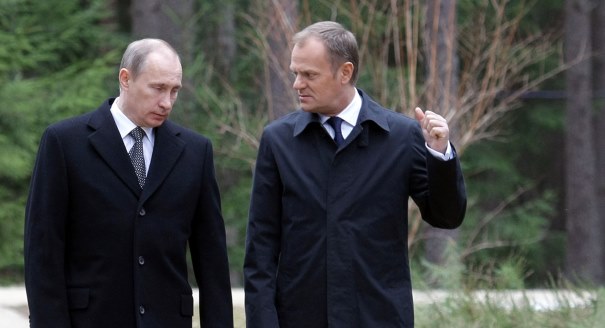
Poland has canceled the Polish Year in Russia and Russian Year in Poland, which would have been an unprecedented joint cultural celebration. But some links remain.
It wasn’t much of an announcement.
“Poland’s cabinet has decided to call off the Polish Year in Russia and the Russian Year in Poland, planned for 2015,” government spokesperson Małgorzata Kidawa-Błońska announced on July 23.
The decision to scrap the joint initiative celebrating bilateral cultural ties came just a few days after pro-Russian rebels shot down Malaysia Airlines Flight 17 in eastern Ukraine, killing all 298 people on board, the majority of whom were Dutch citizens.
It’s easy to understand why Poland made this announcement. Donald Tusk’s center-right government is under immense pressure from the conservative-nationalist Law and Justice party to cut off relations with Russia, especially in light of parliamentary elections due in Poland in 2015. Yet surely, this would have been an important moment for Poles to reach out to Russian liberal intellectuals instead of isolating them—even though many liberals in Russia are biding their time rather than standing up to Russian President Vladimir Putin.
In response to Western sanctions against Russia, Putin has imposed a battery of countermeasures on Europe that include a ban on Polish apples and other produce. But Russia and Poland need each other for trade, exchanges, and services. If and when Russia’s relations with the EU are put back on an even keel, Moscow will need Warsaw’s goodwill.
So it’s good news that behind the scenes and on a different level, Russia and Poland have been cautiously pressing ahead with reconciliation.
For several months now, Polish and Russian academics have been meeting to debate the issues that divide them. The events are organized by the Center for Polish-Russian Dialogue and Understanding.
Adam Daniel Rotfeld, a former Polish foreign minister, and Anatoly Torkunov, rector of the Moscow State Institute of International Relations, chair the center. Together, they made sure to continue Russian-Polish youth exchanges and conferences for high-level academics.
Rotfeld is also co-chairman of the Polish-Russian Group for Difficult Matters (what a great name!). The group was set up in 2002 to deal with the issues that divide Russia and Poland, but it remained dormant under Poland’s previous nationalist-conservative government until Tusk’s center-right coalition was voted into power in 2007.
Thanks to Tusk’s persistent lobbying in Brussels, Moscow, and Berlin, the inhabitants of Kaliningrad, a Russian exclave that is sandwiched between EU and NATO members Lithuania and Poland, can now cross the border into Poland without visas. That’s an immense achievement, to say the least.
Such a step could not have happened if Poland had not reached out to Russia and, as a result, shown its EU partners that it wanted reconciliation with its archenemy.
“In 2007 we decided to deal with all the difficult issues in our relations,” Rotfeld explained in an interview with Carnegie Europe. “But the most difficult one is political psychology. There are two different narratives about the same facts and events.”
During our meeting, Rotfeld took a mighty tome down from his bookshelf. The recently published 1,000-page book is a fascinating set of essays on Polish-Russian relations dating back to 1918.
In the volume, Polish and Russian historians give their respective interpretation of events. There is little meeting of minds, whether about the treatment of Russians in Polish prisoner-of-war camps in 1920 or about the circumstances leading up to the murder of thousands of Polish officers by Stalin’s secret police in the woods near the Russian city of Smolensk in 1940.
It was near Smolensk that Lech Kaczyński’s plane crashed in April 2010. The then Polish president was on his way to commemorate the seventieth anniversary of those murders, known as the Katyn massacre. The crash caused an outpouring of grief in Poland but also in Russia, particularly by Putin, who was prime minister at the time. That same week, Russian television even broadcast Katyń, a marvelous epic film by veteran Polish director Andrzej Wajda. Out of the tragedy, there were huge hopes that reconciliation would deepen.
Four years on, Poles cannot understand why Putin will not return the downed Polish plane. “We are bewildered that four years after the accident, the plane has still not been handed over,” said Katarzyna Pełczyńska-Nałęcz, Poland’s new ambassador to Moscow and an expert in Polish-Russian relations.
“There is symbolic meaning for Poland and Polish citizens in getting the wreckage back,” she said in a very revealing interview with Russian news agency RIA Novosti.
The longer the delay in sending the aircraft back to Warsaw, the more the episode plays into the hands of the Law and Justice party, led by Jarosław Kaczyński, the twin brother of Lech. With the Ukraine crisis, he opposes reconciliation with Russia more than ever.
The Tusk government has a difficult balancing act—both diplomatically and domestically. The pressure is on, all the more because of next year’s parliamentary elections in Poland.

Nonresident Senior Fellow, Carnegie Europe
Judy Dempsey is a nonresident senior fellow at Carnegie Europe
Recent Work
Judy Dempsey
Judy Dempsey
Carnegie does not take institutional positions on public policy issues; the views represented herein are those of the author(s) and do not necessarily reflect the views of Carnegie, its staff, or its trustees.

European Commission President Ursula von der Leyen is about to give her annual address on the state of the EU. Here’s what she won’t—but should—say.

Rym Momtaz

The aftermath of the Ceuta crisis shows Europe has drawn the wrong lessons. Rather than doubling down on failed migration policies, the EU needs to address the underlying roots of such episodes.

Richard Youngs
An overwhelming victory by a far-right-wing party in a small state in eastern Germany will have major repercussions for Chancellor Friedrich Merz’s coalition.
Judy Dempsey

Canadian Prime Minister Mark Carney has twice inspired praise for standing up to U.S. President Donald Trump: at the 2026 World Economic Forum in Davos and on Canada-U.S. trade negotiations. Is Carney showing a third way better than the EU has in dealing with the Trump administration?
Rym Momtaz, ed.

The EU’s responses to two recent incidents expose the gulf between European perceptions and capabilities. Unless the union can bridge that gap, it will never become a real geostrategic power.
Rym Momtaz