

Commentary
The European Commissioner for Trade is headed to China. But after President Xi’s bridge-building visit to Washington, can a more isolated EU overcome Beijing’s stranglehold on critical raw materials? Who will blink first?
Rym Momtaz, ed.
{
  "authors": [
    "Ben Tonra"
  ],
  "type": "commentary",
  "blog": "Strategic Europe",
  "centerAffiliationAll": "",
  "centers": [
    "Carnegie Endowment for International Peace",
    "Carnegie Europe"
  ],
  "collections": [],
  "englishNewsletterAll": "",
  "nonEnglishNewsletterAll": "",
  "primaryCenter": "Carnegie Europe",
  "programAffiliation": "",
  "programs": [],
  "projects": [],
  "regions": [
    "Western Europe",
    "Europe"
  ],
  "topics": [
    "Foreign Policy",
    "EU"
  ]
}
Source: Getty
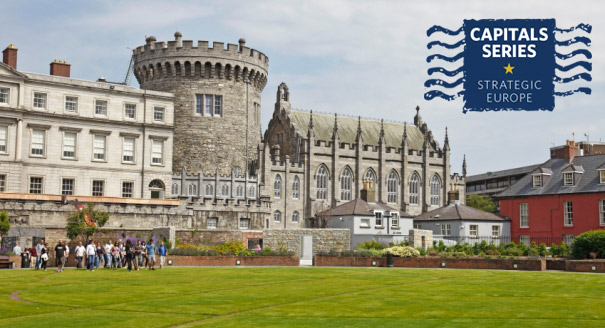
Despite two major institutional constraints, Irish foreign policy has ambition. Ireland may lack capacity, confidence, and, occasionally, resolve—but the drive is there.
Strategic Europe continues its series devoted to explaining the foreign and security policy ambitions of the 28 EU member states. We have asked our contributors from each capital to give a candid assessment of their country’s perception of security and strategy, with a ranking on a scale from 0 (the laggards) to 5 (the ambitious). This week, the spotlight is on Ireland.
*
Irish foreign policy suffers from two significant institutional limitations when it comes to defining and pursuing a strategic vision.

The second institutional limitation is one of focus. Ireland enjoys an exceptionally benign geostrategic position but continues to devote considerable time, energy, and resources to political and security issues in Northern Ireland. Although the province’s peace process has been institutionalized, it demands continuing and at times intense high-level attention, to the detriment of other foreign policy areas.
Despite these two institutional caveats, there is nevertheless a discernible Irish vision within EU foreign, security, and defense policy. As for Ireland’s level of ambition, the country scores a solid 3.5 out of 5.

In a sense, both Ireland and the EU are emblematic of what some policymakers and academics had dubbed the new security agenda of the post–Cold War era. To that extent, it is unsurprising that Ireland has taken a relatively hawkish stance on the Ukraine crisis, is a committed player on the proposed Transatlantic Trade and Investment Partnership (TTIP), is a long-standing supporter of further EU enlargement, and has been a vocal critic of illegal Israeli settlements in the occupied Palestinian territories.
Where things become problematic for Irish foreign policy makers is precisely also where the wheels come off the European foreign policy cart. Difficult issues include the use or threatened use of military force, the balance to be struck between human rights promotion and economic interests, and the institutionalization of EU foreign policy through the European External Action Service (EEAS).
#Ireland enjoys an exceptionally benign geostrategic position.Tweet This
On the use of military force, Ireland is among the most reliable contributors to EU Common Security and Defense Policy missions, participating in most operations and contributing substantially to others. The Irish parliamentary requirement for UN authorization for any military mission to which Ireland might contribute more than twelve personnel is a potential complication that other EU member states also have to deal with.
To date, neither Ireland’s nonmembership in NATO nor its constitutional prohibition on joining a collective EU defense has served significantly to undermine Irish participation in EU missions. And there is no doubt that any decision by EU partners to pursue such a collective defense or more robust military interventions overseas would force unwanted choices on Ireland.
On balancing human rights and economic self-interest, there is also no doubt that the center of gravity in Irish policy has shifted since the 2008 financial crisis. Ireland’s pursuit of China and its vast market has been deliberate and sustained even as it has entailed some domestic criticism from NGOs. At the same time, human rights promotion is such a core, self-identified value of Irish foreign policy that lawmakers must tread warily.
Critically, however, Irish policymakers—conscious of their own limited capacity for unilateral advantage—are stalwart supporters of collective EU action vis-à-vis China and other major trading partners. The Irish are also strong defenders of the role and rights of the European Commission in determining and implementing policy for the union as a whole.
On institutionalizing EU foreign, security, and defense policy, a generic Irish ambition for credibility, consistency, and effectiveness at the EU level hits the same wall of national sovereignty as is evident in other member states.
Many in #Ireland see limited scope for added value from the @eu_eeas.Tweet This
Notably, many in Ireland see limited scope for any added value from the EEAS for Irish foreign policy. The EU’s diplomatic service threatens either to diminish politically valuable Irish visibility in core, niche areas of high politics such as human rights, disarmament, and development or to rob Irish foreign policy of a significant part of its budgetary justification for the provision of consular services.
Just as the EEAS struggles to define and pursue a role for itself, so Irish foreign policy makers struggle to see a role for the institution that does not diminish them. Ireland’s recent foreign policy review references opportunities for diplomatic co-location with EEAS offices as being considered only “where practical and cost-effective.”
In sum, there is a striking synergy between Ireland’s strategic vision for the EU and the EU’s vision of itself. This offers some justification for those who criticize the union for pursuing a small-state foreign policy when it should be aiming for great-power statecraft. At the same time, it would be wrong to characterize Irish foreign policy as lacking ambition. It lacks capacity, it can lack confidence, and it occasionally lacks resolve—but the ambition exists.
Ben Tonra is head of the School of Politics and International Relations at University College Dublin.
Ben Tonra
University College Dublin
Carnegie does not take institutional positions on public policy issues; the views represented herein are those of the author(s) and do not necessarily reflect the views of Carnegie, its staff, or its trustees.

The European Commissioner for Trade is headed to China. But after President Xi’s bridge-building visit to Washington, can a more isolated EU overcome Beijing’s stranglehold on critical raw materials? Who will blink first?

Rym Momtaz, ed.

The domestic impacts of how long it is taking to end the war in Ukraine have pushed the French electorate to the political extremes and compromised the country’s diplomatic capacity.
Rym Momtaz

Before the next wave of EU enlargement takes place, the union needs to grapple with thorny questions of how power is distributed among its members.


Emil Sondaj Hansen, Ditte Brasso Sørensen

A summer of escalation in the Black Sea has hurt Ukraine economically and is exacerbating world food security. A truce is needed—as is a broader reframing of Europe’s Ukraine strategy.

Thomas de Waal

Are Germany’s economic, industrial, and political struggles becoming a liability for the EU’s ability to rise to the geopolitical moment?
Rym Momtaz, ed.