

Commentary
Judy Dempsey
{
  "authors": [
    "Judy Dempsey"
  ],
  "type": "commentary",
  "blog": "Strategic Europe",
  "centerAffiliationAll": "",
  "centers": [
    "Carnegie Endowment for International Peace",
    "Carnegie Europe"
  ],
  "collections": [],
  "englishNewsletterAll": "",
  "nonEnglishNewsletterAll": "",
  "primaryCenter": "Carnegie Europe",
  "programAffiliation": "",
  "programs": [],
  "projects": [],
  "regions": [
    "Middle East",
    "Iran",
    "Saudi Arabia",
    "Yemen"
  ],
  "topics": [
    "Security",
    "Military"
  ]
}
Source: Getty
Every week, a selection of leading experts answer a new question from Judy Dempsey on the foreign and security policy challenges shaping Europe’s role in the world.
Every week, a selection of leading experts answer a new question from Judy Dempsey on the foreign and security policy challenges shaping Europe’s role in the world.
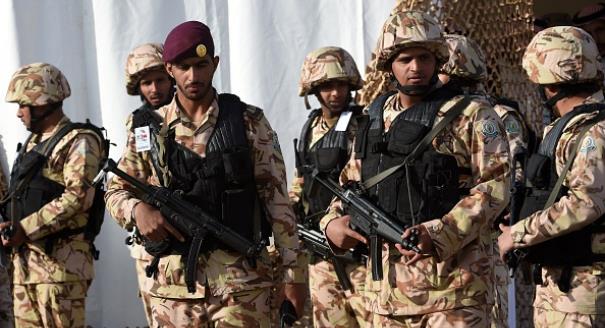
It is easy to dismiss as a chimera the idea of a unified Arab military force to police the region. The proposal announced on March 29 is built around a momentary coalition of authoritarian rulers who possess no strategic vision other than a desire to protect existing regimes from threats posing as social and religious divisions (sectarianism), political movements (groups aligned with the Muslim Brotherhood), and a regional power (Iran).
It is easy to dismiss a unified #Arab military force.Tweet This
But the moves in the direction of such a force—if more symbolic than real—still mark three very significant political changes in regional politics following the upheavals of 2011.
First, the Westphalian-style post-1967 order among Arab regimes, in which states stopped ideological disputes at their borders, is now not merely eroded but shattered.
Second, the line between sectarian identity, on the one hand, and political and security interests, on the other, has also collapsed.
Third, the expectation of many Arab regimes that external powers (mainly the United States) would take the lead in organizing the region has now been replaced by an unprecedented level of initiative by regional actors.
These trends do not amount to a new regional order. Instead, they point to a kind of disorder that the new authoritarian alliance is attempting to resist but will likely only deepen.
Yes, a united Arab force will definitely be a game changer. It is the first time since the failed Arab coalition in the 1967 war against Israel that Arab countries have decided to join forces in a concrete and strategic way. So far, there has been a lot of talk about Arab unity. The Arab League’s initiative on March 29 to establish a joint military force could make this old dream a tangible reality.
A united #Arab force will definitely be a game changer.Tweet This
Just as European integration and NATO started as answers to the threat of the Soviet Union, so the Arabs regard Iranian expansion as an existential threat to them. They see Iran taking over four Arab capitals: Damascus, Baghdad, Sana’a, and, to a certain extent, Beirut. The self-proclaimed Islamic State is a second existential threat that undermines the entire Arab world.
If this united Arab force becomes a reality, it will need strategic political cooperation. That way, military cooperation might trigger regional integration, just as the European Coal and Steel Community set up in 1952 led to broader European integration.
Finally, there are signs that the Arab military force is already a game changer. Sudan, a longtime ally of Iran, decided to join the initiative and thus turn its back on Tehran. What is taking place now is only the start of a new game in the Arab world.
Maybe. But probably not in the way Western observers are hoping.
The idea of #Arab nations coming together is appealing.Tweet This
The idea of Arab nations coming together to serve the greater collective good is appealing. But the main purpose of the prospective joint Arab force announced on March 29 is not to make the Middle East a safer place. Rather, it is to strengthen the geopolitical position of Saudi Arabia and its allies vis-à-vis its rival Iran, at a moment when Tehran appears to steal away Riyadh’s most powerful ally, the United States. The proposed Arab military force is a step to institutionalizing the polarization that looks set to lead the region toward a major clash.
The force’s declared goal to fight Islamist extremism is, for most Arab regimes, a tactical objective to ensure long-term regime survival. Not only do groups like Daesh—also known as the Islamic State—challenge incumbents and Middle Eastern statehood more broadly. The untouchable counterterrorism narrative also provides a neat framework to uproot domestic dissent. The ongoing Saudi-led air campaign in Yemen illustrates the selective use of this narrative as Daesh- and al-Qaeda-linked jihadists are likely to benefit from Yemen’s collapse.
The idea of a permanent collective security mechanism among highly divided Arab nations has been around for six decades, so expectations should be kept in check. The coming year will show whether the new initiative will fly as a collective outfit. If it does, it may create more problems than it solves.
The Arab military force is not a game changer but a tool in an ongoing game of political rivalry.
The #Arab military force is a tool in a game of political rivalry.Tweet This
It would have been interesting to see a pan-Arab counterterrorism strategy that uses military cooperation among different states to rid the region of cross-border security threats. Such a strategy would rely on the establishment of a harmonious elite military force, the sharing of intelligence, and the implementation of joint security sector reform measures.
The creation of a joint Arab military force as announced by the Arab League on March 29 is far from this ideal. It is merely a further step by Saudi Arabia—the driver behind the initiative—in its attempts to reclaim its position as a regional political force in the Middle East.
The joint Arab military force is more symbolic than practical. But even if the project were to be implemented, it remains an idea without substantive plans to make it operational. The initiative therefore has to be understood as a measure by Saudi Arabia to stand up to the increasing influence of its Shia rival Iran in a Sunni-majority Arab world, to cement its superiority in the face of Arab political competitors like Qatar and the Muslim Brotherhood, and to present itself as the regional guardian against the threat of Sunni extremist groups like the self-proclaimed Islamic State.
Rereading Samuel Huntington’s celebrated 1993 essay “The Clash of Civilizations?” today, one is reminded of an aspect often forgotten in the present debate: his question mark. While the dispute on the clash of civilizations roars online, pundits forget about the political scientist’s doubts and dilemmas, which end with a humble forecast: “For the relevant future, there will be no universal civilization, but instead a world of different civilizations, each of which will have to learn to coexist with the others.”
Indeed, observers were surprised to wake up to a world in which the real clash was between Sunni and Shia—a creepy, shadowy proxy war that pits Iran against Saudi Arabia, each supported by its own allies and clients.
A unified #Arab army will be only one factor in a wider theater.Tweet This
A unified Arab army, as the early coalition gathering in Yemen proves, will be only one factor in this wider theater. Eventually, the initiative may have a positive effect on some intractable conflicts (see Libya), but it will not dominate the deeper clashes: Sunni versus Shia, fundamentalists versus nonfundamentalists, and leaders ready to engage in a global community of civilizations versus leaders ready to sacrifice blood and treasure to win a cultural and religious war.
Huntington’s question mark remains unanswered.
The willingness of several key Sunni Arab players to commit forces and assets to joint military operations to counteract growing security threats across the Middle East is an important trend.
Efforts to share capabilities extend beyond the initiative of Egyptian President Abdel Fattah el-Sisi to form an Arab military force under the auspices of the Arab League. More broadly, the trend toward military cooperation reflects an understanding that with new regional geopolitical realities, the West’s Arab allies can no longer rely solely on the U.S. military umbrella. Saudi Arabia and its Sunni partners realize that they need to fend for themselves and pool resources to meet the threats posed by Iran and the self-proclaimed Islamic State.
Perhaps Europeans can learn a lesson or two from the Middle East.Tweet This
The rather ambitious Egyptian initiative will meet significant challenges within the Arab League as two member states—Iraq and Lebanon—have expressed considerable reservations. (Not surprisingly, both are under strong Iranian influence.) However, efforts will likely continue toward enhancing Sunni Arab military-to-military cooperation and interoperability resulting in joint military operations, even if there will be no Middle Eastern NATO.
Nevertheless, the Sunni Arab powers will still resort to U.S. support. The ongoing Saudi-led military operation in Yemen relies on U.S. intelligence and logistical support. Perhaps Europeans can learn a lesson or two from the Middle East on how to stand up to regional threats and not exclusively rely on U.S. benevolence.
The states that are to form the military force announced by the Arab League on March 29 have amassed serious firepower, acquired from a plethora of suppliers. Several of these states have shown their willingness and increasing ability to use their weapons—in Yemen, Libya, and Syria.
The buildup of #Arab military capabilities looks set to continue.Tweet This
The buildup of Arab nations’ military capabilities looks set to continue, as the United States and Western Europe are keen on lucrative arms deals with the strategically important Arab states. Even the heavy-handed use of force by Arab regimes to repress movements seeking political change has led to only a few hiccups in arms flows to the region, with Russia and China standing ready to fill any gaps.
But which game will be changed by combining this Arab firepower: that of human security, peace, and stability; or that of regional dominance and regime survival? Arab military force was used in the game of regime survival in Bahrain, but it did not deal with the root causes of political instability.
The regional power game could change if Arab states ignore the need for arms control and combine their increasingly advanced military capabilities against a cash-strapped Iran under a UN arms embargo. Instead of creating regional stability, the resulting increased military asymmetry may push Iran further in the direction of alternatives to advanced conventional weapons. A game changer it could be, but to anyone’s advantage?

Nonresident Senior Fellow, Carnegie Europe
Judy Dempsey is a nonresident senior fellow at Carnegie Europe
Recent Work
Judy Dempsey
Judy Dempsey
Carnegie does not take institutional positions on public policy issues; the views represented herein are those of the author(s) and do not necessarily reflect the views of Carnegie, its staff, or its trustees.

Mounting economic strain and battlefield losses will not necessarily make the Kremlin less dangerous. They could instead push Moscow toward a more aggressive hybrid campaign designed to test NATO’s Eastern flank, exploit allied hesitation, and fracture European resolve.

Maksym Beznosiuk

Over the past ten years, NATO has held almost as many summits as it did during the entirety of the Cold War. Are they still useful, or is it time to stop holding annual meetings?

Rym Momtaz, ed.

Western Europe’s dual-use infrastructure melted down during its latest heat wave. If a predicted hot weather event can take the continent by surprise, what chance does it have to withstand unexpected geopolitical crises?
Rym Momtaz
There is an elephant in the room when it comes to the EU’s upcoming security strategy: Donald Trump. Unless European leaders acknowledge the depth of the transatlantic crisis, true autonomy will remain out of reach.

Stefan Lehne
Defense tech innovations will be at the heart of Europe’s new security strategy. But so far, Brussels has been making moves without a broader plan, undermining readiness and credibility.

Raluca Csernatoni