

Commentary
Before the next wave of EU enlargement takes place, the union needs to grapple with thorny questions of how power is distributed among its members.
Emil Sondaj Hansen, Ditte Brasso Sørensen
{
  "authors": [
    "Marta Dassù"
  ],
  "type": "commentary",
  "blog": "Strategic Europe",
  "centerAffiliationAll": "",
  "centers": [
    "Carnegie Endowment for International Peace",
    "Carnegie Europe"
  ],
  "collections": [],
  "englishNewsletterAll": "",
  "nonEnglishNewsletterAll": "",
  "primaryCenter": "Carnegie Europe",
  "programAffiliation": "",
  "programs": [],
  "projects": [],
  "regions": [
    "Europe",
    "Western Europe"
  ],
  "topics": [
    "Foreign Policy",
    "EU"
  ]
}
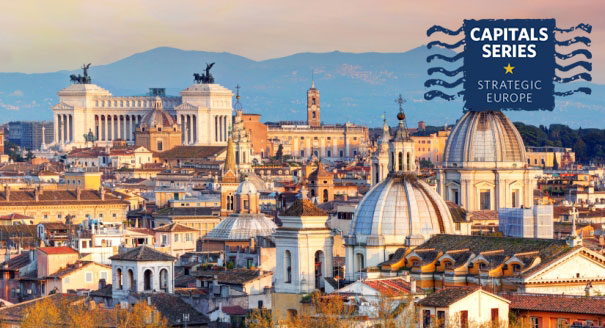
Source: Getty
Italy is committed to a stronger global role for the EU. But delegating authority to Brussels doesn’t mean that Rome is trying to shirk its international responsibilities.
Strategic Europe continues its series devoted to explaining the foreign and security policy ambitions of the 28 EU member states. We have asked our contributors from each capital to give a candid assessment of their country’s perception of security and strategy, with a ranking on a scale from 0 (the laggards) to 5 (the ambitious). This week, the spotlight is on Italy.
*
When in 2014 the Italian government firmly endorsed the country’s former foreign minister Federica Mogherini as the EU’s new foreign and security policy chief, Rome was making a significant political statement: Italy’s commitment to a stronger international role for the EU is a central national interest.

Let us look at the heated case of migration. The determined way in which Mogherini is now trying to coordinate the EU’s response to the issue of Mediterranean migration—itself a top national priority for Italy—confirms the importance of the link between Rome and Brussels. The reality, however, is that the European Commission’s proposals on this issue (first and foremost, the relocation of some of the refugees within the EU) have been emptied of much of their significance by national vetoes.
In connection with the external dimension of the migration challenge—most urgently, how to deal with the security situation in Libya, the country through which many of the migrants travel—a similar dynamic emerges. In theory, the EU is ready to do more, including a potential Common Security and Defense Policy mission. But in concrete terms, given the absence of a UN Security Council mandate to back up such a mission, nothing has been done apart from bolstering the EU’s existing Triton border patrol operation.

Rome is exercising a kind of moral suasion with its EU partners by bringing the Mediterranean to the forefront of their agendas. Yet Italy is also proposing to play a major direct role in the above-mentioned EU security operation in Libya, including a command role. In a nutshell: by playing the EU card, Italy is not trying to shirk its responsibilities, as it has sometimes done in the past. Yet, precisely in connection with Libya, Italy’s plans remain too vague to be fully credible.
Thrashing out an intra-EU agreement in support of Italy’s aims is going to require a deal on two fronts: on the one hand, Italy will need to secure the solidarity of other member states vis-à-vis the Mediterranean challenge; on the other, Rome will have to lend its support to the EU’s common position on Ukraine and Russia. Here, Italy’s level of ambition is relatively low, given the defensive posture adopted by Rome.
#Rome is exercising a kind of moral suasion with its EU partners.Tweet This
Italy has a skeptical view of the EU sanctions against Russia and does not like the ad hoc format of the union’s dealings with Moscow on the Ukraine crisis; yet Rome is not going to break ranks with the EU. The Italian government also believes that (re)engaging Moscow at various levels is a useful and necessary way to maintain some degree of influence over Russia’s evolution and to fully involve the country in the struggle against the self-styled Islamic State.
These trends were confirmed by Russian President Vladimir Putin’s visit to Italy on June 10. Despite the media fanfare and Italian businesses grumbling about the sanctions, Italian Prime Minister Matteo Renzi reiterated the G7 link between the Minsk II peace process for Ukraine and any future reassessment of the sanctions. The bottom line is that Italy’s margins for autonomous action are extremely limited, and its fundamental interests continue to require close coordination with those of Rome’s Western partners.
On a broader level in and around Europe, Italy’s view is that relations with the EU’s vast neighborhood should be differentiated and pursued by other means than just the accession process. And yet, where Serbia and even Turkey are concerned, Rome still perceives EU enlargement as a viable option—on paper, at least.
It remains true that, as in the past, Italy is seen as punching below its weight on the global stage. This reflects the constraints—particularly those of a budgetary nature—that affect Rome’s foreign and defense policies. Moreover, the political elite led by Renzi is absorbed mostly by domestic reforms.
#Italy is seen as punching below its weight on the global stage.Tweet This
This is why Italy’s long-standing readiness to contribute to EU stability and security missions begins and ends with Libya, with a prolonged presence in Afghanistan in the meantime. Aside from that, strategic prudence prevails, balanced by a more active economic diplomacy. Italy’s new defense white paper unveiled in April 2015 aims to offer a rationale for the country’s declining defense budget. That is—by definition—mission impossible.
Continuity prevails in Rome’s attempt to maintain a working balance between the European and transatlantic dimensions of Italy’s foreign policy, so that the two strands complement and reinforce each other. A clear case in point is the country’s commitment to a successful Transatlantic Trade and Investment Partnership (TTIP), despite the great complexity of the ongoing negotiations between the EU and the United States. Whenever EU solidarity and transatlantic cohesion pull in opposite directions, Italy risks being sidelined and weakened diplomatically.
A less traditional way to look at Italy’s foreign policy predicament is to consider that the country’s overall international stance is affected by the confluence of four contradictory dynamics that converge on its territory: migrants from the South; gas from Russia and, to a lesser extent, from the South; cash from China—not yet in any large measure, but at an increasing rate; and the U.S. military footprint, which is lighter than in the past, but still significant.
The main challenge for any Italian government is to manage these four simultaneous sources of pressure through consistent policies, and to turn these difficulties into assets—for Italy and for Europe. For the time being, the challenge is far more evident than the strategic answer.
Marta Dassù is editor in chief of Aspenia and senior director for European affairs at the Aspen Institute.
Marta Dassù
Aspen Institute Italia
Carnegie does not take institutional positions on public policy issues; the views represented herein are those of the author(s) and do not necessarily reflect the views of Carnegie, its staff, or its trustees.

Before the next wave of EU enlargement takes place, the union needs to grapple with thorny questions of how power is distributed among its members.


Emil Sondaj Hansen, Ditte Brasso Sørensen

A summer of escalation in the Black Sea has hurt Ukraine economically and is exacerbating world food security. A truce is needed—as is a broader reframing of Europe’s Ukraine strategy.

Thomas de Waal

Are Germany’s economic, industrial, and political struggles becoming a liability for the EU’s ability to rise to the geopolitical moment?

Rym Momtaz, ed.

European Commission President Ursula von der Leyen is about to give her annual address on the state of the EU. Here’s what she won’t—but should—say.
Rym Momtaz

The aftermath of the Ceuta crisis shows Europe has drawn the wrong lessons. Rather than doubling down on failed migration policies, the EU needs to address the underlying roots of such episodes.

Richard Youngs