

Commentary
Judy Dempsey
{
  "authors": [
    "Judy Dempsey"
  ],
  "type": "commentary",
  "blog": "Strategic Europe",
  "centerAffiliationAll": "",
  "centers": [
    "Carnegie Endowment for International Peace",
    "Carnegie Europe"
  ],
  "collections": [
    "EU Integration and Enlargement"
  ],
  "englishNewsletterAll": "",
  "nonEnglishNewsletterAll": "",
  "primaryCenter": "Carnegie Europe",
  "programAffiliation": "",
  "programs": [],
  "projects": [],
  "regions": [
    "Europe",
    "Eastern Europe"
  ],
  "topics": [
    "EU",
    "Foreign Policy"
  ]
}
Source: Getty
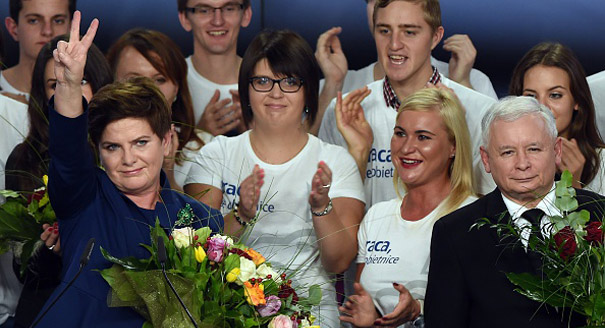
A big victory for Poland’s Law and Justice party in the country’s recent parliamentary election is not going to make life easy for the EU or NATO.
When Poland’s right-wing Law and Justice party lost the country’s parliamentary election in 2011, its conservative and nationalist leader, Jarosław Kaczyński, vowed to bring the party back to power.
Not only that. “One day, we will have a Budapest in Warsaw,” he promised, referring to how Hungary’s Prime Minister Viktor Orbán used his twice-won two-thirds majority to make sweeping constitutional changes.
The good news is that in Poland’s election on October 25, Law and Justice won over 37 percent of the vote but failed to secure two-thirds of the parliamentary seats. This means that the party will not be able to change laws as easily as Orbán’s Fidesz party has been able to do, because Poland, like Hungary, requires a two-thirds parliamentary majority for constitutional changes.
That stability could allow Beata Szydło, Poland’s new prime minister designate, to fundamentally shift Poland’s foreign and security policy from the outward-looking and ambitious one that the center-right Civic Platform had pursued to a more inward-looking one more focused on the immediate region. This will affect Warsaw’s relations with the EU and NATO.
Supporters of Law and Justice are conservative, nationalist, and Euroskeptic. They resent what they see as diktats issued by Brussels and they will certainly oppose EU plans to accept more refugees that are arriving in Europe. Kaczyński has already said that refugees and migrants coming to Europe caused “epidemics.”
Yet Law and Justice has to admit that Poland has done very well out of the EU. Civic Platform had put energy security as well as an energy union—two big priorities for Warsaw—high on the EU’s agenda. Poland has had repeated run-ins with Brussels over carbon emission levels and the subsidies that Warsaw provides to the Polish coal industry. In short, Civic Platform cannot be accused of kowtowing to Brussels.
It’s the Euroskepticism of Law and Justice that is bad news for the EU. Another Euroskeptic government has the potential to further weaken the union’s ability to project a united, liberal voice.
This can only be good news for Russian President Vladimir Putin, who can look with satisfaction at the rise of Euroskeptic parties that challenge what the EU stands for. A strong and coherent Europe is not in Putin’s interests.
However, it would be surprising if Law and Justice wavered over the EU sanctions on Russia. Apart from being Euroskeptic, Kaczyński is also very anti-Russian, unlike his Hungarian counterpart and the Czech president. He has never stopped believing that his twin brother and former Polish president, Lech, was assassinated (by Russia) when his presidential plane crashed in Smolensk, western Russia, in April 2010.
Furthermore, Law and Justice was critical of how Civic Platform had begun a dialogue with Russia aimed at working toward a reconciliation with one of Poland’s archenemies. That dialogue suffered after Russia’s annexation of Crimea in March 2014, but those diplomats and experts who started this immensely difficult task managed to continue it against all the odds. There is little doubt that this dialogue could be a casualty of Law and Justice’s foreign policy.
Another casualty could be Poland’s relationship with its neighbor Germany. The political, trade, and social ties had blossomed under Civic Platform. Kaczyński, however, has never hidden his dislike of Germany. His supporters told Carnegie Europe that Civic Platform was too beholden to Berlin, that Poland did everything that German Chancellor Angela Merkel told them to do.
And when Germany opposed NATO establishing a permanent base in Poland because Berlin didn’t want to provoke Russia (regardless of what Russia has been doing in Ukraine), Law and Justice blasted that decision.
It’s a decision that Law and Justice is sure to bring up in NATO and make into an issue when Warsaw hosts the next NATO summit in 2016—if it is not resolved before then. One thing is certain: it will be hard to see Szydło, with Kaczyński in the background, taking no for an answer from NATO as this duo steers Poland to a not entirely predictable future.

Nonresident Senior Fellow, Carnegie Europe
Judy Dempsey is a nonresident senior fellow at Carnegie Europe
Recent Work
Judy Dempsey
Judy Dempsey
Carnegie does not take institutional positions on public policy issues; the views represented herein are those of the author(s) and do not necessarily reflect the views of Carnegie, its staff, or its trustees.

A summer of escalation in the Black Sea has hurt Ukraine economically and is exacerbating world food security. A truce is needed—as is a broader reframing of Europe’s Ukraine strategy.

Thomas de Waal

Are Germany’s economic, industrial, and political struggles becoming a liability for the EU’s ability to rise to the geopolitical moment?

Rym Momtaz, ed.

European Commission President Ursula von der Leyen is about to give her annual address on the state of the EU. Here’s what she won’t—but should—say.
Rym Momtaz

The aftermath of the Ceuta crisis shows Europe has drawn the wrong lessons. Rather than doubling down on failed migration policies, the EU needs to address the underlying roots of such episodes.

Richard Youngs
An overwhelming victory by a far-right-wing party in a small state in eastern Germany will have major repercussions for Chancellor Friedrich Merz’s coalition.
Judy Dempsey