

Commentary
Marc Pierini
{
  "authors": [
    "Marc Pierini"
  ],
  "type": "commentary",
  "blog": "Strategic Europe",
  "centerAffiliationAll": "",
  "centers": [
    "Carnegie Endowment for International Peace",
    "Carnegie Europe"
  ],
  "collections": [
    "Europe’s Southern Neighborhood"
  ],
  "englishNewsletterAll": "",
  "nonEnglishNewsletterAll": "",
  "primaryCenter": "Carnegie Europe",
  "programAffiliation": "",
  "programs": [],
  "projects": [],
  "regions": [
    "Middle East",
    "North Africa",
    "Tunisia",
    "Southern, Eastern, and Western Africa"
  ],
  "topics": [
    "Political Reform",
    "Democracy",
    "EU"
  ]
}
Source: Getty
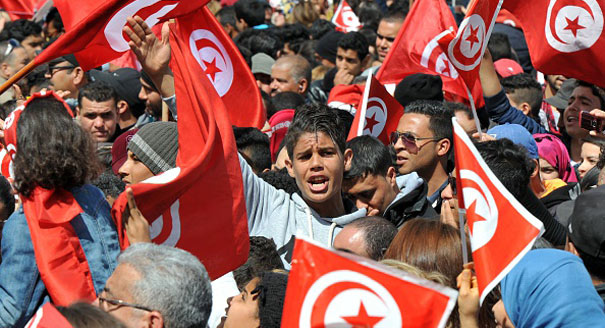
This year’s Nobel Peace Prize confers new responsibilities on Tunisian civil society and, more widely, on all those in charge of the country’s future.
Much has been written in celebration of the awarding of the 2015 Nobel Peace Prize to Tunisia’s National Dialogue Quartet, the ensemble of civil society organizations that played such a crucial part in forging a way forward for their polarized, divided postrevolution country. The prize is a well-deserved recognition of the remarkable courage of those trade unionists, human rights activists, lawyers, and business representatives in getting Tunisia’s main political parties to reach a compromise on the essential pillar of any democracy: the constitution.
Looking ahead, it is worth asking what the Nobel Peace Prize brings to Tunisian civil society, to Tunisia in general, and to the international community.
As for myself, a former diplomat much faulted by the now-defunct police state for talking too much to the Tunisian Human Rights League, one of the members of the quartet, I feel honored to have worked confidently with such dedicated and courageous people. But this is the past.
Now, the Nobel Peace Prize confers new responsibilities on Tunisian civil society and, more widely, on all those in charge of the country’s future. A reward doesn’t change the fundamentals of a country in transition. Tunisia is still facing daunting challenges in terms of economic reforms and income distribution as well as security sector reform.
The broader issue is that Tunisia is split between conflicting views of society, between the conceptions of the future offered by Nidaa Tounes (Call for Tunisia), the main secular party, and by Ennahdha, the Islamist party that was in power from 2011 to 2013. These issues have been abundantly documented, and Tunisian stakeholders, foreign donors, and think tanks alike know well what is at stake.
Tunisia is governed by a coalition that looks like a mutual assurance pact between the two main parties. Although the coalition may seem unsustainable, with rejectionists in each of the two central pillars, it reflects both the clear will of the Tunisian people in the November 2014 election and the distinct ability of political leaders to advance through dialogue and compromise. Yet, liberal democracy is about more than just the ballot box.
The #NobelPeacePrize confers new responsibilities on #Tunisia's civil society.Tweet This
This is where civil society comes in—not just in a one-off exercise like the quartet’s remarkable achievements, but in a lasting, structural way. As I wrote in April 2015, “Because [civil society] actors engineered the transition to democracy and forced politicians to change course, they earned huge credentials and retain significant political legitimacy. These stakeholders now have to decide how they will exercise—individually and collectively—their newly acquired responsibility.”
Tunisian civil society has achieved much: it has done away with the police state and forced opposing political actors into compromises they didn’t like, while preserving the essential values of any liberal democracy, not least on the status and role of women. Political parties showed the courage to heed citizens’ requests.
The quartet invented a Tunisian method for moving toward democracy. This method now needs to become permanent and be enlarged to take the form of an inclusive, consensus-building mechanism geared toward steering a diverse, divided society in a constructive direction. Not a meeting in which politicians dictate, not a caucus in which civil society opposes, but a forum in which all concerned will be able to debate and forge consensus—or at least compromise.
The Nobel Peace Prize also brings responsibilities for Tunisia’s outside supporters: governments, international donors, and think tanks. All have rejoiced, of course: Tunisia’s fragile success is such a gem amid the folly gripping the postrevolution Arab world that every interested foreign interlocutor wants to help. But while helping is fine, smothering is not permitted; rather, modesty is in order.
If there is one lesson in postrevolution Tunisia, if there is one message from the Nobel Peace Prize committee, it is this: Tunisians are a courageous, sophisticated people who surpassed the revolution’s deep divisions and awful murders, and took charge.
Let Tunisians, all Tunisians, lead the way to an inclusive democracy.Tweet This
Let’s not repeat the mistake well-intentioned foreigners too often make by proclaiming, “We Westerners know democracy well, we will show you the way, we will forge your consensus!” Tunisians—liberal and Islamist politicians, civil society groups, and ordinary citizens—are too smart to be satisfied with imported recipes, too proud of their revolution to swallow intellectual contempt.
As I wrote earlier this year, Tunisians are still reeling between pride and anger, between optimism and frustration. Their foreign partners should bring not more frustrations but, on the contrary, discrete help. Let Tunisians, all Tunisians, lead the way to an inclusive democracy.

Senior Fellow, Carnegie Europe
Marc Pierini is a senior fellow at Carnegie Europe, where his research focuses on developments in the Middle East and Turkey from a European perspective.
Recent Work
Marc Pierini
Marc Pierini
Carnegie does not take institutional positions on public policy issues; the views represented herein are those of the author(s) and do not necessarily reflect the views of Carnegie, its staff, or its trustees.

The EU can impose sanctions but struggles to enforce them without the United States. With Washington increasingly disinterested in backing European interests, the bloc must now fend for itself.


Nicu Popescu, Tiago Antunes

Russia is testing the waters of NATO’s mutual defense clause. What do strikes in Romanian territorial waters mean for the alliance’s posture toward Moscow?

Dimitar Bechev

With its public finances in shambles, the far right polling at 35 percent ahead of the 2027 presidential election, and a growing protest movement, is France’s crisis a threat to the EU’s geopolitical awakening?

Rym Momtaz, ed.

Ahead of a tough winter for Ukraine, Donald Trump’s swing back toward Russia bodes ill. But instead of panicking, Kyiv’s European allies are focusing on action.
Rym Momtaz

While the EU and European governments are embracing the much-lauded middle-power moment, this entails three difficult conundrums.

Richard Youngs