

Commentary
Nathalie Tocci, Jan Techau
{
  "authors": [
    "Jan Techau"
  ],
  "type": "commentary",
  "blog": "Strategic Europe",
  "centerAffiliationAll": "",
  "centers": [
    "Carnegie Endowment for International Peace",
    "Carnegie Europe"
  ],
  "collections": [],
  "englishNewsletterAll": "",
  "nonEnglishNewsletterAll": "",
  "primaryCenter": "Carnegie Europe",
  "programAffiliation": "",
  "programs": [],
  "projects": [],
  "regions": [
    "Europe",
    "Western Europe",
    "Germany"
  ],
  "topics": [
    "Foreign Policy"
  ]
}
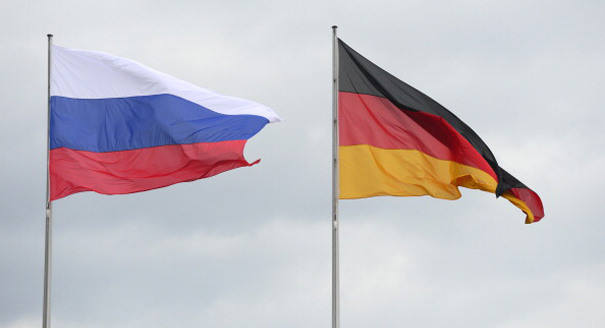
Source: Getty
Dealing with Russia requires not only a soft approach based on trust and common ground. It also needs dialogue and cooperation underpinned by Western strength.
On April 1, I published an April Fools’ Day piece here on Carnegie Europe’s Strategic Europe blog. A lot of people liked it, a good number of quite serious people were hoodwinked by it, and I even received some e-mails with juicy insults, accusing me of things unfit for publication.
One response, however, stood out. It came from a rather famous retired American academic, and his unease about my joking at the expense of German foreign policy was obvious. He wrote:
Mr. Techau’s performance reminds us that the cultivation of suspicion of Germany’s loyalty to “the West” is at least as old as [former German chancellor Konrad] Adenauer’s visit to Moscow in 1955. It coincides with the passing of a very great European, [former German foreign minister] Hans-Dietrich Genscher.
Here, in slightly modified form, is what I wrote back to the retired professor:
You are right, of course, when you say that my piece uses the fear of German unreliability in its commitment to the West as its driver. I have always tried to defend my fellow countrymen from some of the most ludicrous accusations against them, especially when it comes to the alleged closeness of the German political class to Russia. These accusations are often hopelessly overdone, sometimes deliberately so. But at the same time, there are worrying signs that must not be ignored. By highlighting them in an indirect way in my April Fools’ Day joke, I tried to do just that.
There are primarily two aspects of German foreign policy I am concerned about.
First, German Westbindung, or integration with the West, is a fateful question, not just for Germans, but for all of Europe. Yet Westbindung is by no means a done deal. By instinct and in terms of its political culture, Germany is only partly a Western country. Berlin’s big temptation is not going East to Moscow but going it alone, positioning itself as an in-between country, equidistant from Washington and Moscow.
This is a very dangerous temptation. Germany, in my opinion, can be at peace with itself and its neighbors only as long as it is firmly embedded in the family of Western nations, even against some of its political and cultural instincts. So Westbindung needs to be fought for on a daily basis, whether that comes in the framework of Germany’s role in NATO, its essential role in the EU, its performance at the UN, or its role as a security provider in Europe.
Second, and much more importantly, there is a reason why I made the German foreign minister, a Social Democrat, the subject of my joke. In Germany’s political debate, a very narrow, historically warped, and therefore misleading interpretation of Ostpolitik prevails. This misreading is omnipresent in the German debate, across the political spectrum, but Social Democrats in Germany are especially prone to falling for it.
This interpretation essentially believes that the original Ostpolitik of the 1970s was about the soft parts of détente—that it was just about constructive outreach to Russia, offering partnership, finding common ground, building trust, and so forth. This reading overlooks the hard part of the equation, namely that Ostpolitik was possible (and ultimately successful) because it was done from a position of strength, which was provided by the United States via extended deterrence. The common view also likes to ignore the fact that former German chancellor Willy Brandt, Social Democratic politician Egon Bahr, and the other proponents of Ostpolitik had to coordinate every single step very closely with Washington. Bahr was on the phone with former U.S. secretary of state Henry Kissinger all the time.
The current German foreign minister used the myth of this depleted version of Ostpolitik in the speech he gave on assuming the role of chairman in office of the Organization for Security and Cooperation in Europe in January 2016. The problem is that dealing with Russia, in the 1970s as now, does not only require the soft approach. It also needs dialogue and cooperation based on Western strength. That is what happened, at least partly, in the way NATO and the EU responded after Russia’s 2014 annexation of Crimea and aggression in eastern Ukraine.
And yet, this strength is at permanent risk, and many German politicians are creating the impression that Germany can somehow engage Russia based on its goodwill alone and on the assumption that Moscow’s cost-benefit calculations are similar to Berlin’s. They are not. This is why Germany needs to be so careful when it talks about détente while forgetting about the robust side of engagement, which is much less likable than the fairytale version.
And that is why I decided to raise the issue in my April Fools’ Day piece.
Director, Europe Team, Eurasia Group
Techau is director with Eurasia Group's Europe team, covering Germany and European security from Berlin. Previously, he was director of Carnegie Europe.
Recent Work

Nathalie Tocci, Jan Techau
Jan Techau
Carnegie does not take institutional positions on public policy issues; the views represented herein are those of the author(s) and do not necessarily reflect the views of Carnegie, its staff, or its trustees.

The aftermath of the Ceuta crisis shows Europe has drawn the wrong lessons. Rather than doubling down on failed migration policies, the EU needs to address the underlying roots of such episodes.

Richard Youngs

An overwhelming victory by a far-right-wing party in a small state in eastern Germany will have major repercussions for Chancellor Friedrich Merz’s coalition.

Judy Dempsey

Canadian Prime Minister Mark Carney has twice inspired praise for standing up to U.S. President Donald Trump: at the 2026 World Economic Forum in Davos and on Canada-U.S. trade negotiations. Is Carney showing a third way better than the EU has in dealing with the Trump administration?

Rym Momtaz, ed.

The EU’s responses to two recent incidents expose the gulf between European perceptions and capabilities. Unless the union can bridge that gap, it will never become a real geostrategic power.
Rym Momtaz
In supporting Europe’s far-right, MAGA and Russia both want the same thing: a weaker EU. Europe must defend itself without abandoning the openness these forces exploit.

Armida van Rij