

Commentary
Nathalie Tocci, Jan Techau
{
  "authors": [
    "Jan Techau"
  ],
  "type": "commentary",
  "blog": "Strategic Europe",
  "centerAffiliationAll": "",
  "centers": [
    "Carnegie Endowment for International Peace",
    "Carnegie Europe"
  ],
  "collections": [
    "EU Integration and Enlargement",
    "Brexit and UK Politics"
  ],
  "englishNewsletterAll": "",
  "nonEnglishNewsletterAll": "",
  "primaryCenter": "Carnegie Europe",
  "programAffiliation": "",
  "programs": [],
  "projects": [],
  "regions": [
    "Europe",
    "Western Europe",
    "United Kingdom"
  ],
  "topics": [
    "EU"
  ]
}
Source: Getty
Campaigners who want Britain to leave the European Union misunderstand the basic mechanics of globalization.
By now, it has become clear that the heated confrontation in Britain over the issue of Brexit has very little to do with the actual arguments, especially among those who want the UK to leave the European Union when the country votes on the question in a referendum in June. Much of the debate is driven by emotions and by fuzzy but very potent concepts of sovereignty and identity. And yet, it is also interesting to look at the more intellectual, policy-based arguments for Brexit, for they reveal another underlying truth: the Out camp fundamentally misunderstands the central mechanics of globalization.
The analytical case for Brexit boils down to two core arguments: First, it is possible to have greatly beneficial economic integration without political integration. Second, Britain could regain major influence over its own affairs by getting out of the EU. In both cases, the exact opposite is true.
The first argument is based on the old conservative dream of keeping the dirty world of politics out of the honorable, gentlemanly world of business. This is perhaps feasible if economic integration does not go farther than a simple free-trade arrangement. It is not an option once you enter into a highly integrated single market that is not only more complex but also produces a lot more wealth for those in it.
Britain’s excellent commercial instincts have made the country a strong proponent of the EU’s single market. But now, the great champion of capitalism is shocked to learn that the forces unleashed by deep economic interaction among member states make the integrationist logic spill over into the political realm. You can’t have a single market without, in the end, also talking about a more unified approach to taxes, social policies, banking regulation, and labor laws, to name just a few fields under pressure from the sheer forcefulness of integrated capitalism.
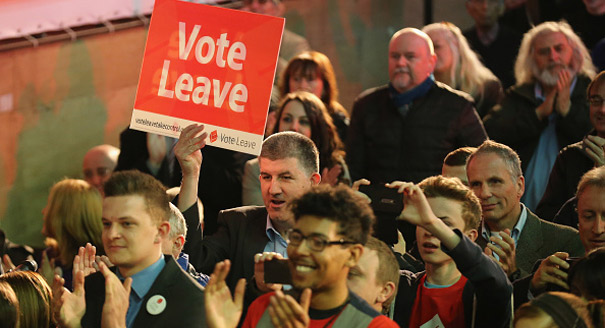
The second argument wants people to believe that the EU has taken away Britain’s ability to get the best possible deal in the world. This is Mayor of London Boris Johnson’s big point when he gives speeches in front of banners reading “Let’s take back control: Vote Leave.” Britain, so the underlying message has it, is controlled by external forces that prevent the country from taking matters into its own hands and, consequently, from flourishing.
It’s not easy to say whether there ever was a time when staying away from the table at which decisions were made was a winning proposition. Would it have been smart for Britain to eschew the Congress of Vienna in 1814–1815 just because binding agreements with the continentals were meant to be made there? This may seem too odd a comparison—but only to those who don’t understand that the EU is in many ways a permanent Congress of Vienna among countries that are interested in keeping Europe from slipping into chaos again.
The #Brexit camp fundamentally misunderstands the mechanics of globalization.Tweet This
In any case, the EU is the dominant political, economic, and regulatory power in Europe today, whether you like it or not. Being in it is the only way to have a say in how it is run and what it produces. Getting out would cost Britain an enormous amount of influence. The UK would lose control if it jumped out, not take control back. No one has phrased this more smartly than former British foreign secretary David Miliband, who wrote in the Guardian: “No nation in human peacetime history has voluntarily given up as much political power as we are being invited to throw away on 23 June.”
When you look at both pro-Brexit arguments carefully, and also at their refutation, then you realize that at the core of the Leave campaign’s reasoning lies an antiglobalization sentiment. The same arguments that Euroskeptics are making against the EU are made by antiglobalization activists against the capitalist, open-market, competition-driven system we call the liberal world order: a loss of sovereignty, nondemocratic rule by faceless powers accountable to no one, and a big unifying force that wipes out national and local traditions in favor of a shallow, globally harmonized mass culture. In both cases, criticism is not entirely unjustified, but flawed at the core and gravely exaggerated.
Anti-EU activists do not realize that the political integration the EU has brought is not the illness but the remedy. This integration is meant to give back to nations and people a say in affairs that are otherwise driven by the anonymous forces of the market—and by other powers that no individual European country has the weight to pit itself against successfully. In other words, the EU is designed to hand nation-states control they would otherwise lose. The EU is not about destroying sovereignty, it is about saving it by way of sharing it.
The EU is not about destroying sovereignty, it is about saving it by sharing it.Tweet This
Just as a globally integrated economy leads directly to questions of global governance—climate change, the fight against terrorism, international trade agreements, the control of weapons of mass destruction, global financial regulation, and so on—so European economic integration leads directly to questions of European governance. But while at the global level, governance is for the most part absent, in the EU a system of governance has been invented that allows even small member states that would otherwise be plowed under to enjoy the blessings of a globalized economy. From a European perspective, therefore, it is intellectually impossible to be in favor of globalization (as many Euroskeptics are) while at the same time being against European integration (as they also are).
If Britain wants to reap all the benefits of globalization while having a say in the way it unfolds and being protected from some of its negative side effects, the country needs to stay in the EU. The price for that will be to accept the sometimes irritating, sometimes tedious company of other Europeans to whom Britain would be bound in a fateful way. And yet, that would still be better than being fatefully unbound. With a sober head and emotions firmly under control (which is what Brits like, presumably), the gains of being in the EU far outweigh the costs. May good old British common sense prevail.

Director, Europe Team, Eurasia Group
Techau is director with Eurasia Group's Europe team, covering Germany and European security from Berlin. Previously, he was director of Carnegie Europe.
Recent Work

Nathalie Tocci, Jan Techau
Jan Techau
Carnegie does not take institutional positions on public policy issues; the views represented herein are those of the author(s) and do not necessarily reflect the views of Carnegie, its staff, or its trustees.

Before the next wave of EU enlargement takes place, the union needs to grapple with thorny questions of how power is distributed among its members.


Emil Sondaj Hansen, Ditte Brasso Sørensen

Are Germany’s economic, industrial, and political struggles becoming a liability for the EU’s ability to rise to the geopolitical moment?

Rym Momtaz, ed.

European Commission President Ursula von der Leyen is about to give her annual address on the state of the EU. Here’s what she won’t—but should—say.
Rym Momtaz

The aftermath of the Ceuta crisis shows Europe has drawn the wrong lessons. Rather than doubling down on failed migration policies, the EU needs to address the underlying roots of such episodes.

Richard Youngs

An overwhelming victory by a far-right-wing party in a small state in eastern Germany will have major repercussions for Chancellor Friedrich Merz’s coalition.

Judy Dempsey