

Commentary
Judy Dempsey
{
  "authors": [
    "Judy Dempsey"
  ],
  "type": "commentary",
  "blog": "Strategic Europe",
  "centerAffiliationAll": "",
  "centers": [
    "Carnegie Endowment for International Peace",
    "Carnegie Europe"
  ],
  "collections": [
    "Europe’s Eastern Neighborhood",
    "EU Integration and Enlargement"
  ],
  "englishNewsletterAll": "",
  "nonEnglishNewsletterAll": "",
  "primaryCenter": "Carnegie Europe",
  "programAffiliation": "",
  "programs": [],
  "projects": [],
  "regions": [
    "Europe",
    "Eastern Europe"
  ],
  "topics": [
    "EU",
    "Democracy"
  ]
}
Source: Getty
Poland’s conservative Law and Justice party has embarked on a deep reform of the state aimed at strengthening the nation’s sovereignty and challenging the EU.
On July 8–9, U.S., Canadian, and European leaders will gather in Warsaw for a NATO summit. The meeting matters a great deal to Poland’s governing conservative Law and Justice party. For the host, the summit is about demonstrating to Russia that the U.S.-led military alliance is now serious about increasing the security of its Eastern European allies.
The summit is also about Poland demonstrating to its allies that it is a significant player in NATO. It has committed to spending 2 percent of its GDP on defense, one of the pledges that was made at the September 2014 NATO summit in Wales but that only a few NATO members have met. Poland has also embarked on a long-term program to modernize its armed forces through investing heavily in equipment, training, and infrastructure. This is good news for NATO.
But Poland’s commitment to NATO is at odds with its view of the European Union. Joining these two organizations was the country’s goal after 1989. Now, over a quarter of a century later, Poland is undertaking a radical change of direction that will have profound implications for the country and major repercussions for the EU.
It is a policy aimed at giving the government and state more control over the economy, making the country less dependent on foreign ownership, and putting the nation at the center of political, social, and economic policies. It’s a gamble because it could lead to Poland losing influence among the big EU member states.
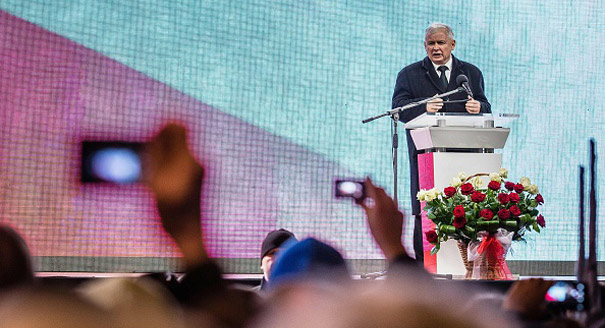
Guiding these changes is Jarosław Kaczyński, the leader of Law and Justice. These moves, which are already affecting the independence of the Constitutional Tribunal and the media, are supposed to bolster the nation.
For Law and Justice, the two most important features of a full-fledged nation are sovereignty and empowerment. “The nation is above all an organic cultural and historical community, not a political entity (a community of citizens),” write the authors of a new report on Poland published by the Stefan Batory Foundation, which is based in Warsaw.
In practice, this ideology could lead to a profound change of Poland’s role in the EU and in Central Europe, turning it from an outward-looking country to one more focused on itself and on like-minded governments in the region.
“The emphasis on the specific nature of Polish historical experience, the significance of the Catholic religion to the national identity . . . as well as the value of cultural and ethnic homogeneity, is an expression of the belief that this model of ‘Polishness’ ought to be defended above all else,” argue the authors of the report.
For the Law and Justice elite, this sense of Polishness was undermined—or at least weakened—when Poland’s post-1989 governments made it their priority to join the EU. For Law and Justice, it was as if identity and the nation had been subsumed by EU membership and the Western model of modernization. Poland had never had the chance since 1939 to articulate its identity and nationhood.
Law and Justice has sought to redress this since being swept into power in October 2015. Since then, the party has questioned “the political model based on liberal democracy and socio-cultural values dominant in Western Europe seen as a threat to traditional Polish values.”
Indeed, Kaczyński has argued that it is Poland that is the defender of real freedom. “In the defence of religion that is threatened in western Europe, defending real freedom of speech, Poland is also defending what is best in European tradition: true freedom of speech. It is us who are the bulwark of real Europe.”
It would be unwise to dismiss these statements. Law and Justice has moved with lightning speed to consolidate its power. Moreover, its policies are similar to those being pursued by Hungarian Prime Minister Viktor Orbán and his right-wing Fidesz party. The Stefan Batory Foundation report makes the point that both Fidesz and Law and Justice identify more with the majoritarian model of democracy than with the pluralistic model. Again, the role of the nation takes center stage, while the writ of the EU is challenged.
Law and Justice intends to expand its influence when on July 1 it takes over the presidency of Visegrád group, which as well as Poland also includes the Czech Republic, Hungary, and Slovakia. The idea is to give the region more clout when it comes to influencing EU policy.
This is a big change of emphasis for Poland. After 1990, and particularly during the center-right Civic Platform party’s stint in power from 2007 to 2015, Poland’s foreign and economic policy was outward-looking and proactive. Law and Justice’s more inward-looking ideology could reduce Poland’s influence in the EU. Law and Justice officials argue the contrary: Poland’s new direction would find sympathizers in the region.
For all its criticism of the EU as a model, Law and Justice and Fidesz realize that the modernization of their countries could not have taken place without foreign investment and, particularly, the EU’s structural funds. For the period from 2014 to 2020, Poland has been allocated €86 billion ($97 billion) in structural and rural development funds. To put that figure in context, that amounts to 2.7 percent of GDP.
Any thought of leaving the EU—as the UK is contemplating—is certainly not in the cards for Poland. But the country’s concept of nationhood and sovereignty run counter to a more integrated Europe, which Poland once supported. It’s as if Poland were looking back to a more distant past while undoing some of its fine achievements since 1989.

Nonresident Senior Fellow, Carnegie Europe
Judy Dempsey is a nonresident senior fellow at Carnegie Europe
Recent Work
Judy Dempsey
Judy Dempsey
Carnegie does not take institutional positions on public policy issues; the views represented herein are those of the author(s) and do not necessarily reflect the views of Carnegie, its staff, or its trustees.

While the EU and European governments are embracing the much-lauded middle-power moment, this entails three difficult conundrums.

Richard Youngs

Much has been said of the changes Brussels is trying to make to the EU enlargement process. Here’s why gradual integration might—or might not—be the answer.

Dimitar Bechev

The European Commissioner for Trade is headed to China. But after President Xi’s bridge-building visit to Washington, can a more isolated EU overcome Beijing’s stranglehold on critical raw materials? Who will blink first?

Rym Momtaz, ed.

The domestic impacts of how long it is taking to end the war in Ukraine have pushed the French electorate to the political extremes and compromised the country’s diplomatic capacity.
Rym Momtaz

Before the next wave of EU enlargement takes place, the union needs to grapple with thorny questions of how power is distributed among its members.


Emil Sondaj Hansen, Ditte Brasso Sørensen