

Commentary
Judy Dempsey
{
  "authors": [
    "Judy Dempsey"
  ],
  "type": "commentary",
  "blog": "Strategic Europe",
  "centerAffiliationAll": "",
  "centers": [
    "Carnegie Endowment for International Peace",
    "Carnegie Europe"
  ],
  "collections": [
    "EU Integration and Enlargement"
  ],
  "englishNewsletterAll": "",
  "nonEnglishNewsletterAll": "",
  "primaryCenter": "Carnegie Europe",
  "programAffiliation": "",
  "programs": [],
  "projects": [],
  "regions": [
    "Europe",
    "Western Europe",
    "France"
  ],
  "topics": [
    "EU",
    "Political Reform"
  ]
}
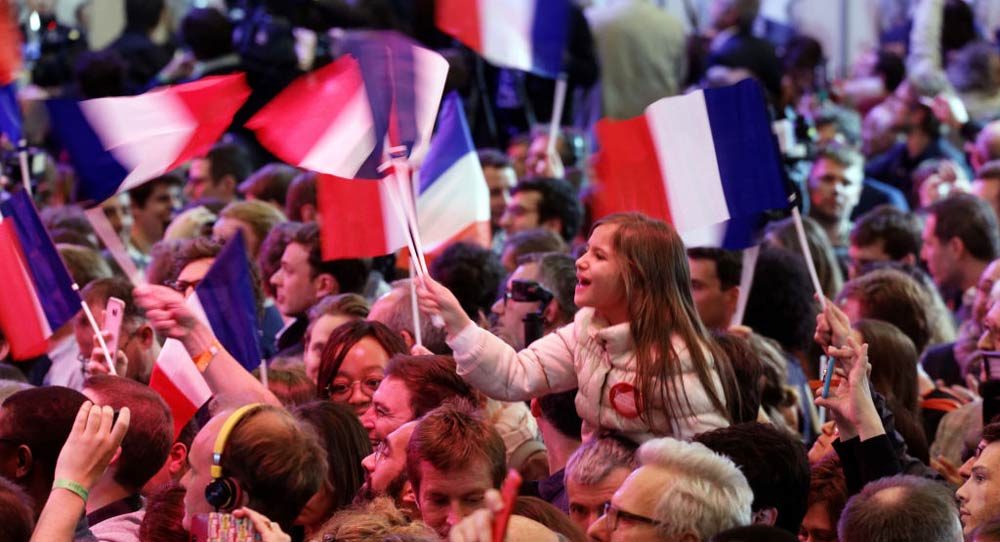
Source: Getty
The selection of the next president of France will have profound implications for the country, for Europe, and for the Western liberal order.
France is on the cusp of a new era. In less than two weeks, the country’s citizens will know whether they will be led by Marine Le Pen or Emmanuel Macron. Whom they choose will shape France’s future in Europe and the West.
The choice is as stark as it is frightening and exciting. Le Pen, whose far-right National Front won 22 percent of the vote and came second in the first round of the presidential election on April 23, represents a brand of European populism that is inward looking, anti-immigration, and anti-EU to the extent that her supporters believe that France can go it alone. “French voters must seize this opportunity . . . globalization has put our civilization in danger,” Le Pen said after preliminary results came through.
Macron, whose centrist movement En Marche ! (On the Move!) just less than a year ago consisted of a motley group of idealistic, energetic young people, wants France to regain its place in Europe and the world. That means ending the economic, social, and political paralysis in this founding member of the EU. It also means relaunching a liberal agenda for France whose spillover to other parts of Europe should not be underestimated.
By winning 24 percent of the vote in the first round, Macron showed that the French do want change. “The people of France wanted change so badly . . . In one year we have entirely changed the French political situation,” Macron told his supporters.
The fact that Macron never once shied away from campaigning for Europe demonstrates that Europe matters to France as much as France matters to Europe. In this regard, the differences between Le Pen and Macron couldn’t be clearer. What happens on May 7, the date of the second-round runoff, will affect Europe and the Western liberal order in several ways.
Now that the EU is bidding farewell to Britain and, with it, British influence, which had in any case been declining over the past few years, it falls to France to ensure that Europe can move forward. France cannot do that with a weak economy, an atrophying political class, and a miserable integration policy. Paris also needs its traditional ally, Berlin, to move the EU forward. Germany is neither willing nor able to go it alone.
Macron has promised to repair all these things if he wins. These steps will take time to implement. But the point is that a Macron victory would change the dynamics of Europe. The EU’s center of gravity, which had shifted to Berlin in recent years because of France’s weakness, could be reset.
Were that to happen, that shift could also inject much-needed energy into Europe’s underperforming foreign, security, and defense policies. Macron’s advisers have no illusions about the need for Europe to cooperate much more closely to deal with terrorism, share intelligence, ensure highly trained security forces, and develop credible defense structures. Recent terrorist attacks in Berlin, Brussels, London, Nice, and Paris not only infiltrated Europe’s comfort zone. They also confirmed the need for a more politically integrated Europe.
Yet Macron’s advisers know too that the way democracy operates in Europe is bordering on dysfunction. The ritualistic visit to polling stations once every four years is no longer adequate on the national or the European level. Yes, the voters confer legitimacy. But low voter turnouts across many EU member states repeatedly confirm the disconnect between citizens and the elites, which populist movements have been able to exploit.
In France, the high turnout of 79 percent on April 23 may have bucked that trend. The high participation rate was due to several factors. The stakes were tremendous. Macron and Le Pen mobilized the grass roots. The French wanted to vote against a self-perpetuating establishment. In the end, they opted for two different political philosophies that either challenge or take forward France’s liberal traditions. Macron and Le Pen offered them that choice.
Le Pen’s policies challenge not only the establishment but also France’s position in Europe. Her France—if she is to be believed—would be closed to its allies and to the world, even though much of the country’s economy depends on exports, while its security and defense require special cooperation with NATO, the United States, and its European partners. A Le Pen presidency would weaken France and possibly sign the EU’s death warrant. Such are the choices facing France and Europe.
This blog post is the fifth in a set of contributions providing insights into the 2017 French presidential election.

Nonresident Senior Fellow, Carnegie Europe
Judy Dempsey is a nonresident senior fellow at Carnegie Europe
Recent Work
Judy Dempsey
Judy Dempsey
Carnegie does not take institutional positions on public policy issues; the views represented herein are those of the author(s) and do not necessarily reflect the views of Carnegie, its staff, or its trustees.

Are Germany’s economic, industrial, and political struggles becoming a liability for the EU’s ability to rise to the geopolitical moment?

Rym Momtaz, ed.

European Commission President Ursula von der Leyen is about to give her annual address on the state of the EU. Here’s what she won’t—but should—say.
Rym Momtaz

The aftermath of the Ceuta crisis shows Europe has drawn the wrong lessons. Rather than doubling down on failed migration policies, the EU needs to address the underlying roots of such episodes.

Richard Youngs

An overwhelming victory by a far-right-wing party in a small state in eastern Germany will have major repercussions for Chancellor Friedrich Merz’s coalition.
Judy Dempsey

Canadian Prime Minister Mark Carney has twice inspired praise for standing up to U.S. President Donald Trump: at the 2026 World Economic Forum in Davos and on Canada-U.S. trade negotiations. Is Carney showing a third way better than the EU has in dealing with the Trump administration?
Rym Momtaz, ed.