

Commentary
Judy Dempsey
{
  "authors": [
    "Judy Dempsey"
  ],
  "type": "commentary",
  "blog": "Strategic Europe",
  "centerAffiliationAll": "",
  "centers": [
    "Carnegie Endowment for International Peace",
    "Carnegie Europe"
  ],
  "collections": [
    "EU Integration and Enlargement"
  ],
  "englishNewsletterAll": "",
  "nonEnglishNewsletterAll": "",
  "primaryCenter": "Carnegie Europe",
  "programAffiliation": "",
  "programs": [],
  "projects": [],
  "regions": [
    "Europe",
    "Eastern Europe"
  ],
  "topics": [
    "EU",
    "Democracy",
    "Civil Society"
  ]
}
Source: Getty
A move by Hungarian Prime Minister Viktor Orbán to control a prestigious university in Budapest is about fear, not education laws.
During the 1970s, a phenomenon was well under way in Czechoslovakia, Hungary, and Poland. Dissidents and academics whose critical, independent stance had no place in official academic life were setting up their own private seminars in their apartments.
These were extraordinary sessions. I remember attending one such seminar in Julius Tomin’s apartment in central Prague. The steely philosopher had attracted the attention not only of the Communist secret police but also of a group of British academics, including several from Oxford University.
The academics joined Tomin as often as they could—which was not easy given the regime’s fear of alternative, autonomous structures. Some, like the British philosopher Roger Scuton, were roughed up. I had met Tomin the day after he had been thrown down a flight of stairs and onto a heap of coal. “I’ll continue teaching,” he told me at the time.
The flying universities, as they were called, had a large following in Poland, which had a long tradition of underground universities. They served to preserve a national identity and culture throughout many occupations. After 1945, these seminars were also aimed at ensuring a space free from Communist indoctrination.
Hungary had these parallel structures too, albeit on a smaller scale. Education and freedom of thought were staunchly defended by young and old, whatever the risks. Those risks ended in 1989 as the Communist system throughout Central and Eastern Europe imploded.
But now in Hungary, Prime Minister Viktor Orbán, who was himself a dissident, has decided to take on the Central European University. The CEU was founded in 1991 by the Hungarian-born philanthropist George Soros, who, by the way, gave Orbán the chance in the early 1990s to study for a short time in Oxford. But now the university has become Orbán’s bête noire.
The official reason is that the CEU, which is registered in the United States and accredited in Hungary, does not comply with Hungary’s education laws. A bill that was passed by the Hungarian parliament on April 4 forbids the university from issuing its American degrees. Under the law, the CEU will have to open a campus in the United States, and the Budapest institution will be put under the control of the Hungarian government.
For Michael Ignatieff, the CEU’s rector and president, there is a different agenda at play. “The government would have the power to deny work permits to faculty members from outside the European Union and use the visa system to restrict the university’s ability to choose its students,” he wrote on April 2.
Other countries, notably Britain, are making the costs of higher education prohibitive not only for their own citizens but for foreigners too. The latter are also saddled with increasing restrictions to study in Britain. But the difference between Britain’s and Hungary’s policies is that Orbán, who intends to restrict the activities of some other higher-education institutions too, is pursuing a campaign against Soros.
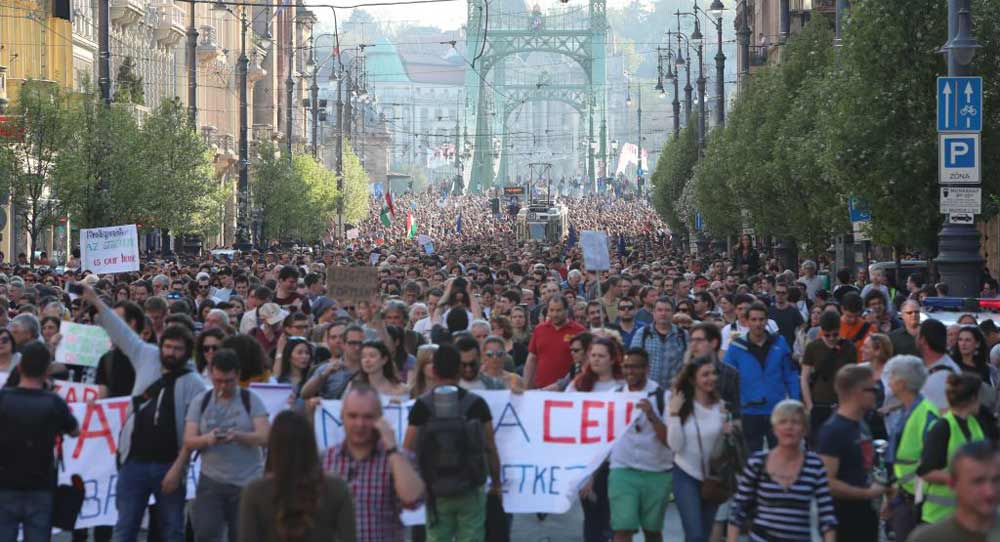
Orbán’s change to the education regulations has not gone unchallenged. Several thousands marched past the CEU’s campus on April 2 in support of the institution. And academics from across the world, many of whom have worked for or were educated in the CEU, have protested. Such support for the CEU is unlikely to fade.
Responding to the domestic and international reactions, Orbán said on April 3, “The Hungarian government – and also, I am sure, the Government of the United States of America, will be motivated by good intentions, so there is no need for alarm on anyone’s part.”
There is need for alarm. Over the centuries, universities across Central Europe have struggled to preserve their centers of excellence and integrity. And when it became intolerable for some academics to continue teaching, they either retreated to the flying universities or emigrated.
This is what is happening in Belarus, where students critical of the regime of President Alexander Lukashenko find support to study in neighboring Poland or Lithuania and receive support from the EU. But in Hungary? Is Orbán really afraid of a campus that attracts students and lecturers from across the world and that spawns ideas, curiosity, and independence?

Nonresident Senior Fellow, Carnegie Europe
Judy Dempsey is a nonresident senior fellow at Carnegie Europe
Recent Work
Judy Dempsey
Judy Dempsey
Carnegie does not take institutional positions on public policy issues; the views represented herein are those of the author(s) and do not necessarily reflect the views of Carnegie, its staff, or its trustees.

The aftermath of the Ceuta crisis shows Europe has drawn the wrong lessons. Rather than doubling down on failed migration policies, the EU needs to address the underlying roots of such episodes.

Richard Youngs

An overwhelming victory by a far-right-wing party in a small state in eastern Germany will have major repercussions for Chancellor Friedrich Merz’s coalition.
Judy Dempsey

Canadian Prime Minister Mark Carney has twice inspired praise for standing up to U.S. President Donald Trump: at the 2026 World Economic Forum in Davos and on Canada-U.S. trade negotiations. Is Carney showing a third way better than the EU has in dealing with the Trump administration?

Rym Momtaz, ed.

The EU’s responses to two recent incidents expose the gulf between European perceptions and capabilities. Unless the union can bridge that gap, it will never become a real geostrategic power.
Rym Momtaz

In supporting Europe’s far-right, MAGA and Russia both want the same thing: a weaker EU. Europe must defend itself without abandoning the openness these forces exploit.

Armida van Rij