

Commentary
Judy Dempsey
{
  "authors": [
    "Judy Dempsey"
  ],
  "type": "commentary",
  "blog": "Strategic Europe",
  "centerAffiliationAll": "",
  "centers": [
    "Carnegie Endowment for International Peace",
    "Carnegie Europe"
  ],
  "collections": [
    "EU Integration and Enlargement",
    "Brexit and UK Politics"
  ],
  "englishNewsletterAll": "",
  "nonEnglishNewsletterAll": "",
  "primaryCenter": "Carnegie Europe",
  "programAffiliation": "",
  "programs": [],
  "projects": [],
  "regions": [
    "Europe",
    "Western Europe",
    "United Kingdom"
  ],
  "topics": [
    "EU"
  ]
}
Source: Getty
Britain’s decision to leave the European Union could spur the unification of Ireland and the breakup of the United Kingdom.
Just weeks before the British held a referendum in June 2016 on whether to leave the EU, Irish diplomats were extremely anxious. They knew what was at stake if the British chose to quit the bloc. It wasn’t just Ireland’s future economic and trade relationship with Britain or the ramifications for the rest of the EU. It was the future of the Good Friday Agreement, that extraordinary accord forged in 1998 by the Irish and British leaders with immense assistance from the United States and, of course, from the leaders of the nationalist and unionist communities in Northern Ireland.
Nearly twenty years on, the Good Friday Agreement is back in the limelight, no thanks to the British government. “British diplomats seemed completely unaware of the implications for Northern Ireland if Brexit were to happen,” an Irish diplomat explained before the referendum. “When we tried to bring up the issue, there was no response. It was as if Northern Ireland wasn’t on their agenda,” he added.
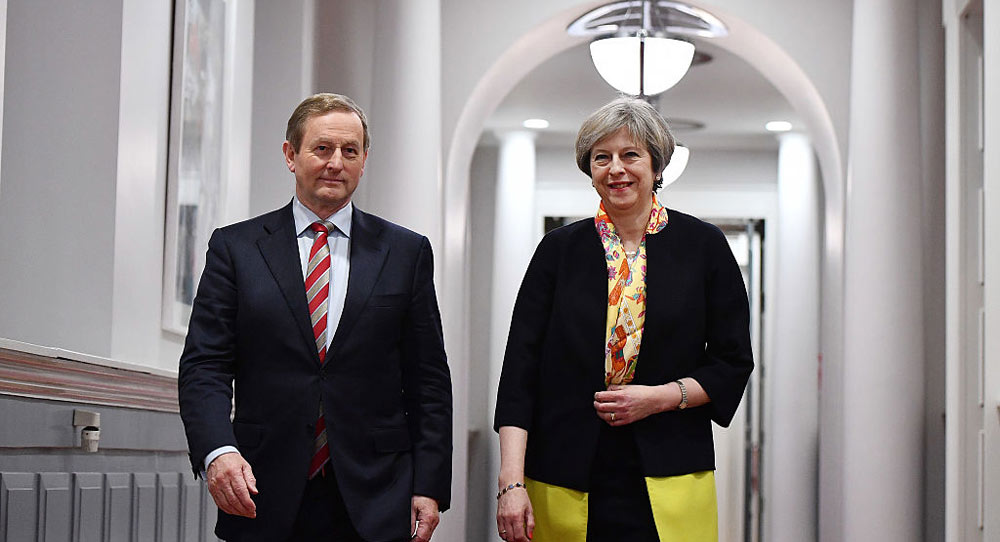
It is now—and not only for British Prime Minister Theresa May’s Conservative government. On April 29 during a summit in Brussels, the other 27 EU leaders endorsed the so-called Kenny text, named after the Taoiseach, or Irish prime minister, Enda Kenny. It’s a very short text, but the content cannot be overestimated.
It reads: “The European Council acknowledges that the Good Friday Agreement expressly provides for an agreed mechanism whereby a united Ireland may be brought about through peaceful and democratic means. In this regard, the European Council acknowledges that, in accordance with international law, the entire territory of such a united Ireland would thus be part of the European Union.”
Were that to happen, the integrity of the UK as we know it today would be over. Indeed, it is already being threatened by the Scots, who intend to hold another referendum on whether to remain a part of the UK. But the difference between Scotland and Northern Ireland is that the Good Friday Agreement sets out the terms for any agreed and eventual unification of the two parts of Ireland.
The accord states that it is up to the people of the island of Ireland alone, “by agreement between the two parts respectively and without external impediment, to exercise their right to self-determination on the basis of consent, freely and concurrently given, North and South, to bring about a united Ireland, if that is their wish, accepting that this right must be achieved and exercised with and subject to the agreement and consent of a majority of the people of Northern Ireland.”
Such language might have been rhetorical back in 1998. But in practical terms, the Good Friday Agreement put in train several important developments. Over time, the heavily fortified border between Northern Ireland and the republic has all but disappeared. There is now a seamless link between the two parts of the island. Tens of thousands of people commute each day across the border to work in the North or the South.
Furthermore, the agreement allows the people of Northern Ireland “to identify themselves as Irish or British, or both, as they may so choose and accordingly confirm that their right to hold both British and Irish citizenship is accepted by both governments and would not be affected by any future change in the status of Northern Ireland.” Over 1.8 million people in Northern Ireland are entitled to Irish citizenship.
This is where Brexit kicks in. Kenny has spent the past several months explaining to EU leaders, particularly German Chancellor Angela Merkel, why Northern Ireland and the republic cannot afford a so-called hard border. It would potentially undermine the Good Friday Agreement, which aimed precisely at creating a soft border to foster confidence, trade, cultural and social ties, and shared security.
Just in case the British government has forgotten this fact, in Northern Ireland, a majority of over 55 percent voted in the June 2016 referendum to stay in the EU. And because of the uncertainty of Brexit for their future, there been a huge increase in people from Northern Ireland and the rest of the UK applying for Irish passports. In January 2016, there were 3,973 applications from Northern Ireland and 3,525 from Great Britain. In January 2017, the numbers jumped to 7,045 and 6,026, respectively.
Irish unification is not going to happen overnight, nor is it a foregone conclusion. Despite nearly two decades of (often unstable) peace, reducing hatred and barriers between the mainly Catholic nationalists and largely Protestant unionists will take at least a generation to overcome. As it is, high concrete walls still divide the communities, just as there are some suspicions of the intentions of the Dublin government. An opinion poll in September 2016 showed that a clear majority in Northern Ireland would vote to remain in the UK, while just over one-fifth would support a united Ireland.
Those numbers could change, depending on the outcome of the Brexit negotiations. But by making Northern Ireland a European, not a British issue, EU leaders recognize the vulnerability of the Good Friday Agreement, the fear of instability, and the doubts about the integrity of the United Kingdom.

Nonresident Senior Fellow, Carnegie Europe
Judy Dempsey is a nonresident senior fellow at Carnegie Europe
Recent Work
Judy Dempsey
Judy Dempsey
Carnegie does not take institutional positions on public policy issues; the views represented herein are those of the author(s) and do not necessarily reflect the views of Carnegie, its staff, or its trustees.

Are Germany’s economic, industrial, and political struggles becoming a liability for the EU’s ability to rise to the geopolitical moment?

Rym Momtaz, ed.

European Commission President Ursula von der Leyen is about to give her annual address on the state of the EU. Here’s what she won’t—but should—say.
Rym Momtaz

The aftermath of the Ceuta crisis shows Europe has drawn the wrong lessons. Rather than doubling down on failed migration policies, the EU needs to address the underlying roots of such episodes.

Richard Youngs

An overwhelming victory by a far-right-wing party in a small state in eastern Germany will have major repercussions for Chancellor Friedrich Merz’s coalition.
Judy Dempsey

Canadian Prime Minister Mark Carney has twice inspired praise for standing up to U.S. President Donald Trump: at the 2026 World Economic Forum in Davos and on Canada-U.S. trade negotiations. Is Carney showing a third way better than the EU has in dealing with the Trump administration?
Rym Momtaz, ed.