

Commentary
Marc Pierini
{
  "authors": [
    "Marc Pierini"
  ],
  "type": "commentary",
  "blog": "Strategic Europe",
  "centerAffiliationAll": "",
  "centers": [
    "Carnegie Endowment for International Peace",
    "Carnegie Europe",
    "Carnegie Russia Eurasia Center"
  ],
  "collections": [
    "Turkey’s Transformation"
  ],
  "englishNewsletterAll": "",
  "nonEnglishNewsletterAll": "",
  "primaryCenter": "Carnegie Europe",
  "programAffiliation": "",
  "programs": [],
  "projects": [],
  "regions": [
    "Europe",
    "Türkiye",
    "Middle East"
  ],
  "topics": [
    "EU",
    "Foreign Policy"
  ]
}
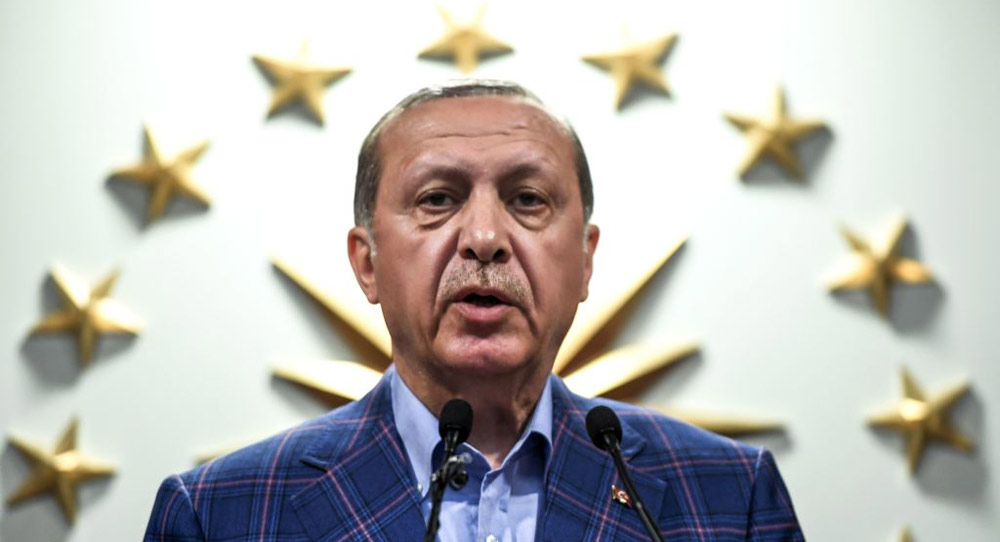
Source: Getty
The consequence of Turkey’s April 16 referendum result is that in foreign policy, the country will now resemble a Central Asian republic more than a European democracy.
A revolution has just occurred in Turkey, where the president declared victory in the April 16 referendum and will now transform the country’s constitution to obtain sweeping executive powers. The victory was a meager 51 percent, compared with his declared ambition of 60 percent. But the fact is that Recep Tayyip Erdoğan has now become the absolute ruler of Turkey. By the same token, he has taken his country away from the prospect of a close political alliance with the EU. That may suit both sides, but not Turkish democracy.
The referendum campaign was tense and unfair. The yes camp benefited from both the state apparatus and the massive machinery of the ruling Justice and Development Party (AKP). The jailed leadership of the pro-Kurdish Peoples’ Democratic Party (HDP) could not campaign. Supporters of a no vote were routinely harassed. The state of emergency in force since the failed coup attempt in July 2016 gave the government additional means of control. And before the vote count started, the Supreme Electoral Council declared invalid ballot papers acceptable. As a result, the referendum result is now contested by both parliamentary opposition parties, the HDP and the Republican People’s Party (CHP).
No matter where these legal complaints end up, the Turkish leader is already forging ahead with the new political setup. The pace is probably more hurried than it would have been after a sweeping victory, because Erdoğan needs to avoid questions about the legitimacy of the change. Such questions will likely linger for a while, especially as they come less than two years after the AKP failed to secure a majority in the June 2015 legislative election and as the no campaign prevailed in the three major cities of Ankara, Istanbul, and İzmir. The Turkish president readily dismissed critical statements by the Council of Europe and the Organization for Security and Cooperation in Europe (OSCE) on April 17.
In addition, Turkey’s state of emergency is being extended, giving the president wide-ranging executive powers while the constitution is modified. In this new Turkey, a more moderate political climate is highly unlikely.
One of the first proclamations made on the evening of April 16 was that the process to reinstate the death penalty will start immediately. There are two possible motivations behind this hasty move. One is to give a clear signal that challenging the Turkish state can lead dissenters to death row. The other is to indirectly trigger a breakup of Turkey’s EU accession negotiations without Ankara formally declaring so. In other words, the “national will”—in AKP parlance—would lead to the reinstatement of the death penalty, and it would then fall on the EU to declare accession talks over. If necessary, the government could call new referenda on both the death penalty and the relationship with the EU.
More generally, EU leaders can expect a harsh narrative from Ankara to become the new normal. After all, during the referendum campaign, several EU leaders were labeled “Nazi remnants” and fascists who could “revive gas chambers,” and the EU was branded a “rotten continent.” An anti-EU discourse is likely to remain a mainstay of Erdoğan’s foreign policy, a useful device to justify a strong leadership.
The United States will not be spared, especially as three pending issues are like open wounds. First, the exiled cleric Fethullah Gülen, who resides in the United States, is unlikely to be extradited to Turkey, as Ankara has requested. Second, the U.S. case now pending before a New York jurisdiction against Turkish businessman Reza Zarrab, who is accused of helping Iran evade international sanctions through a massive gold-trading scheme, remains a painful thorn for the president’s entourage. Third, the divergence between Ankara and Washington on the future military role of the Syrian Kurdish forces known as the People’s Protection Units (YPG) in the Syrian conflict is acute.
While a divided country will keep debating the future of its democracy, what matters for European leaders and citizens is what comes next for Turkey. In foreign policy, bare perceptions come before realities: Turkey will now resemble a Central Asian republic more than an EU democracy. The country will move far away from the EU political standards it once declared as its own ambition, while maintaining that all of this is done in the name of democracy. Beyond controlling political power, a single-person executive regime will help implement a counter-Kemalist revolution (the so-called revenge of the Black Turks) and introduce a religious-conservative societal norm.
In short, with the new constitution, the political project of integrating Turkey into the EU is over. This suits the Turkish leadership, because the slightest move to return to a decent level of rule of law would constitute an obstacle to absolute presidential power. Cynically, this will also suit a number of EU leaders who either have never been convinced of Turkey’s European ambitions or have been dismayed by the wholesale dismantling of the country’s rule of law in the past few years.
A more transactional relationship will now be in order between the EU and Turkey. Priorities will include upgrading the EU-Turkey Customs Union, fostering antiterrorism cooperation, and implementing the tail end of the March 2016 EU-Turkey refugee agreement. The general narrative about sharing EU values and the EU being a strategic objective of Turkey may remain on Ankara’s books, but it will have zero credibility when the constitutional amendments become the law of the land. As an alternative to accession, Brussels could agree on a tailor-made partnership with Ankara in parallel with the new post-Brexit relationship between the EU and the UK. This would have the merit of clearing long-standing ambiguities.
At a personal level, with the exception of NATO and G20 summitry, the prospects of seeing the Turkish president hosted by the European Council are now distant. After Turkey decided to revert to openly hostile language with Europe and shift to an autocratic system, photo opportunities on gilded armchairs will come at a hefty electoral price for EU leaders at home. Despite an EU tradition of going to extreme lengths to try to find accommodations with third parties, high-level meetings with Turkey will become rare. The relationship will stay, but it will become colder.
The remaining challenge will be to preserve the hope of a return—one day—to a more democratic Turkey and not to equate all citizens of Turkey with their leadership. How the EU will continue to extend a hand to Turkish democrats is now a more important question than ever before.

Senior Fellow, Carnegie Europe
Marc Pierini is a senior fellow at Carnegie Europe, where his research focuses on developments in the Middle East and Turkey from a European perspective.
Recent Work
Marc Pierini
Marc Pierini
Carnegie does not take institutional positions on public policy issues; the views represented herein are those of the author(s) and do not necessarily reflect the views of Carnegie, its staff, or its trustees.

The EU can impose sanctions but struggles to enforce them without the United States. With Washington increasingly disinterested in backing European interests, the bloc must now fend for itself.


Nicu Popescu, Tiago Antunes

Russia is testing the waters of NATO’s mutual defense clause. What do strikes in Romanian territorial waters mean for the alliance’s posture toward Moscow?

Dimitar Bechev

With its public finances in shambles, the far right polling at 35 percent ahead of the 2027 presidential election, and a growing protest movement, is France’s crisis a threat to the EU’s geopolitical awakening?

Rym Momtaz, ed.

Ahead of a tough winter for Ukraine, Donald Trump’s swing back toward Russia bodes ill. But instead of panicking, Kyiv’s European allies are focusing on action.
Rym Momtaz

While the EU and European governments are embracing the much-lauded middle-power moment, this entails three difficult conundrums.

Richard Youngs