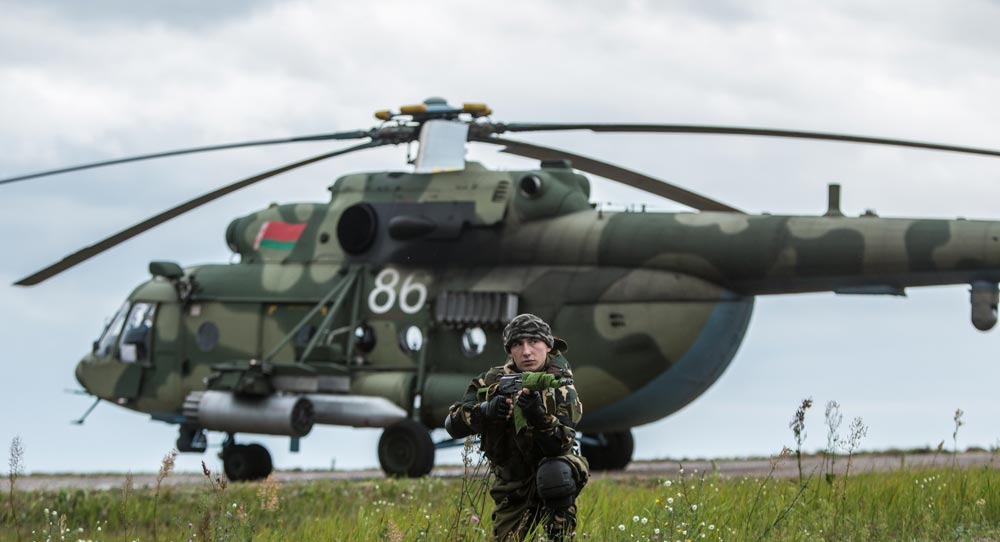
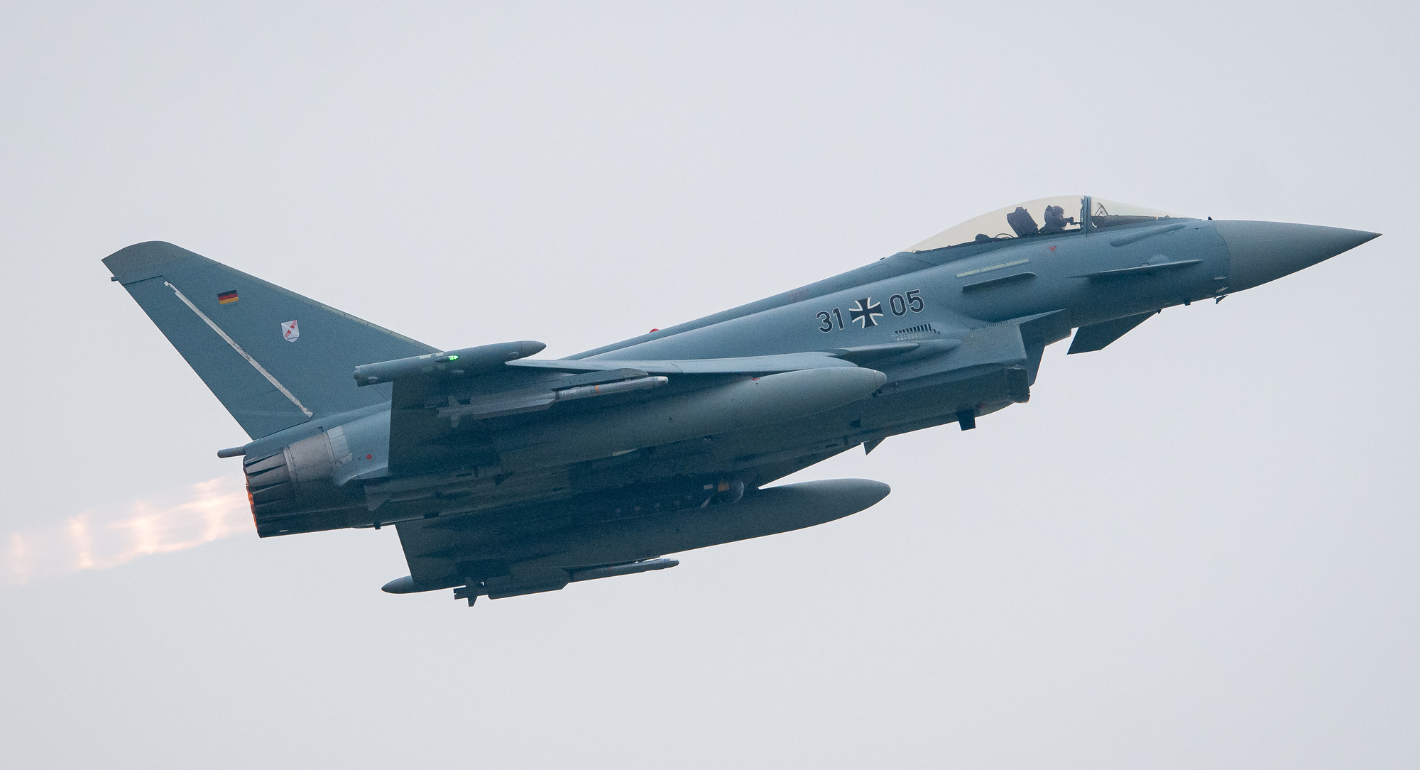
As this posting goes to press, the Zapad 2017 exercise is coming to a close in Belarus, Kaliningrad, the Baltic Sea, and western Russia. The large exercise unfolded over the course of the last week, with some maneuvers occurring within 100 kilometers of Russia’s border with Estonia. Despite disagreement about the precise number of troops involved and concern over whether Moscow will leave some portion of Russian forces in Belarus even after the exercise ends, Moscow has clearly achieved important strategic effects. Media coverage of the scale of the event, the exercise scenario, and the array of offensive capabilities on display have assuredly convinced the Kremlin that a strong deterrent signal has been conveyed to the West. The question NATO must now ask itself is whether it has or can achieve a similar deterrent effect within Moscow.
Of course, it’s impossible to read the minds of Putin and his generals. Nonetheless, the alliance can probably feel confident that it has achieved some deterrent effect through rhetoric, through allied solidarity—witness the many alliance members participating in the enhanced forward presence (EFP) initiative—and through the capabilities displayed in a wide variety of many small and medium-sized exercises.
One area where the West has struggled though is in mounting the kind of capability display similar to Zapad 2017. That is, deploying large-scale combat power from across the continent and across the Atlantic for the purposes of conducting corps-level training, maneuvers, and live fire, all to achieve tactical, operational, and strategic objectives. Conducting such a large-scale training event periodically is necessary, not simply because the alliance has seen its ability to train and fight at the corps level atrophy, but also because of the unmistakable deterrent message to Moscow.
During NATO's Wales Summit in 2014, the alliance agreed to periodically conduct a so-called high-visibility exercise starting in 2015. That training event—Trident Juncture 2015—occurred in October and November 2015, and was hosted by Spain, Portugal, and Italy. Next year, the 2018 iteration will be hosted by Norway. This was a step in the right direction, but it’s insufficient for several reasons.
First, Trident Juncture 2015 wasn’t large enough. Even though it reportedly involved roughly 30,000 allied troops, the exercise was essentially a division-level event. If the West is to turn back a Russian landgrab in the Baltics, significantly larger numbers of troops than a mere division of roughly 10 to 12,000 will be necessary. Instead, NATO should be training as it would fight in the most catastrophic of scenarios—that is, at the corps- or multi-corps-level. And it should feature the United States deploying a division’s worth of troops across the Atlantic.
Second, Trident Juncture is not frequent enough. Russia conducts a strategic-level exercise every year, rotating them among four regions (west, east, southwest, and south-central), thereby ensuring its forces are ready for a strategic-level challenge from nearly any direction. NATO need only be concerned about a strategic-level challenge from a single direction, namely, Russia and its willful disregard for European norms. However, practicing only once every three years for such a challenge is insufficient to build the necessary skills and muscle memory. Instead, NATO ought to conduct a corps- or multi-corps-level exercise every other year.
Finally, Trident Juncture isn’t problematic enough. That is, the scenarios and events encountered by exercise participants aren’t always realistic or reflective of the true challenges they’re likely to face against a near-peer like Russia employing ambiguity, hybrid warfare, anti-access and area denial techniques, and/or advanced long-range systems. For instance, NATO exercises ought to feature delayed political decisionmaking by the NAC; the loss of satellite communications; attacks on critical nodes in the rear due to long-range artillery, drones, and cruise missiles; the jamming of GPS signals; and the loss of commercial power, cellphone networks, and other critical infrastructure. Perhaps as importantly, successful responses to these more problematic exercise scenarios and events ought to be communicated loudly to Moscow, post-exercise, so as to undermine the Kremlin’s confidence in its ability to exploit perceived asymmetric advantages.
Conducting a corps- or multi-corps-level exercise every other year will no doubt cause pain within the alliance for several reasons. For instance, it’s certain to require more resourcing, which may be difficult for some allies to swallow. Second, it’ll require a change in outlook from NATO and especially from Allied Command Transformation (ACT). ACT is responsible for training, and it’s been largely focused on preparing the NATO Response Force (NRF), not on organizing or implementing larger scale exercises. Finally, this may require a change in how the alliance conceptualizes its operational requirements, or what NATO calls its level of ambition.
Despite these hurdles, there are significant benefits to be achieved by conducting a problematized corps- or multi-corps-level training event every other year. Most importantly, the alliance would strengthen lost fighting skills. Any serious challenge by Russia will need to be met by vast numbers of allied troops, and require all of the ingenuity and initiative that differentiate Western militaries from non-Western ones. Conducting a corps- or multi-corps-level exercise every other year would go far in (re)building the proficiency of alliance forces to the level necessary to counter Russia.
Additionally, a problematized corps- or multi-corps-level biennial NATO training event would reassure alliance member states and their citizens. Last year, public reports outlining NATO's inability to adequately defend its most vulnerable member states from a concerted Russia attack significantly undermined assurance—and probably boosted the Kremlin’s confidence. NATO needs to counter it.
Finally, just as Zapad 2017 has done vis-à-vis Western audiences, a problematized corps- or multi-corps-level biennial NATO exercise would send a clear deterrent message to Russia. It would signal that any attempt by Moscow to hand the alliance a fait accompli through a quick grab for the Baltics, or some portion thereof, would be met with a swift and overwhelming response and is therefore unwinnable for Russia.
John R. Deni is a research professor of security studies at the Strategic Studies Institute of the U.S. Army War College and an adjunct professor at the American University’s School of International Service. The views expressed are those of the author and do not necessarily reflect the official policies or positions of the U.S. Department of the Army, the U.S. Department of Defense, or the U.S. government.