

Commentary
There is an elephant in the room when it comes to the EU’s upcoming security strategy: Donald Trump. Unless European leaders acknowledge the depth of the transatlantic crisis, true autonomy will remain out of reach.
Stefan Lehne
{
  "authors": [
    "Gabriele Woidelko"
  ],
  "type": "commentary",
  "blog": "Strategic Europe",
  "centerAffiliationAll": "",
  "centers": [
    "Carnegie Endowment for International Peace",
    "Carnegie Europe"
  ],
  "collections": [],
  "englishNewsletterAll": "",
  "nonEnglishNewsletterAll": "",
  "primaryCenter": "Carnegie Endowment for International Peace",
  "programAffiliation": "",
  "programs": [],
  "projects": [],
  "regions": [
    "Russia"
  ],
  "topics": [
    "EU"
  ]
}
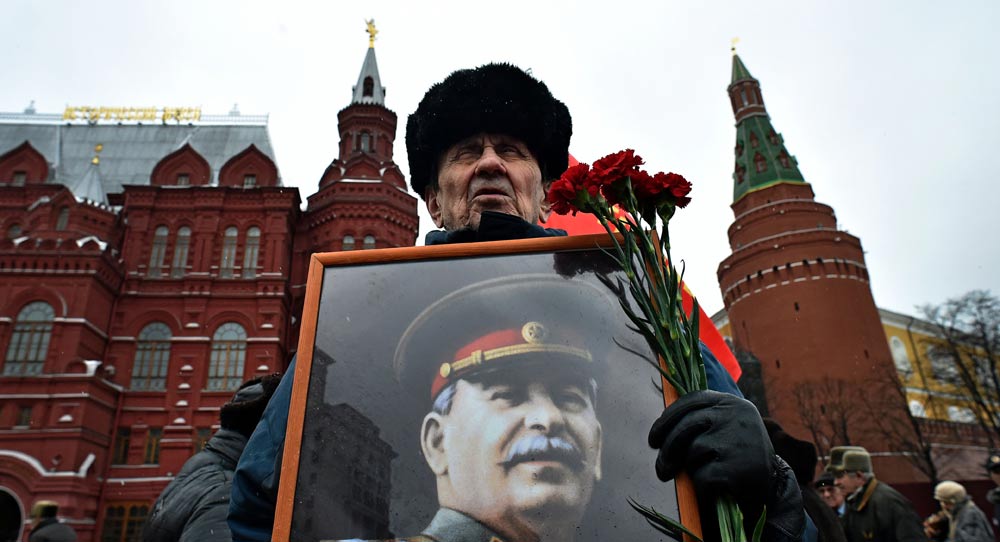
Source: Getty
Creating a unified, streamlined narrative about a country´s glorious and heroic past is one of the most powerful weapons widely used by authoritarian and nationalist governments.
In Russia, President Putin and his government have for the last ten years invested much effort into combining different elements of both the Tsarist and Soviet past into a national history of patriotic pride, bravery, and victory.
This narrative aims to provide a basis for a country that, more than twenty-five-years after the breakup of the Soviet Union, still finds itself in the middle of an unfinished process of nation building. Alas, the governmental version of history is merely eclectic and does not succeed in bridging the huge memory gaps that exist within the post-Soviet Russian society.
Much of Russia’s self-perception and self-confidence as a world power is based on two elements: first, that it is the juridical successor of the USSR and thus the heir of its Soviet imperial ideology; second, that it was victorious in World War II under the leadership of Stalin and thus liberated Europe from Fascism.
Both elements are intertwined and do not only affect Russia’s foreign policy—which sees Soviet successor states like Ukraine, Moldova, and others as part of the Kremlin’s national sphere of interest. They also determine Moscow’s domestic policies by willingly supporting a new Russian patriotism that rehabilitates Stalin as a successful military leader in the current public discourse.
Not surprisingly, in Russian foreign policy, patriotic history based on national exclusiveness and pride has fueled confrontation with neighboring countries such as Ukraine, the Baltic States, and Poland—all of which suffered from the Stalinist dictatorship and Soviet occupation with all its consequences. In Russia, the rehabilitation of Stalin goes hand in hand with minimizing his crucial role as the dictator who killed millions of Russian and Soviet citizens during his reign of almost thirty years.
This part of the narrative is particularly challenging for Russian society, where almost every single family was affected by the Stalinist dictatorship. Memories of family members who became victims of Stalinism are pushed back into the private sphere—a place from where they had only been released in the late eighties and early nineties.
That was when the archives were opened and people started to publicly write and talk about the scars that Stalinism had left in their families and surroundings.
This new atmosphere of silencing contradictory historical narratives about World War II and Stalin, and stigmatizing them as “non-patriotic” and “anti-Russian,” started already around 2008, but gained momentum with the annexation of Crimea.
One of the most telling examples of the Russian government’s increasingly nationalist approach to the history of World War II is the way Moscow deals with the so-called “Molotov-Ribbentrop Pact”—the 1939 nonaggression pact between Hitler and Stalin, and particularly its secret protocol in which the two dictators separated Eastern Europe into spheres of influence.
Both the pact and its secret protocol have been one of the most controversial historical topics in the Soviet Union and continue to be so in post-Soviet Russia, with its emphasis on its victorious battle against National Socialism in Europe.
When in 2009, the European Parliament announced August 23—the day that the Molotov-Ribbentrop Pact was signed—as the “European day of remembrance for the victims of Nazism and Stalinism,” there was an immediate protest from Moscow. The Kremlin’s main argument was that a joint commemoration of victims of both dictatorships would belittle the crimes of National Socialism.
In November 2014, little more than half a year after the annexation of Crimea, Putin defended the Molotov-Ribbentrop Pact in a meeting with Russian academics stating that it was a “payback” for Poland because it incorporated a part of Czechoslovakia when Nazi Germany occupied the country in 1938.
In 2015, during a press conference with German Chancellor Angela Merkel, the Russian president again publicly defended the pact as being crucial for the security of the Soviet Union. With these statements, Putin legitimized both the historical and current policies of “spheres of influence” and occupation.
In today’s Russia, stating that Stalin and Hitler joined forces to attack Poland, carve up Eastern Europe, and start World War II in 1939 is illegal. In July 2016, the blogger Vladimir Luzgin was fined 200, 000 Rubles by the Perm District Court for making such a statement.
In September 2016, the Russian Supreme Court upheld the conviction arguing that it contributed to the “rehabilitation of National Socialism.”
A recent representative poll on the Molotov-Ribbentrop Pact, published by the independent Levada Centre in September 2017, provides evidence of both growing support for the official historical narrative and deepening gaps within Russian society itself.
Whereas 40 percent of the respondents stated that they have already heard about the secret protocol of the nonaggression pact and think that it existed, 17 percent said that they had heard about it but think it is false; 33 percent stated that they had never heard about the pact at all. This means that half of the Russian population has either no knowledge of, or doesn’t believe in, the secret protocol as a historical fact. Keeping in mind that the secret protocol was rediscovered and published in Russia in the early nineties and triggered off a broad debate in Russian society and beyond, the new amnesia is even more alarming.
It is obvious that in Russia reinterpreting history in patriotic terms and creating juridical instruments to punish those who claim a more diverse historical narrative that includes both perpetrators and victims, victories and losses, has encouraged an authoritarian and anti-liberal climate in society. Those who are not in line with the official narrative are stigmatized and attacked. This split in Russian society will be difficult, if not impossible, to overcome in the near future.
Gabriele Woidelko is director of the “Russia in Europe” program at the Körber Foundation in Hamburg.

Gabriele Woidelko
There is an elephant in the room when it comes to the EU’s upcoming security strategy: Donald Trump. Unless European leaders acknowledge the depth of the transatlantic crisis, true autonomy will remain out of reach.

Stefan Lehne
Defense tech innovations will be at the heart of Europe’s new security strategy. But so far, Brussels has been making moves without a broader plan, undermining readiness and credibility.

Raluca Csernatoni
When the U.S.-Iran memorandum of understanding was announced, the UK, France, Germany, and Italy declared their readiness to help demine the Strait of Hormuz and lift nuclear sanctions on Tehran. But does Europe need new tools to recover a diplomatic role?

Rym Momtaz, ed.
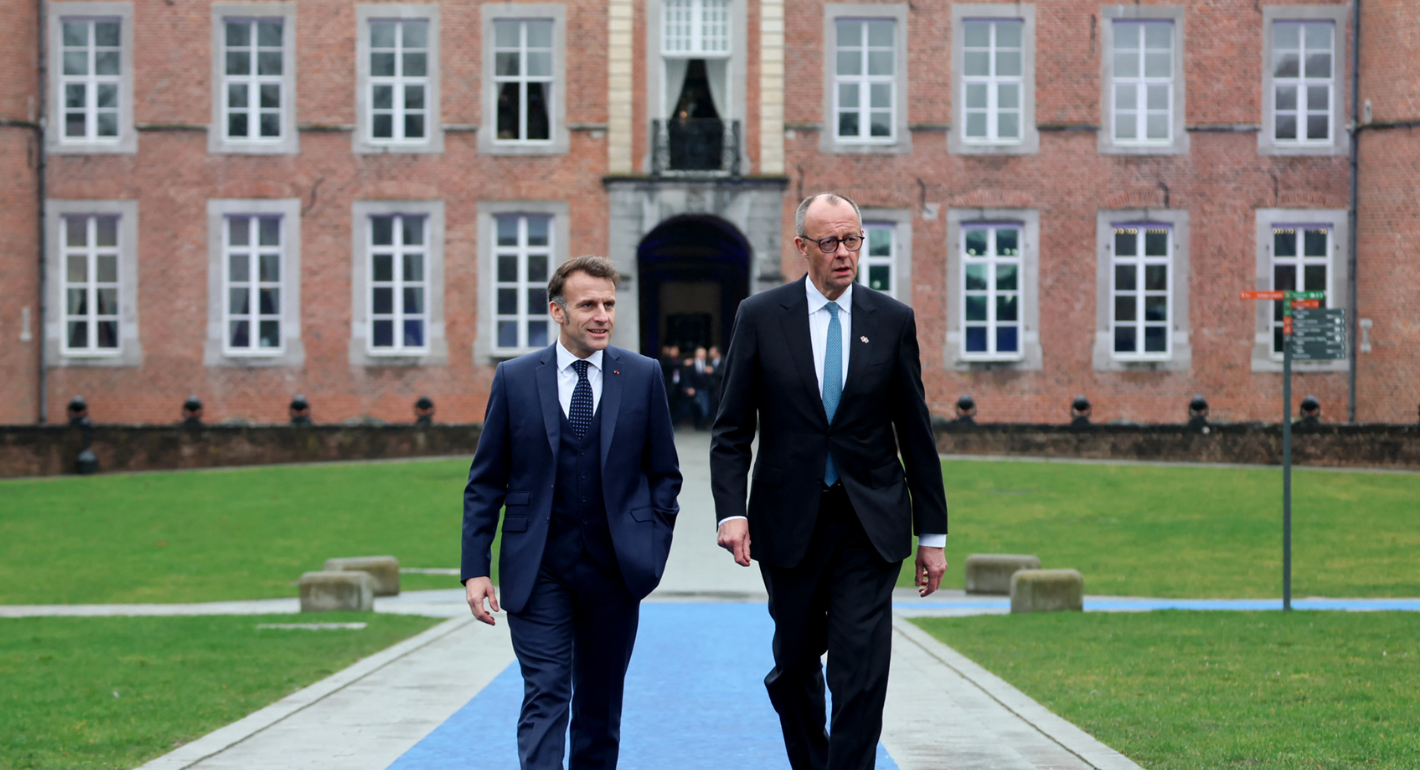
The Franco-German relationship is on the rocks again. But unlike previous moments of tension, the epochal changes on the world stage require that both step up investment in their bilateral ties.
Rym Momtaz
The EU is putting together a new security strategy to meet today’s myriad challenges. But for any proposal to be effective, the union needs to grapple with its identity and ambitions.

Pierre Vimont