

Commentary
Rym Momtaz, ed.
{
  "authors": [
    "Rym Momtaz"
  ],
  "type": "commentary",
  "blog": "Strategic Europe",
  "centerAffiliationAll": "",
  "centers": [
    "Carnegie Endowment for International Peace",
    "Carnegie Europe"
  ],
  "collections": [
    "EU Integration and Enlargement"
  ],
  "englishNewsletterAll": "",
  "nonEnglishNewsletterAll": "",
  "primaryCenter": "Carnegie Europe",
  "programAffiliation": "",
  "regions": [
    "Europe",
    "Western Balkans",
    "France",
    "Germany"
  ],
  "topics": [
    "EU",
    "Foreign Policy",
    "Security",
    "Military"
  ]
}
Source: Getty
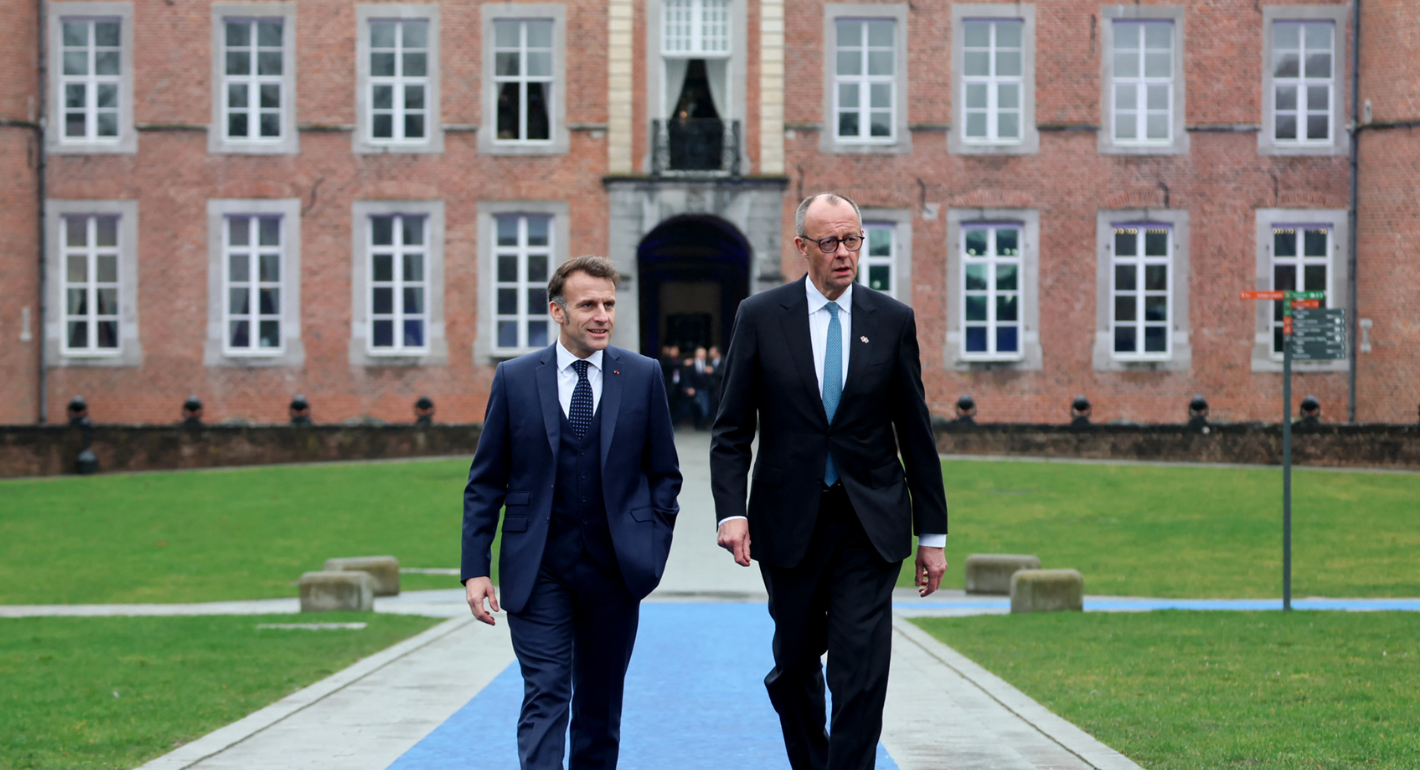
The Franco-German relationship is on the rocks again. But unlike previous moments of tension, the epochal changes on the world stage require that both step up investment in their bilateral ties.
One of the flagship European defense projects came crashing down before it even got close to its first test flight.
The demise of the Franco-German (and Spanish) Future Combat Air System (FCAS), Europe’s fighter jet of the future, has been a long time coming. But the blindsiding cattiness of its announcement was emblematic of the crisis at the heart of relations between the EU’s two pillars. German officials leaked it to the press ahead of the Berlin Air Show, ostensibly in an attempt to open the way for alternative industrial alliances. The move took French officials by surprise, facing a seeming fait accompli. Their subsequent comments to the press squarely blamed Berlin for the project’s breakdown after years of coyly pretending that political will could overcome industrial divorce.
Yet in a way, FCAS is the least fraught divergence afflicting the Franco-German relationship. In any given discussion with officials from either country, on European defense, trade relations with China, energy security, or the relationship with the United States, it doesn’t take long for the finger-pointing and eyerolling to start—and increasingly, the drudging up of historical suspicions that were meant to have been laid to rest through the European project.
To be sure, this isn’t the first—or last—moment of polytension between Paris and Berlin. But the way it is triggering ghosts of traumas past amid an epochal upheaval of the international order sets it apart. To put it mildly, this isn’t the time for old quarrels to take the wind out of both capitals’ sails. Although Brussels has grown accustomed to navigating this stormy relationship, it needs both powers to pull in the same direction if it wants to save any chance Europeans may have of standing their geopolitical ground. While other member states like Denmark, Estonia, Finland, or Poland are stepping up to the geopolitical moment, without fixing the Franco-German dysfunction, the EU cannot fire on all cylinders.
The gravity and uniqueness of the moment is front of mind in both capitals, but Paris and Berlin continue to be two ships passing in the night. Their timing always seems to be off. They are constantly fighting against the mismatched temperaments of their leaders, their orthogonal domestic politics, and the irreconcilably diverging strategic cultures at the heart of their deep states. It is time for both systems to come together and build a bilateral institutional framework—a sort of permanent Franco-German situation room whose daily job it is to ensure the two are never too far out of step with each other.
This would require that both countries designate their relationship as a matter of national security and dedicate the appropriate staffing and political bandwidth to its daily maintenance. It would have to be a whole-of-system approach, from politics to defense, with industry and business at the center—like an orchestra conductor bringing harmony in seemingly dissonant instruments. Without that, both systems will continue to woefully mystify each other despite decades of European construction.
In Berlin, the Zeitenwende has awoken, at least in some quarters, a desire to come out from under Paris’s strategic dominance and be more than just be the purse of the union. Yet, German strategic thinking is still crippled by an inability to think outside the American security guarantee, the diktats of German industry, and fiscal orthodoxies. It is also still unable to overcome its bristling at France’s disarrayed finances and recognize that part of those fiscal woes result from the country’s project to build energy independence and defense capabilities that Berlin is still struggling to match.
In Paris, policymakers across the spectrum shudder at every encounter with this increasingly assertive Berlin. It has become increasingly commonplace to hear a passing remark in reference to past German sins against its European neighbors. And the prospect of Germany regaining its position atop the military scoreboard—at least by the budgetary numbers—is not exactly a welcome development west of the Rhine. But in their irritation, French policymakers are bristling first and foremost at their fleeting means and power. Germany’s resurgence doesn’t have to be at the expense of Paris.
Even with a German Chancellor committing two cardinal sins: heavily borrowing from the French geopolitical canon, and declaring the need to be independent from the United States—and even with the extension of French nuclear deterrence—the two countries have remained out of step on the best way forward on European defense, the relationship with Washington, and trade.
The need to step up and shoulder more of the continent’s security has awoken enmity that the United States had pacified for decades through its role as the reliable outside arbiter, underwriter of European security, and NATO glue. The United Kingdom’s exit from the EU took away another safety valve in the dynamic that hasn’t been—and isn’t being—replaced by attempts to bolster the Weimar Triangle with Poland.
Not everything is broken between Berlin and Paris. Despite heightened tensions, they established a nuclear steering group in March, 2026, to engage in doctrinal dialogue on conventional, missile defense, and French nuclear capabilities—a move which had long been anathema to Germany. The two countries have also been increasingly cooperating in the fields of AI and quantum computing, among other tech areas. These are strategic fields where means, scale, and speed are determinant to ensuring Europeans aren’t left in the dust by the United States and China.
When they have found a sweet spot, France and Germany have produced transformational breakthroughs like the post-Covid-19 recovery fund. The fund would have been historic at any other moment since the inception of the union, but its fleeting impact encapsulates both how high the bar has been set and the need for follow-up mechanisms to deepen these fleeting moments and transform them into the driving force the EU still lacks.
Subscribe to Strategic Europe, delivered every Tuesday and Thursday!

Editor in Chief, Strategic Europe
Rym Momtaz is the editor in chief of Carnegie Europe’s blog Strategic Europe. A multiple Emmy award-winning journalist-turned-analyst, she specializes in Europe and the Middle East and the interplay between those two spaces.
Recent Work
Rym Momtaz, ed.
Rym Momtaz
Carnegie does not take institutional positions on public policy issues; the views represented herein are those of the author(s) and do not necessarily reflect the views of Carnegie, its staff, or its trustees.

With its public finances in shambles, the far right polling at 35 percent ahead of the 2027 presidential election, and a growing protest movement, is France’s crisis a threat to the EU’s geopolitical awakening?
Rym Momtaz, ed.

Ahead of a tough winter for Ukraine, Donald Trump’s swing back toward Russia bodes ill. But instead of panicking, Kyiv’s European allies are focusing on action.
Rym Momtaz

While the EU and European governments are embracing the much-lauded middle-power moment, this entails three difficult conundrums.

Richard Youngs

Much has been said of the changes Brussels is trying to make to the EU enlargement process. Here’s why gradual integration might—or might not—be the answer.

Dimitar Bechev

The European Commissioner for Trade is headed to China. But after President Xi’s bridge-building visit to Washington, can a more isolated EU overcome Beijing’s stranglehold on critical raw materials? Who will blink first?
Rym Momtaz, ed.