

Article
Thomas Carothers
{
  "authors": [
    "Thomas Carothers"
  ],
  "type": "commentary",
  "blog": "Strategic Europe",
  "centerAffiliationAll": "",
  "centers": [
    "Carnegie Endowment for International Peace",
    "Carnegie Europe"
  ],
  "collections": [
    "Transatlantic Cooperation"
  ],
  "englishNewsletterAll": "",
  "nonEnglishNewsletterAll": "",
  "primaryCenter": "Carnegie Endowment for International Peace",
  "programAffiliation": "",
  "programs": [],
  "projects": [],
  "regions": [
    "North America",
    "United States",
    "Europe"
  ],
  "topics": [
    "Security",
    "EU"
  ]
}
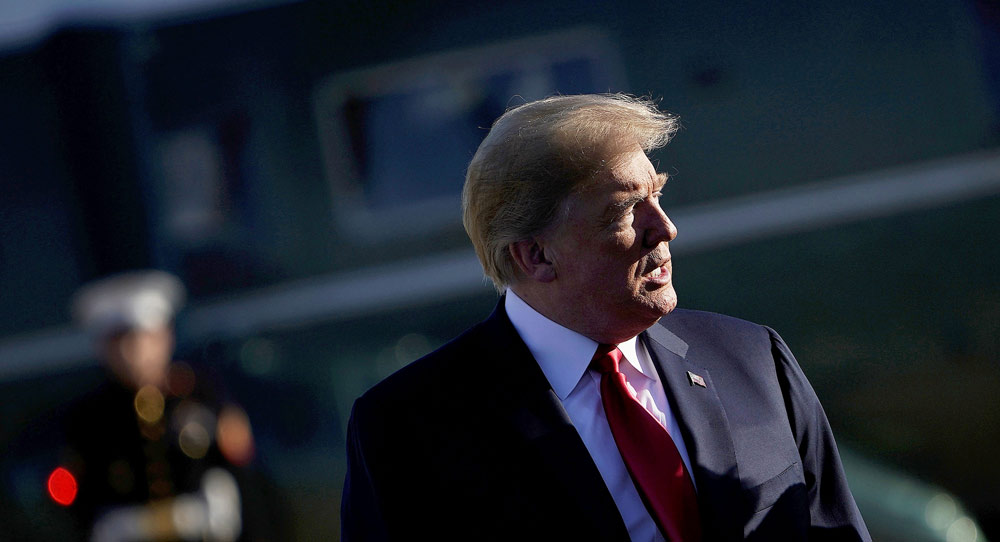
Source: Getty
Donald Trump’s foreign policy is an extension of the harsh quality of American politics: combative, lonely, and winner-take-all.
Carnegie Europe was on the ground at the 2018 NATO summit in Brussels, offering readers exclusive access to the high-level discussions as they unfold.
**
The Donald Trump that lands in Brussels this week is a relatively simple man, yet Europeans get him surprisingly wrong.
Let’s begin with the common assumption that Trump likes dictators more than leaders of democratic countries. He does seem to have a fondness for the strongman type, reflecting his notable mix of deep insecurities and natural arrogance. But to understand the president’s approach to U.S. relations with other countries, a better way to look at it is this: Trump believes there are only two kinds of states—the United States and everybody else.He regards current allies as being too close to the United States—as hangers-on who need to be pushed away to show that America means business and intends to bolster what it gets from them. Those who have a more hostile relationship with the United States need to be brought closer to Trump so that everybody is in about the same position. It does not matter whether he likes an ally or adversary better than another, he just wants the United States to be surrounded by a large set of potential transactional business partners with whom he can then decide what deals he wants to make. There is no gain in treating Trump as ally; his instinct is to keep friends and enemies alike at a similar distance.
For the first time, at least in modern history, the United States has a president who is a businessperson. Businesspeople don’t have ideological allies or rivals. They have people they do business with. Sometimes they have friendly business relations and sometimes they have hostile business relations. The world to Trump is a series of transactional opportunities and challenges, not of unchangeable, long-term relationships. Everything is up for question with Trump, and the main question for him is: What’s good for the United States, right now? Trump is puzzled that this approach comes as a surprise to Europe because he believes that narrow self-interest should be the driving force on both sides of every state-to-state encounter.
The world to Trump is a series of transactional opportunities and challenges, not of unchangeable, long-term relationships.
That is not necessarily the view of some around him, like Secretary of Defense James Mattis, but the assumption that Trump can be restrained by “the adults in the room” needs to be put to rest. Trump 2.0—that is, the Trump of 2018—is a different man from the Trump who attended his first NATO summit last year. His popularity is rising among Republicans: he now has a nearly 90 percent approval rating amongst Republican voters, which is the second highest of any Republican president since World War II, exceeded only by president Bush right after 9/11. Trump’s national job approval rating reached a personal best of 45 percent last month, just 1 percent below his vote total in 2016. He feels he’s doing well and therefore is less open to being told to change course.
There are also fewer and fewer critical voices around him. With Mike Pompeo newly installed at the State Department and John Bolton replacing McMaster at the National Security Council, Trump feels that he’s now got people on side who understand him and who work with him. The new team energizes him, and they carry out his orders—they don’t reinterpret his decisions. Trump is even more confident than last year about disrupting the status quo, consequences be damned.
Trump feels that his core message to NATO—increase your defense budgets—is both popular with the American people and working. He thinks that his foreign policy is in good shape in general. He’s found his feet internationally; he's more self-confident about overseas trips and views summits as a chance to shine and to take control of the narrative. The July 16 Helsinki summit with Russian President Vladimir Putin will be Trump’s second try at a big one-on-one meeting, which he feels is his natural strength. It’s what he always believed that as president he offers to the world—his ability to charm, bully, bluster, and gesture his way through one-to-one encounters with other leaders.
Donald Trump is a postmodern president; he’s history-free, fact-free, structure-free, and protocol-free.
Donald Trump is a postmodern president; he’s history-free, fact-free, structure-free, and protocol-free. He is acting in ways that belie the last 60 years of assumed history of the United States and the world, and the way the world is organized. He has been a disruptive figure from the day he announced he was running for president. If one put that characteristic to him as a rebuke, he would be genuinely surprised. The response would be: of course I am disruptive, that’s why I’m successful. Trump will continue to disrupt until the day he leaves the office. It is his core message and that’s what his supporters are happy about.
Trump is producing intensified polarization in the United States, which also brings out fundamental differences between U.S. and European politics. European politics is much more about consensus, civility, and continuity. In U.S. politics, polarization has been growing for decades, and with that has come a steady erosion of consensus and civility. Presidential races are often disruptive affairs, in which outsiders not initially chosen by the leadership of the two main parties—such as Donald Trump, Barack Obama, Bill Clinton, or Jimmy Carter—challenge through an open primary process, raise much of their own money, and wage their own fight to victory. It’s much less about party politics than the national elections in most European countries are. Presidential campaigns have a strong element of self-financed entrepreneurial politics. As a result, leaders who come to power often have little real obligation to the party and instead remake the party in their own image. Trump’s foreign policy is a dark extension of this harsh quality of American politics: combative, lonely, winner-take-all.
As Europe worries about the Trump-Putin summit next week, it is worth keeping in mind that the U.S. president is probably not going into it aiming for a specific deal, in which he trades a concession on Syria for a concession on Ukraine, or some grand bargain with multiple parts. At the Singapore summit with Chairman Kim, Trump’s goal was not to reach a fully negotiated agreement so much as simply to say that he had forged a changed emotional relationship, and therefore the United States is better off because the animosity from this particular foreign leader has been reduced.
As Trump approaches his summit with Putin, he’s probably focused on showing that he and the Russian president can sit down and talk in a friendly fashion.
As Trump approaches his summit with Putin, he’s probably focused on showing that he and the Russian president can sit down and talk in a friendly fashion. To Trump, a meeting of this sort is less about specific results than about how he frames the outcome. He wants to come out of it and say: I have overcome the animosity between Putin and the United States, and that’s what I’m bringing. That’s good for America. That’s all. Which is a bad thing if you believe there are serious issues on which the United States and Russia need to work together, but possibly a relief of sorts if one worries about Trump compromising European security through specific trades or concessions.
Unfortunately, one cannot rule out Trump saying something startling on Crimea or sanctions. The temptation of further disruption will be great to the world’s new disrupter in chief.

Harvey V. Fineberg Chair for Democracy Studies; Senior Fellow, Democracy, Conflict, and Governance Program
Thomas Carothers, a senior fellow in the Carnegie Endowment for International Peace’s Democracy, Conflict, and Governance Program, is a leading expert on comparative democratization and international support for democracy.
Recent Work
Thomas Carothers
Thomas Carothers
Carnegie does not take institutional positions on public policy issues; the views represented herein are those of the author(s) and do not necessarily reflect the views of Carnegie, its staff, or its trustees.

Much has been said of the changes Brussels is trying to make to the EU enlargement process. Here’s why gradual integration might—or might not—be the answer.

Dimitar Bechev

The European Commissioner for Trade is headed to China. But after President Xi’s bridge-building visit to Washington, can a more isolated EU overcome Beijing’s stranglehold on critical raw materials? Who will blink first?

Rym Momtaz, ed.

The domestic impacts of how long it is taking to end the war in Ukraine have pushed the French electorate to the political extremes and compromised the country’s diplomatic capacity.
Rym Momtaz

Before the next wave of EU enlargement takes place, the union needs to grapple with thorny questions of how power is distributed among its members.


Emil Sondaj Hansen, Ditte Brasso Sørensen

A summer of escalation in the Black Sea has hurt Ukraine economically and is exacerbating world food security. A truce is needed—as is a broader reframing of Europe’s Ukraine strategy.

Thomas de Waal