

Article
Thomas de Waal
{
  "authors": [
    "Thomas de Waal"
  ],
  "type": "commentary",
  "blog": "Strategic Europe",
  "centerAffiliationAll": "",
  "centers": [
    "Carnegie Endowment for International Peace",
    "Carnegie Europe",
    "Carnegie Russia Eurasia Center"
  ],
  "collections": [
    "Europe’s Eastern Neighborhood"
  ],
  "englishNewsletterAll": "",
  "nonEnglishNewsletterAll": "",
  "primaryCenter": "Carnegie Europe",
  "programAffiliation": "",
  "programs": [],
  "projects": [],
  "regions": [
    "Russia",
    "Europe",
    "Caucasus",
    "Eastern Europe"
  ],
  "topics": [
    "Foreign Policy",
    "Security",
    "EU"
  ]
}
Source: Getty
Moscow’s recognition of both Abkhazia and South Ossetia as independent states in 2008 has benefited no one—including the two territories and Russia itself.
This blog is part of EU-LISTCO, an innovative and timely project that investigates the challenges facing Europe’s foreign policy. A consortium of fourteen leading research institutions and universities aims to identify risks connected to areas of limited statehood and contested orders—and the EU’s ability to respond.
*
Ten years ago, the Georgia-Russia war of August 2008 played out like a horrible movie in which terrible forebodings all came to pass. For two years we watched as Russia intimidated the Georgians and ratcheted up the pressure; as then Georgian president Mikheil Saakashvili grew evermore reckless and provoked the Russians; as parts of the Bush administration in Washington made things worse and failed to rein Saakashvili in. All that came to a head in violence in South Ossetia on the night of August 7-8, 2008.Yet the denouement that came on August 26, 2008 was still unexpected. On that day Moscow recognized both Abkhazia and South Ossetia as independent states, turning the geopolitics of the Caucasus upside down.
From the perspective of a decade on, we can see that that decision benefited no one—not even, I would argue, the Russians.
First of all, the recognition move basically killed off the negotiating process over the two regions. The Geneva International Discussions, held four times a year, are a forum for the interested parties to raise current issues, but no more than that. They are a pale imitation of the processes that preceded them, mediated by the United Nations and the Organization for Security and Cooperation in Europe. Simply put, the Abkhaz and Ossetians have no incentive to compromise on status or security issues when there are two Russian embassies in Sukhumi and Tskhinvali and 7,000 Russian troops at their back.
So in August 2008, Georgia lost any meaningful chance of recovery of Abkhazia and South Ossetia. You could say they were already lost in the wars of 1991-1993, but as long as they were shadowy territories between Georgia and Russia there was still a chance of negotiating some kind of compromise on their status. In human terms that means that around a quarter of a million Georgian displaced persons, made homeless in Abkhazia in 1993 and in South Ossetia in 2008, face almost no prospect of return.
Things are no better for Abkhazia and South Ossetia. Look at the map and you see that South Ossetia, separated from Russia by the mountains of the Caucasus, makes sense as a viable entity only inside Georgia’s economic space. Until Saakashvili’s first misadventure there in 2004, this was an eminently soluble conflict, and Georgians and Ossetians moved freely across an open boundary line. The closed border there now has more or less killed South Ossetia’s modest economy, and its population is currently estimated to be as low as 30,000.
In Abkhazia, there is a joke that “we used to have independence, now we have recognition.” Indeed, in the early 2000s Abkhazia had ambitious if rather improbable goals to build a relationship with the European Union as well as with Russia, even without international recognition. (The key document here is the Key to the Future plan of 2006 of former Abkhaz president Sergei Bagapsh). Several international organizations were active in Abkhazia, there was a UN mission on the ground, and Western diplomats came back and forth regularly.
Russian recognition solved Abkhazia’s security worries. A big influx of Russian money has made it much better off. Yet most of the internationals have gone, its global isolation is deeper, and since the Ukraine crisis no one talks about the EU any more. Nowadays the biggest building in the center of Sukhumi is the big new Russian embassy. All roads lead to de facto integration with Russia, something the Abkhaz elite do not want but can at best only slow down.
As for the Russians, they surely hoped for a lot more in 2008. There are reasons to believe that the decision was taken by then prime minister Vladimir Putin and then president Dmitry Medvedev in a moment of euphoria and that other key figures in Moscow were not consulted. The rumor certainly is that foreign minister Sergei Lavrov advised against the move.
Medvedev talked about Kosovo as he announced the recognition of the two territories. The expectation was apparently that there would be a counterwave of recognitions in parallel to that of Kosovo. Reality bit hard when Putin’s closest ally, Belarusian President Alexander Lukashenko, declined to follow his lead. Lukashenko told a press conference in 2014 that he was subjected to vigorous lobbying by the Russians on the one hand and by then EU foreign policy chief Javier Solana on the other—Solana’s arguments were more persuasive.
As a result, the only countries that now recognize Abkhazia and South Ossetia are Russian allies with no stake in the region (Nicaragua, Venezuela, and, recently, Syria) and a Pacific island state notorious for putting its acts of recognition politics up to the highest bidder (Nauru).
Where does this leave Russia? With two rather tricky clients, which make big claims on its budget but do not respond with much gratitude. The Abkhaz still push back against Russia’s requests to legalize the sale of property to foreigners—meaning Russians. The South Ossetians had the nerve to elect the “wrong” president in 2011, and it took a lot of effort for the vote to be rerun.
In return, Russia has basically lost Georgia. For sure, NATO is still reluctant to admit Georgia so long as the Abkhaz and Ossetian conflicts are unresolved. Yet that was already the case a decade ago, and Georgia now needs NATO membership less anyway, having since 2008 forged a much stronger bilateral military relationship with the United States. Moscow, still vilified as the occupying power and having no diplomatic relations with Tbilisi, can only watch as Georgia builds a deeper economic and political relationship with the EU and discusses its future with everybody but Russia.
Putin is sometimes credited with being a chess player. His recognition politics of a decade ago only led to a stalemate for all concerned, including himself.
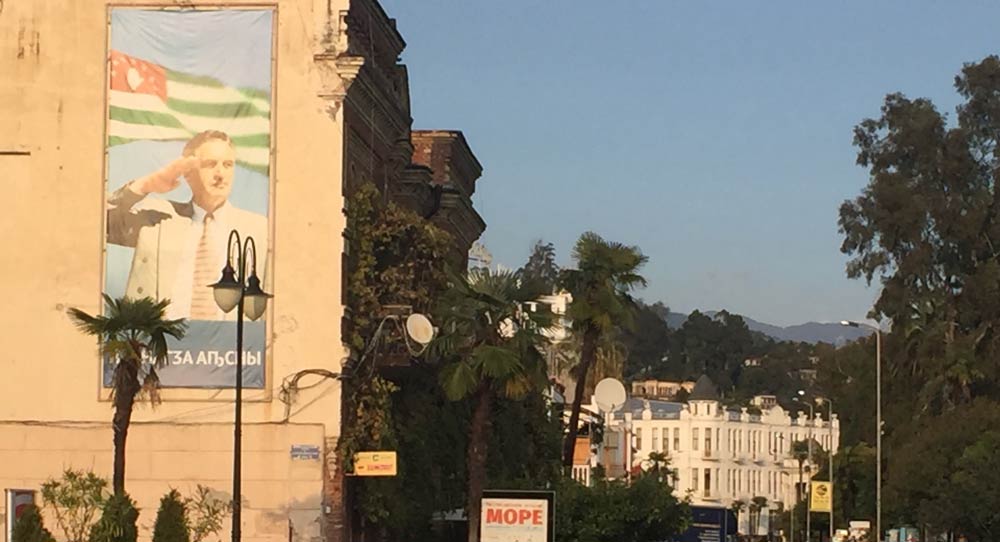
Photo credit: Thomas de Waal


Senior Fellow, Carnegie Europe
Thomas de Waal is a senior fellow at Carnegie Europe, specializing in Eastern Europe and the Caucasus.
Recent Work
Thomas de Waal
Thomas de Waal
Carnegie does not take institutional positions on public policy issues; the views represented herein are those of the author(s) and do not necessarily reflect the views of Carnegie, its staff, or its trustees.

As we close out another season of Strategic Europe, it is worth taking stock of the deep shifts underway.

Rym Momtaz

The EU had to compromise to adopt a twenty-first sanctions package against Russia, exposing growing cracks in the union’s resolve. Is this latest, weaker round worth it to keep pressure on Moscow?
Rym Momtaz, ed.

Trump is distracted and Ukraine wants Europe to step up. The continent’s leaders must find their voice and assert it in talks with Russia.

Alissa de Carbonnel

Mounting economic strain and battlefield losses will not necessarily make the Kremlin less dangerous. They could instead push Moscow toward a more aggressive hybrid campaign designed to test NATO’s Eastern flank, exploit allied hesitation, and fracture European resolve.

Maksym Beznosiuk

Over the past ten years, NATO has held almost as many summits as it did during the entirety of the Cold War. Are they still useful, or is it time to stop holding annual meetings?
Rym Momtaz, ed.