

Commentary
Peter Kellner
{
  "authors": [
    "Peter Kellner"
  ],
  "type": "commentary",
  "blog": "Strategic Europe",
  "centerAffiliationAll": "",
  "centers": [
    "Carnegie Endowment for International Peace",
    "Carnegie Europe"
  ],
  "collections": [
    "Brexit and UK Politics"
  ],
  "englishNewsletterAll": "",
  "nonEnglishNewsletterAll": "",
  "primaryCenter": "Carnegie Europe",
  "programAffiliation": "",
  "programs": [],
  "projects": [],
  "regions": [
    "Europe",
    "Western Europe",
    "United Kingdom"
  ],
  "topics": [
    "EU"
  ]
}
Source: Getty
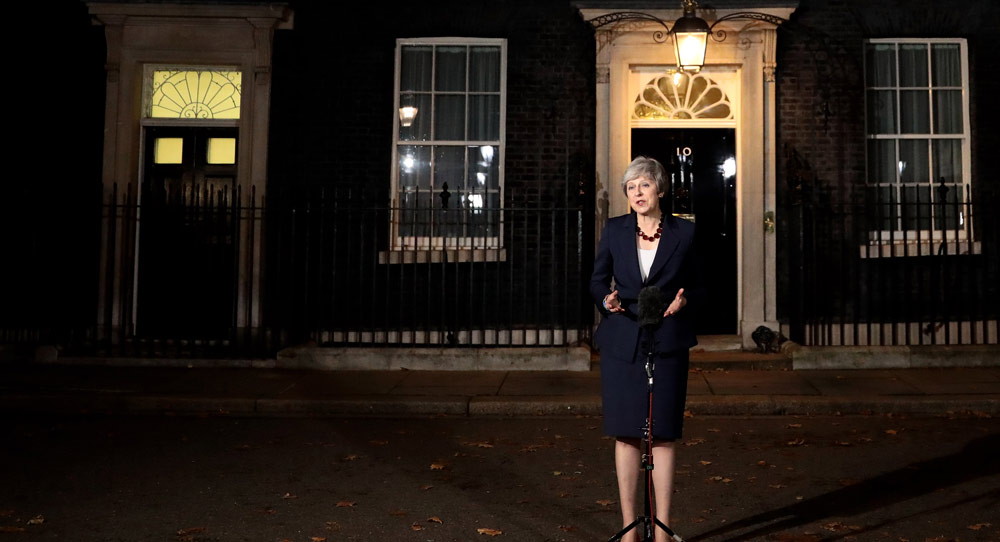
The chances of a new Brexit referendum sometime in 2019 are growing—as is the possibility that the UK will not, in the end, leave the EU at all.
If Theresa May had a moment of pleasure, or at least relief, at the conclusion of the withdrawal agreement between London and Brussels, it did not last long. Within hours, two cabinet members resigned, including her Brexit secretary; enough MPs indicated hostility to her deal to block it in Britain’s Parliament; and the first post-agreement survey of public opinion shows that opposition to Brexit, far from shrinking as she would have hoped, is in fact growing.
Before we address the two big questions—Can May win over enough MPs to keep her deal alive? And what happens if she can’t?—let us survey the battleground as it stands in the immediate aftermath of this week’s deal.
The parliamentary arithmetic is daunting. May leads a minority government. 318 Conservative MPs are outnumbered by 325 non-Conservatives. She is able to govern at all because ten Democratic Unionist Party (DUP) MPs from Northern Ireland have agreed to support her on the major decisions.However, the DUP is furious that the withdrawal agreement weakens the United Kingdom by setting out a different system of regulation for Northern Ireland. (This is a consequence of the need, which almost everyone accepts in principle, for the border between Northern Ireland and the Irish Republic—the only land border between the UK and the rest of the European Union—to remain completely open.) If the DUP cannot be won round, then the government cannot win with Conservative votes alone—even if every single one of them backs the deal.
In reality, May’s plight is worse than this. She is under fire from two opposite wings of her own party. At least 40 strongly pro-Brexit MPs think the government has buckled in the negotiations over the past two years and is not pulling the UK away from the EU’s orbit far or fast enough. A further dozen MPs support the UK remaining in the EU: their complaint is that the withdrawal agreement would create the worst of both worlds, with the UK no longer a member of the EU and therefore with no say over rules that could affect the UK for years, possibly decades, to come.
If these two groups keep their present positions, then May will lose the key vote in the House of Commons by more than 100—even if a handful of pro-Brexit Labour MPs line up with the Government.
Could the prime minister grasp victory in Parliament from the jaws of defeat? It looks unlikely, even if some of the rebels on her own benches in the end rediscover their sense of loyalty. Suppose the number of pro-Brexit rebels halves to 20, while the pro-Remain rebels are reduced to just six. This would still leave May facing defeat by around 50.
One thing she is doing to swell her ranks is to woo Labour MPs who represent Leave-voting areas. Few of them have faith in their party’s own leader, Jeremy Corbyn, and could be open to the argument that the withdrawal agreement is the best way to protect the jobs of their own local voters. However, there will not be enough pro-deal Labour MPs to close a gap that wide.
The real prize would be for May to persuade the DUP to switch sides and back the deal. This would not only improve the parliamentary arithmetic; it would also help to minimize the number of rebellious Conservative backbench MPs, many of whom have worked closely with the DUP in recent months.
In that case, the vote would be very close. It could go either way. But without a U-turn by the DUP, the chances of a government victory are remote in the extreme. And the first survey since the deal, by YouGov, finds that opposition to the government’s Brexit strategy is growing. Three in four voters think that “what is now proposed won’t be anything like what was promised two years ago,” and a two-to-one majority think that “Brexit is turning into a disaster for our businesses, our public services and the future of young people.” So the prime minister cannot claim public backing; and the resignation of her Brexit secretary, Dominic Raab, increases the likelihood that the deal will die a death, possibly within days or even hours.
It is not even clear that May herself will be around to preside over the deal’s funeral. The prospects are rising of a challenge from her fellow Conservative MPs to her leadership of the party. She would probably win a vote of confidence from a majority the 318 MPs with a say in the matter; but if, say, 100 MPs vote for her to go, she might feel that her appetite to stay on has gone. It is yet another possible cause of turbulence in the days to come.
What if the withdrawal agreement is blocked in London, whether or not May stays on? The YouGov poll suggests one way out. It tested support for a new referendum, should the deal fall by the wayside. The public supports a vote in those circumstances by almost two-to-one. And when people are asked how they would vote if such a referendum were held, the response is 56 percent to stay in the EU, and 44 percent to leave.
Plainly, the public mood is likely to shift as events unfold. But this week, the chances of a new referendum sometime next year are growing—as is the possibility that the UK will not, in the end, leave the EU at all.

Former Nonresident Scholar, Carnegie Europe
Kellner was a nonresident scholar at Carnegie Europe, where his research focused on Brexit, populism, and electoral democracy.
Recent Work
Peter Kellner
Peter Kellner
Carnegie does not take institutional positions on public policy issues; the views represented herein are those of the author(s) and do not necessarily reflect the views of Carnegie, its staff, or its trustees.

European Commission President Ursula von der Leyen is about to give her annual address on the state of the EU. Here’s what she won’t—but should—say.

Rym Momtaz

The aftermath of the Ceuta crisis shows Europe has drawn the wrong lessons. Rather than doubling down on failed migration policies, the EU needs to address the underlying roots of such episodes.

Richard Youngs
An overwhelming victory by a far-right-wing party in a small state in eastern Germany will have major repercussions for Chancellor Friedrich Merz’s coalition.

Judy Dempsey

Canadian Prime Minister Mark Carney has twice inspired praise for standing up to U.S. President Donald Trump: at the 2026 World Economic Forum in Davos and on Canada-U.S. trade negotiations. Is Carney showing a third way better than the EU has in dealing with the Trump administration?
Rym Momtaz, ed.

The EU’s responses to two recent incidents expose the gulf between European perceptions and capabilities. Unless the union can bridge that gap, it will never become a real geostrategic power.
Rym Momtaz