

Commentary
Judy Dempsey
{
  "authors": [
    "Judy Dempsey"
  ],
  "type": "commentary",
  "blog": "Strategic Europe",
  "centerAffiliationAll": "",
  "centers": [
    "Carnegie Endowment for International Peace",
    "Carnegie Europe"
  ],
  "collections": [
    "Transatlantic Cooperation"
  ],
  "englishNewsletterAll": "",
  "nonEnglishNewsletterAll": "",
  "primaryCenter": "Carnegie Europe",
  "programAffiliation": "",
  "programs": [],
  "projects": [],
  "regions": [
    "Europe",
    "North America"
  ],
  "topics": [
    "Security",
    "Nuclear Policy"
  ]
}
Source: Getty
Washington’s decision to withdraw from the Intermediate-Range Nuclear Forces Treaty represents the end of the post-Cold war era and America’s new strategic priorities.
It was only a matter of time.
On February 2, President Donald Trump announced that the United States would terminate its participation in the INF Treaty. The treaty had come into force in June 1988 as part of the new climate between Washington and Moscow that ushered in an unprecedented era of arms control between the two superpowers.
Briefly, the treaty eliminated a whole category of nuclear-armed missiles on the American and the Russian sides. This included all nuclear-ground-launched ballistic and cruise missiles with ranges between 500 and 5,500 kilometers. They had posed an enormous threat to Europe’s security.
Trump had repeatedly accused Russia of noncompliance of the INF, which was regarded as a symbol of the end of the Cold War. Russia was, for example, in violation of the treaty by deploying its new SSC-8 cruise missile, which appears to have a maximum range well beyond the ceiling (500 kilometers) specified by the treaty.
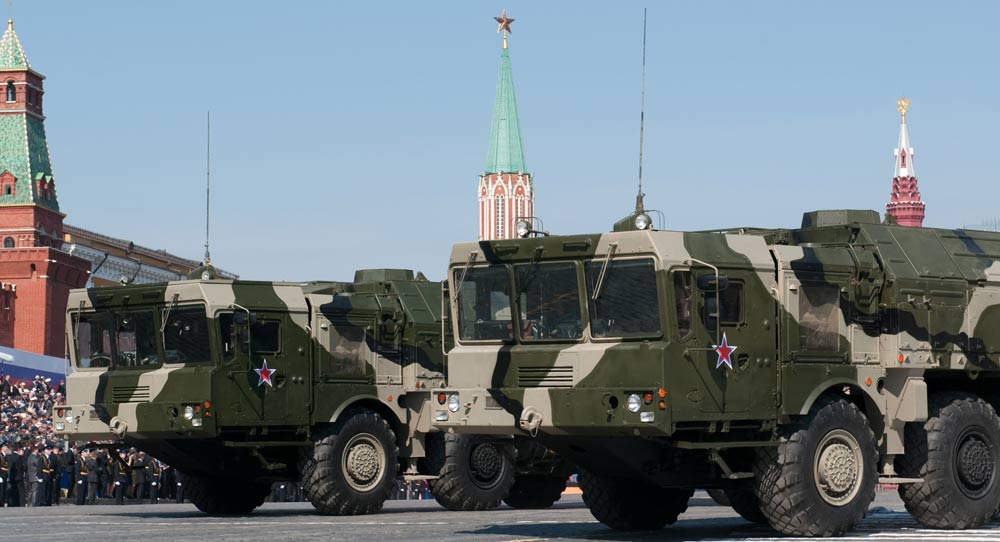
Russia was also building an arsenal of land, air, and sea-based weapon systems with a range of up to 500 kilometers. These weapons can be armed with nuclear warheads. The Iskander is a striking example of these developments. Based in Kaliningrad, a Russian exclave that borders with EU and NATO members Poland and Lithuania, these weapons can reach Berlin.
Russia has its own litany of accusations against the United States, accusing it of violating the treaty by installing Aegis Ashore anti-missile launch facilities in Romania and soon in Poland. Both could be used as cruise missile launchers. Russia has also accused Washington for deploying long-range armed drones that don’t fall into the category of cruise missiles.
The Europeans, especially Germany, dread the end of the INF. For them, even though they were not a party to the treaty, it was considered a core element of European security. Poland, the Baltic states, and other countries in this part of Europe now fear that Russia will find it easier to weaken and ultimately divide NATO. This has been one of Moscow’s long-term objectives.
NATO, however, has remained united and has supported the U.S. allegations levelled at Russia. And the alliance is trying to persuade Moscow to return to compliance with the treaty—not that any serious analyst in Washington, Moscow, or the capitals in Europe believes that will happen. This is because the geostrategic landscape and attitude toward arms control on both sides of the Atlantic has changed fundamentally since the INF was signed.
In 2015, even before Trump was elected, Russia had walked away from the Treaty Conventional Forces in Europe (CFE), which imposed strict limits on troops, weapons, deployments, and movements of materiel across Europe and what was then the Soviet Union. The CFE was anchored on a sophisticated regime of verification and transparency. Indeed, had Russia complied with the CFE, it would have made Russia’s annexation of Crimea and its invasion of parts of eastern Ukraine impossible. In 2002, the United States had walked away from the Anti-Ballistic Missile Treaty.
The Europeans, so long dependent on America’s security guarantee and a culture of arms control to maintain security and stability on the continent, see the demise of the INF Treaty as a possible return to a new Cold War.
The reality is more complex. The circumstances surrounding the INF’s signature have profoundly changed since the end of the Cold War.“The disappearance [of the INF Treaty] in practice is the product of a new context,” according to Bruno Tertrais, deputy director of the Fondation pour la Recherché Stratégique. It’s about Russia’s increasing military power; it’s about “a detestation in the White House of some treaties perceived as shackles.” Above all it’s about “the radical transformation of the strategic landscape (in Asia).”
Even before Trump, the Pentagon saw how the INF didn’t address the imbalances between Chinese and North Korean ballistic and cruise missiles and U.S. resources in the region. “The INF Treaty appeared to be a constraint preventing America from acquiring the means of defense adapted to the changing context,” argues Tertrais. In short, it is what happens in China, North Korea, and the South China Sea—and not in Europe—that preoccupies the United States.
The Europeans, while standing behind NATO, have some hard choices to make. They know their influence on Trump and on Russian President Vladimir Putin is limited. But there is little doubt that Putin can, and indeed has, threatened Europe (meaning Germany) over America’s decision to quit the INF.
Yet rather than succumb to such threats, the Europeans have to ask hard questions about NATO’s response to what Russia is doing in Kaliningrad. Should the alliance modify its missile defense architecture and increase its conventional forces? Some European allies would welcome this. Germany’s Social Democrats would definitely balk at any idea of discussing the nuclear component. But if Germany is so committed to arms control, its ability to articulate new ideas has been sorely lacking.
“The least Germany could do is that if it doesn’t want U.S. missiles on its own territory, it should debate missile defense and support U.S. nuclear deterrence (sea-based) efforts diplomatically,” says Tobias Fella, a German foreign, security, and defense policy advisor at the Friedrich-Ebert-Stiftung that is affiliated to the Social Democratic Party.
Furthermore, as Karl-Heinz Kamp and Wolfgang Rudischhauser argue, the Europeans should push for the United States and Russia leaderships to get China, India, and Pakistan on board so as to make the INF Treaty a multilateral one. As it is they are not bound by any restrictions to their nuclear arsenals. At the moment, “this is unlikely to succeed,” the authors write in a recent paper for the German Federal Academy for Security Policy.
Yet the Europeans, if possible, should speak with one voice. They should step up their role in conventional defense within NATO (and convince Trump they are serious about spending more and serious about defense). They should pursue the multilateral track. And isn’t it time that Americans and Europeans should have a serious debate about Asian strategic stability, Fella said.
Doing none of the above will relegate the Europeans to the level of mere spectators, make it easier for Russia to intimidate them, and ill-prepare the continent for any military confrontation between the United States and China.

Nonresident Senior Fellow, Carnegie Europe
Judy Dempsey is a nonresident senior fellow at Carnegie Europe
Recent Work
Judy Dempsey
Judy Dempsey
Carnegie does not take institutional positions on public policy issues; the views represented herein are those of the author(s) and do not necessarily reflect the views of Carnegie, its staff, or its trustees.

Before the next wave of EU enlargement takes place, the union needs to grapple with thorny questions of how power is distributed among its members.


Emil Sondaj Hansen, Ditte Brasso Sørensen

A summer of escalation in the Black Sea has hurt Ukraine economically and is exacerbating world food security. A truce is needed—as is a broader reframing of Europe’s Ukraine strategy.

Thomas de Waal

Are Germany’s economic, industrial, and political struggles becoming a liability for the EU’s ability to rise to the geopolitical moment?

Rym Momtaz, ed.

European Commission President Ursula von der Leyen is about to give her annual address on the state of the EU. Here’s what she won’t—but should—say.
Rym Momtaz

The aftermath of the Ceuta crisis shows Europe has drawn the wrong lessons. Rather than doubling down on failed migration policies, the EU needs to address the underlying roots of such episodes.

Richard Youngs