

Commentary
Gwendolyn Sasse
{
  "authors": [
    "Gwendolyn Sasse"
  ],
  "type": "commentary",
  "blog": "Strategic Europe",
  "centerAffiliationAll": "",
  "centers": [
    "Carnegie Endowment for International Peace",
    "Carnegie Europe"
  ],
  "collections": [
    "Europe’s Eastern Neighborhood"
  ],
  "englishNewsletterAll": "",
  "nonEnglishNewsletterAll": "",
  "primaryCenter": "Carnegie Europe",
  "programAffiliation": "",
  "programs": [],
  "projects": [],
  "regions": [
    "Europe",
    "Eastern Europe",
    "Ukraine"
  ],
  "topics": [
    "Political Reform",
    "EU"
  ]
}
Source: Getty
Ukraine’s recently elected President Volodymyr Zelenskiy remains largely unknown in European capitals. His true colors will come through only after Ukraine’s parliamentary election later this year.
Two months after his clear election victory and one month after his inauguration as president, Ukraine and the rest of the world continue to puzzle over the personality, outlook, and expertise of political newcomer Volodymyr Zelenskiy. After only thinly veiled skepticism in the run-up to the second round of the election on April 21, most national and EU officials are now trying to give Zelenskiy the benefit of the doubt. They speak of a generational change and stress the different tone in their first conversations with forty-one-year-old Zelenskiy and his team.
But there is as yet no answer to the question of whether the apparent change in style will be accompanied by a change in substance. Anticorruption reforms and tangible progress toward peace in Ukraine’s war-torn eastern Donbas region have become the two key policy fields Zelenskiy’s reform agenda will be measured against. Zelenskiy’s closeness to oligarch Ihor Kolomoyskiy remains a serious concern, fueled further by the appointment of Andriy Bohdan, a former lawyer of Kolomoyskiy’s, as head of the presidential administration.
Overall, however, it looks as if contradictory appointments are being made to both tie in oligarchic support and commit to reforms. Some of these appointments are likely to be temporary, bridging the time between the presidential election and the upcoming parliamentary election.
Yet there are also signs of the administration wasting time and efforts behind the scenes, most notably on the preparation of a referendum on peace in the Donbas. Such a referendum would be meaningless: Who would participate? Of those who participate, who would not vote for peace? What concrete policy would follow from such a referendum?
Zelenskiy’s carefully crafted address to the Ukrainian parliament, or Rada, on the day of his inauguration, in which he dissolved the Rada to bring the next parliamentary election forward from October to July 21, was meant to demonstrate his political resolve. The official justification for the dissolution was the collapse of the governing coalition led by former president Petro Poroshenko’s bloc. Strictly speaking, the governing coalition had already broken down under Poroshenko, making way for more ad hoc coalitions.
Ukraine’s Constitutional Court has been called on to rule whether Zelenskiy’s dissolution of the parliament was constitutional. As Zelenskiy’s most vocal opponent, Poroshenko is trying actively to swing the mood against the new president’s decision. According to a poll by the Rating agency, close to 90 per cent of Ukrainians favor the earlier election date of July 21.
If the early election is given the green light, it will have to be organized within less than a month. Zelenskiy’s party will do well whenever the election is held, despite a degree of uncertainty. The question mark attached to an early election is the turnout rate, especially among younger voters. Conversely, if the election takes place in October, the first disappointment with Zelenskiy might have kicked in and affect voter mobilization or increase the shares of other parties, even if only slightly.
Currently, the polls predict that Zelenskiy’s party will obtain 45–50 per cent of the vote, followed by Opposition Platform—For Life, with 10–12 per cent; Poroshenko’s renamed European Solidarity, with 8–10 per cent; former prime minister Yulia Tymoshenko’s All-Ukrainian Union “Fatherland,” with 7–9 per cent; and musician Svyatoslav Vakarchuk’s new party, Voice, with 5–6 per cent.
The central question is whether Zelenskiy will have to form a coalition in the parliament or whether his party can secure a majority by itself. Tymoshenko’s Fatherland party is beginning to position itself as the most likely coalition partner. In yet another reincarnation, Tymoshenko would then have her eye on the post of prime minister after she failed to win the presidency.
Zelenskiy urgently needs the parliamentary election, and he needs to win big to have a chance to use the political space the Ukrainian constitution affords. The exact election outcome remains difficult to predict, not least because of Ukraine’s mixed electoral system: half of the members of parliament are elected on the basis of proportional representation via closed party lists and a 5 per cent threshold, and the other half on the basis of majoritarian single-member constituencies. While the current polls show that Zelenskiy’s party clearly leads in the party-based competition, the constituencies are harder to control and have traditionally given rise to a considerable influence of oligarchic candidates.
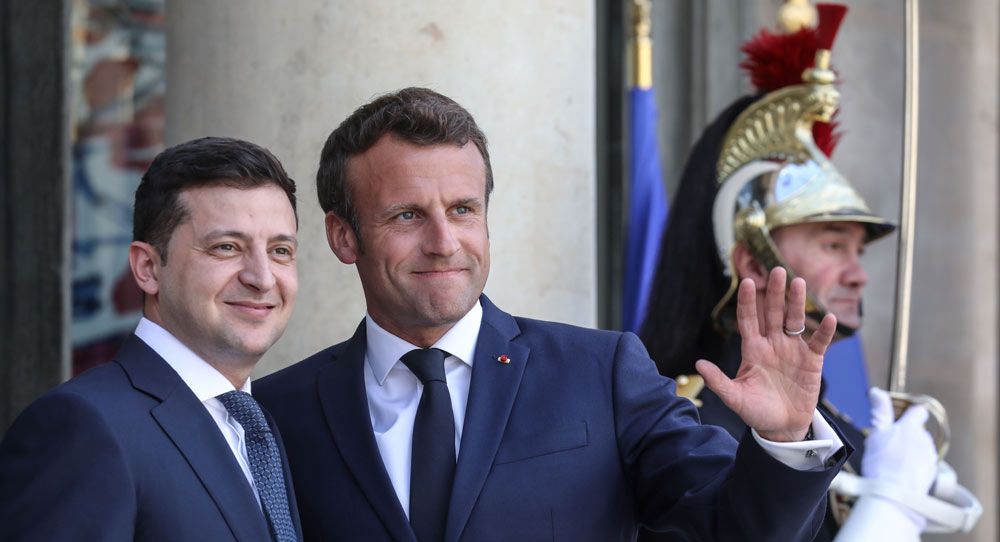
After making his first foreign trip to Brussels on June 4–5, Zelenskiy still needs to build his image in the field of foreign policy, one of the president’s key policy domains under the Ukrainian constitution. On June 17, Zelenskiy visited his French counterpart, Emmanuel Macron; today German Chancellor Angela Merkel and President Frank-Walter Steinmeier will receive him in Berlin.
During the visit to France, Macron emphasized Zelenskiy’s commitment to the reform process and the possibility of holding new talks in the Normandy format, which brings together the French, German, Russian, and Ukrainian leaders, to end the war in the Donbas. The visit to Berlin is likely to conclude with similarly vague statements—although Germany recently increased its financial support for Ukraine’s reform program.
At the moment, every foreign visit helps to understand Zelenskiy’s position a little better, integrate him into European policy networks, and perhaps shape his agenda. In Berlin he is even more of an unknown entity than in Paris, where he made a short visit before the second round of the presidential election. Germany’s involvement will be crucial if a new meeting in the Normandy format is to take place. Any such meeting would be highly politically charged, as it would be the first time that Zelenskiy and Russian President Vladimir Putin have met in person.
The real Zelenskiy will come to the fore only after the parliamentary election—that is, after July or October this year. Until then, domestic and international audiences will keep guessing what his priorities and major appointments will be. In the meantime, Zelenskiy’s trips to European capitals help at least to shape an impression of the person behind the presidency and partly reconfigure policy networks. The stakes remain extremely high for Ukraine.
Gwendolyn Sasse is a nonresident senior fellow at Carnegie Europe and director of the Centre for East European and International Studies (ZOiS) in Berlin.
Nonresident Senior Fellow, Carnegie Europe
Gwendolyn Sasse is a nonresident senior fellow at Carnegie Europe. Her research focuses on Eastern Europe, with a particular focus on Ukrainian politics and society, EU enlargement, and comparative democratization.
Recent Work
Gwendolyn Sasse
Gwendolyn Sasse
Carnegie does not take institutional positions on public policy issues; the views represented herein are those of the author(s) and do not necessarily reflect the views of Carnegie, its staff, or its trustees.
Amid uncertainty caused by the Iran war, the global drive for nonproliferation has stalled. With Europe diplomatically marginalized and countries reassessing their nuclear options, efforts to curb the spread of nuclear weapons risk becoming irrelevant.
Jane Darby Menton
Preparing candidate countries for EU membership is no longer enough. As the enlargement process becomes a reality, the union must also prepare its own societies.

Iliriana Gjoni
Five countries staged the biggest political boycott in Eurovision history over Israel’s participation. With the FIFA World Cup and other sporting or cultural touchstones on the horizon, are boycotts effective?

Rym Momtaz, ed.
The full list of humiliations Europe has endured since Donald Trump returned to the White House makes for grim reading. But Washington’s adversarial approach to its allies undermines its own power base.
Rym Momtaz
The closure of the Strait of Hormuz has triggered a global energy crisis, but Europe is stuck in reaction mode. Without more strategic foresight, the EU will remain dependent on fossil fuels and will never be truly secure.

Milo McBride, Pauline Gerard