

Commentary
Peter Kellner
{
  "authors": [
    "Peter Kellner"
  ],
  "type": "commentary",
  "blog": "Strategic Europe",
  "centerAffiliationAll": "",
  "centers": [
    "Carnegie Endowment for International Peace",
    "Carnegie Europe",
    "Carnegie Russia Eurasia Center"
  ],
  "collections": [
    "EU Integration and Enlargement",
    "Brexit and UK Politics"
  ],
  "englishNewsletterAll": "",
  "nonEnglishNewsletterAll": "",
  "primaryCenter": "Carnegie Europe",
  "programAffiliation": "",
  "programs": [],
  "projects": [],
  "regions": [
    "Europe"
  ],
  "topics": [
    "EU"
  ]
}
Source: Getty
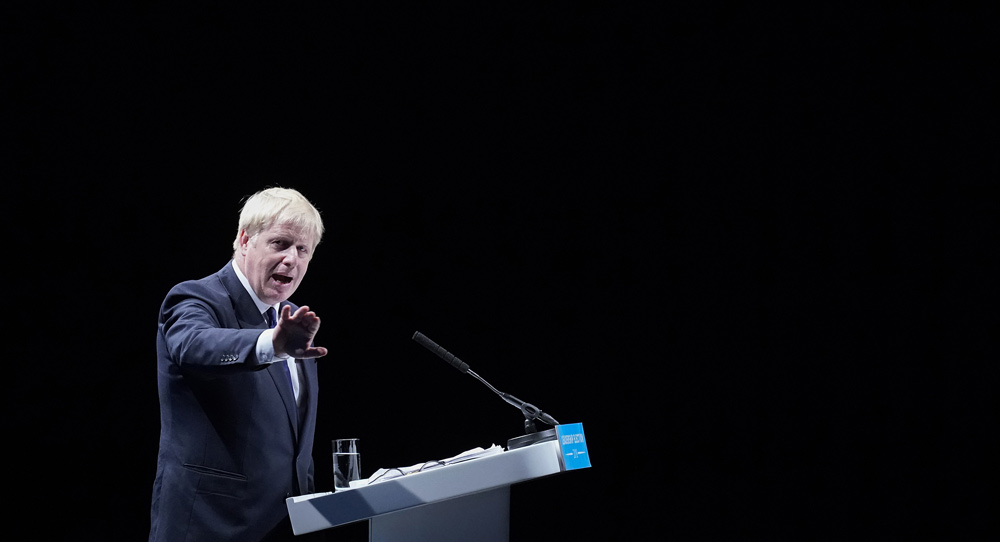
Boris Johnson, who is all but certain to become the next UK prime minister, has promised to deliver Brexit by October 31. But breaking his word has been a theme of his career.
Europe, beware. Unless the contest to succeed Theresa May springs a last-minute surprise, Britain’s new Conservative leader and prime minister will be a proven liar with no principles. In 1988, Boris Johnson was sacked as a journalist on the London Times for inventing a quotation. Sixteen years later, having become a member of Parliament (MP), he was sacked as a shadow minister for lying about his affair with his then mistress.
In between, he spent five years as Brussels correspondent of the Daily Telegraph—then, as now, the unofficial bible for the Conservative Party. Johnson routinely invented or exaggerated stories designed to paint the European Union in a bad, usually ludicrous, light. Among many examples were his absurd predictions that the EU would introduce one-size “eurocoffins” and establish a “banana police force” to regulate the fruit’s shape. His stories helped fuel Euroskepticism on the right of British politics. He should not be surprised if, as prime minister, he is treated on his return to Brussels with less than total respect.Harsh? Try this verdict, delivered on June 24 by Max Hastings, editor of the Daily Telegraph during Johnson’s time in Brussels:
There is room for debate about whether he is a scoundrel or mere rogue, but not much about his moral bankruptcy, rooted in a contempt for truth. His premiership will almost certainly reveal a contempt for rules, precedent, order and stability. . . . Yet his graver vice is cowardice, reflected in a willingness to tell any audience, whatever he thinks most likely to please, heedless of the inevitability of its contradiction an hour later. Almost the only people who think Johnson a nice guy are those who do not know him.
And yet, this dark cloud might have a silver lining. Johnson’s lack of principles can be rephrased as a refusal to be hemmed in by a rigid ideology. True, in the 2016 referendum on the UK’s EU membership he was one of the leading campaigners for Britain to leave the bloc; but he decided only at the last minute which side to back. He wrote two articles—one in favor of leaving, the other in favor of remaining—before choosing which to publish.
Thus, when he pledges to “do or die” in delivering Brexit by the deadline of October 31, one should allow for the possibility that he will neither do nor die, but instead preside over the UK’s continuing membership of the EU.
To understand why, let’s sketch out the likely course of events once Johnson becomes prime minister toward the end of July. He will seek to renegotiate the UK’s EU withdrawal agreement that May negotiated last year with the leaders of the other 27 member states. Above all, he will want changes to the backstop on the UK-Irish border—an insurance policy designed to ensure the frontier remains open. The EU will refuse to make any substantial changes, although it might agree to revise the political declaration that accompanies the main agreement and covers the long-term UK-EU relationship. However, any revisions will be too minor to secure a majority in Britain’s House of Commons.
At this point, probably in late September or early October, Johnson will declare his intention for the UK to leave the EU on October 31 without a deal. He will probably ask for the UK and the EU to continue trading as now, with no tariffs or border controls, pending further negotiations. The EU is unlikely to agree, not least because it is an institution governed by clear rules, which cannot simply be set aside on a political whim.
So, the chances are that by mid-October, the UK will be heading for an economically dangerous Brexit, unless steps are taken to avert this outcome. What might those steps be? The starting point is a law passed by Parliament in April. Under an amendment to the 2018 European Union (Withdrawal) Act, the UK will leave the EU on October 31 unless it amends or repeals that law.
Changing the law is possible but not easy unless the prime minister backs the change. Might Johnson swallow his “do or die” promise and do just that? Here is why he might. While Parliament cannot easily change the law without government support, it can make its view clear. And there is little doubt that come the imminent prospect of the UK crashing out of the EU without a deal, it will do so.
Back in March, MPs voted by 312 to 308 to reject the UK leaving the EU without an agreement. Since then, opposition to a no-deal Brexit has hardened. Seven Conservative MPs who abstained on that vote have since made clear their support for blocking any attempt to leave the EU without an agreement.
Moreover, at least seven of May’s cabinet ministers, including David Lidington, May’s de facto deputy prime minister, and Philip Hammond, the chancellor of the exchequer, have warned publicly against a no-deal Brexit. As cabinet ministers, they voted against the March resolution; but under Johnson they are likely to leave the government and will then be free to vote for economic sanity.
By late October, then, Parliament could have made the political decision to oppose a no-deal Brexit but not taken the legal steps to stop it without Johnson’s agreement. Johnson will then face a stark choice: to defy Parliament or to accept that the UK will remain in the EU beyond October 31.
Defiance would be dangerous. Johnson might face, and lose, a vote of confidence. His tenure as prime minister would be the shortest ever (the current unenviable record of four months was set by George Canning in 1827). Johnson has not lied and plotted his way up the greasy pole to slide back down it after only three months.
His simplest way of keeping the job he has craved would be to accept Parliament’s position by revoking the UK’s decision to leave the EU. But that would undoubtedly split his party and could be another route to a no-confidence vote. One alternative would be to ask the EU for a further extension, and more talks. But this might be rejected unless Johnson can credibly show that, first, he accepts the EU’s redlines on such issues as the Irish backstop and, second, he could win parliamentary approval for such a deal. Neither looks likely; both together look impossible.
Johnson would have two other options. The first is to seek an extension pending a new general election. The EU would probably agree to this. However, Johnson might be unwilling to take the risk of holding an election with Brexit unresolved and the new Brexit Party on the rampage. The party won 31 percent of the vote in the European Parliament elections in May this year. That is most unlikely to be repeated in a general election, but even 10–15 percent, with the party’s votes coming mainly from the Conservatives, would ensure Johnson’s defeat. Without an electoral deal with the Brexit Party—occasionally mooted but in truth unlikely—an election would merely delay Johnson’s downfall by a few weeks.
The second, and final, option would be for Johnson to call a fresh referendum, in which voters have a choice of leaving the EU without a deal or remaining a member state after all. True, Johnson currently opposes this course of action; but breaking his word has become a theme of his career. Changing his mind would be an addition to an already impressive list, not a break with any personal tradition of principled consistency.
Before anyone reacts to this analysis by placing a large bet on a fresh referendum, that outcome is far from certain. Rather, it is one possible outcome, rooted in the logic of the impasse that the UK’s political system must confront in the coming weeks. Whether logic imposes itself on Johnson’s ego and Parliament’s judgement is just one uncertainty in a crisis that is greater than any the UK has faced since 1945.

Former Nonresident Scholar, Carnegie Europe
Kellner was a nonresident scholar at Carnegie Europe, where his research focused on Brexit, populism, and electoral democracy.
Recent Work
Peter Kellner
Peter Kellner

Are Germany’s economic, industrial, and political struggles becoming a liability for the EU’s ability to rise to the geopolitical moment?

Rym Momtaz, ed.

European Commission President Ursula von der Leyen is about to give her annual address on the state of the EU. Here’s what she won’t—but should—say.
Rym Momtaz

The aftermath of the Ceuta crisis shows Europe has drawn the wrong lessons. Rather than doubling down on failed migration policies, the EU needs to address the underlying roots of such episodes.

Richard Youngs

An overwhelming victory by a far-right-wing party in a small state in eastern Germany will have major repercussions for Chancellor Friedrich Merz’s coalition.

Judy Dempsey

Canadian Prime Minister Mark Carney has twice inspired praise for standing up to U.S. President Donald Trump: at the 2026 World Economic Forum in Davos and on Canada-U.S. trade negotiations. Is Carney showing a third way better than the EU has in dealing with the Trump administration?
Rym Momtaz, ed.