

Commentary
Gwendolyn Sasse
{
  "authors": [
    "Gwendolyn Sasse"
  ],
  "type": "commentary",
  "blog": "Strategic Europe",
  "centerAffiliationAll": "",
  "centers": [
    "Carnegie Endowment for International Peace",
    "Carnegie Europe"
  ],
  "collections": [
    "Europe’s Eastern Neighborhood"
  ],
  "englishNewsletterAll": "",
  "nonEnglishNewsletterAll": "",
  "primaryCenter": "Carnegie Europe",
  "programAffiliation": "",
  "programs": [],
  "projects": [],
  "regions": [
    "Europe",
    "Eastern Europe",
    "Belarus"
  ],
  "topics": [
    "Democracy",
    "Political Reform",
    "EU"
  ]
}
Source: Getty
A new survey shows that Belarusian society has become much more politicized since the beginning of protests in August 2020. Western actors must seize on this opportunity to engage with ordinary Belarusians.
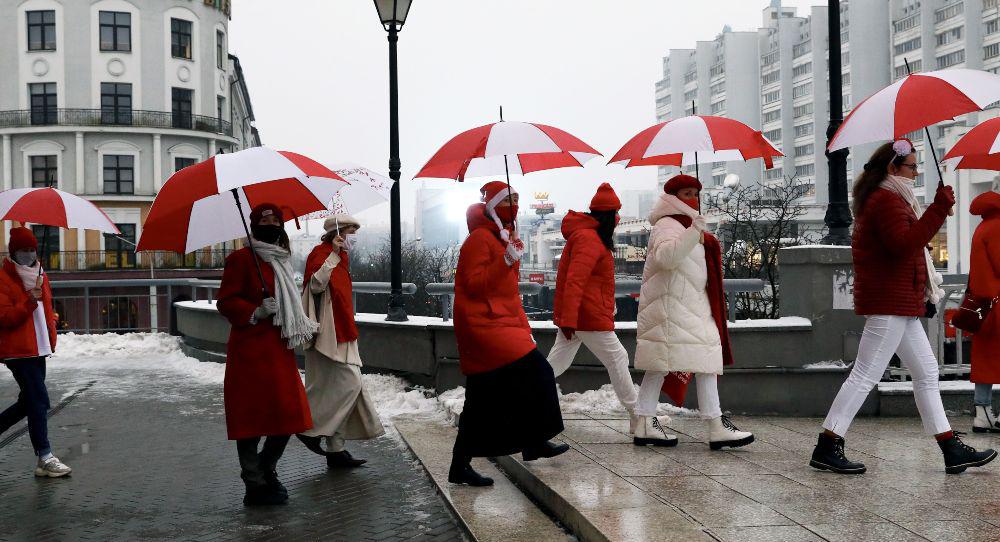
The protests in Belarus against President Alexander Lukashenko will reach the 200-day mark at the end of February 2021.
With the violent and comprehensive repressions by Belarusian security forces—and additionally with the wintry weather—the size of the protests has dwindled, but the protest spirit is being kept alive through ever new small-scale actions, particularly in local neighborhoods in Minsk and other cities.
According to the Minsk-based human rights organization Viasna, 33,000 people have been detained since the beginning of the protests in August 2020, when Lukashenko claimed victory after a rigged presidential election.The extreme repression also targets journalists documenting the developments, thereby reducing the number of images circulating and reports on what is happening on the ground.
In turn, less reporting and images of “only” small protest actions reduce international public attention; Belarusian society by and large remains an unknown to most Europeans. But the high degree of politicization of society in Belarus—beyond simply the protesters—has important implications for Western policymakers.
Sociological data on Belarusian society today is still rare, but an online survey conducted by the Centre for East European and International Studies (ZOiS) in December 2020 among 2,000 Belarusians aged 16–64 from cities of over 20,000 inhabitants—based on a quota sample representative for age, gender, and place of residence—provides insights into the degree of societal politicization beyond actual protest participation.
Of the respondents, 14 percent have taken part in protests between August and December—this amounts to about 700,000 of the 5 million Belarusians represented by the survey. Only a minority of these protesters (4 percent of all respondents) reported previous protest experience, thereby illustrating the mobilizing effect of this movement. Overall, 6 percent of respondents refused to answer the question, possibly due to safety concerns.
The focus of international observers and media so far has been on the protesters. What is striking, however, is the extent to which Belarusian society at large has been politicized.
Even though views of the protests remain diverse—29 percent of respondents agreed with them, while 20 percent completely disagreed—a remarkable 57 percent of the Belarusians surveyed said they are now more interested in politics than before the onset of the protests.
A third stated that their level of interest in politics had not changed, 7 percent were now less interested in politics, and just below 4 percent refused or did not know how to answer the question.
In line with these results, a staggering 71 percent named social media as their most important source of information from a long list of news sources, followed by only 10 percent reporting that they primarily turn to the state media for information. As their second most important source of information, respondents most frequently identified international, non-Russian media (22 percent).
Given the wide age range captured by the survey, the overall shift away from Belarusian state media is remarkable.
In view of this considerable politicization of society, the question about attitudes toward democracy proved particularly revealing: just below 42 percent of respondents agreed with the statement that democracy was the best form of government. Only 13 percent thought that sometimes authoritarian government is preferable to democracy, while about 9 percent said the type of government did not matter to them.
However, close to 33 percent did not know how to answer the question—and about 4 percent refused to give an answer. This high degree of uncertainty about the types of government and, by implication, their suitability for Belarus, points to a considerable ideational vacuum at the heart of the Belarusian society.
On the one hand, this may not come as a surprise after many years of Lukashenko’s authoritarian rule. On the other hand, it maps a wide-open field for Western actors, for example to enable Belarusians easier access to democratic countries, provide possibilities to study abroad, create settings to provide information and discuss expectations, and think of other ways to fill the concept of democracy with meaning and concrete experiences.
As of February 11, Lukashenko’s attempt to cling to power by all means takes an additional institutional focus; the so-called All Belarusian People’s Assembly is meant to begin its work, possibly with a mandate to consider Lukashenko’s still unknown ideas for constitutional reform. The assembly consists of over 2,000 delegates, including representatives of all levels of government, members of the parliament, and directors of Belarus’s large enterprises.
Lukashenko has made use of this body several times before to legitimize his political decisions. With the pressure from Russia to initiate constitutional reforms easing as the Kremlin faces its own domestic political challenges around new anti-regime mobilization, the carefully selected members of the assembly are bound to rubberstamp any proposals that will allow Lukashenko to present himself as a reformer without changing any of the basics of the Belarusian political system.
Lukashenko will tap into the 33 percent of society that remains uncertain about which regime type is best suited for Belarus. Western democratic governments and societies should do the same.
Gwendolyn Sasse is a nonresident senior fellow at Carnegie Europe and director of the Centre for East European and International Studies (ZOiS) in Berlin.
The survey referred to in this article was funded by the German Federal Foreign Office. The interpretation reflects the author’s views.
Nonresident Senior Fellow, Carnegie Europe
Gwendolyn Sasse is a nonresident senior fellow at Carnegie Europe. Her research focuses on Eastern Europe, with a particular focus on Ukrainian politics and society, EU enlargement, and comparative democratization.
Recent Work
Gwendolyn Sasse
Gwendolyn Sasse
Carnegie does not take institutional positions on public policy issues; the views represented herein are those of the author(s) and do not necessarily reflect the views of Carnegie, its staff, or its trustees.
Europe seems to have accepted its sidelining in the Middle East. The EU must reassert its support for the international rules-based order and step up engagement.

Rym Momtaz

Amid uncertainty caused by the Iran war, the global drive for nonproliferation has stalled. With Europe diplomatically marginalized and countries reassessing their nuclear options, efforts to curb the spread of nuclear weapons risk becoming irrelevant.
Jane Darby Menton
Preparing candidate countries for EU membership is no longer enough. As the enlargement process becomes a reality, the union must also prepare its own societies.

Iliriana Gjoni
Five countries staged the biggest political boycott in Eurovision history over Israel’s participation. With the FIFA World Cup and other sporting or cultural touchstones on the horizon, are boycotts effective?
Rym Momtaz, ed.
The full list of humiliations Europe has endured since Donald Trump returned to the White House makes for grim reading. But Washington’s adversarial approach to its allies undermines its own power base.
Rym Momtaz