

Commentary
Judy Dempsey
{
  "authors": [
    "Judy Dempsey"
  ],
  "type": "commentary",
  "blog": "Strategic Europe",
  "centerAffiliationAll": "",
  "centers": [
    "Carnegie Endowment for International Peace",
    "Carnegie Europe"
  ],
  "collections": [],
  "englishNewsletterAll": "",
  "nonEnglishNewsletterAll": "",
  "primaryCenter": "Carnegie Europe",
  "programAffiliation": "",
  "programs": [],
  "projects": [],
  "regions": [
    "Russia",
    "Europe",
    "Eastern Europe"
  ],
  "topics": [
    "Democracy",
    "Political Reform",
    "EU"
  ]
}
Source: Getty
Albeit unwittingly, the Soviet Union’s last president paved the way for complex democratic transformations across Eastern Europe. The values these countries fought for must now be protected within the EU itself.
Change and hope.
Such was the atmosphere when Mikhail Gorbachev visited the Romanian capital in May 1987.
Back then, once dubbed the Paris of the Balkans, Romanian President Nicolae Ceaușescu had built gigantic party and government complexes.
Large swathes of this elegant city were demolished. Not that the public benefited. Ceaușescu’s measures to pay off international loans and impose his own style of ruthless communist rule imposed a terribly high cost for the population.
From the mid-1980s, food was scarce. Electricity and hot water were spasmodic. The Securitate, the dreaded secret police, was ubiquitous. By the late 1980s most of my sources and old friends were too afraid to talk. A climate of fear prevailed. Until Gorbachev visited the country.
I won’t forget that day. Gorbachev’s tour included a visit to the central market. Ceaușescu wanted to show off the abundance of fruit, vegetables, meat, and cheeses—produce that the public hadn’t seen for a long time. Except for that day. As soon as the tour was over, a throng of people rushed into the market to snap up anything in sight. It was almost a stampede.
Stampede is one way of describing Gorbachev’s double legacy he unwittingly bequeathed to his own country and to a part of Europe that the Kremlin reigned over. Despite immense opposition from the party apparatus and KGB, he brought change and hope to millions of people who for decades had been denied basic freedoms.
The changes were nothing short of revolutionary. Just recall how entrenched was the communist one-party system, in which power was maintained by repression, by corruption, by the secret police, by lying, by deceit, by censorship. Travel was banned. Passports were a luxury. Dissent in most countries was stamped out.
Across Central and Eastern Europe, especially after the Berlin Wall fell in November 1989, the thirst for change and hope was palpable.
But making the change from a communist system—over seventy years in the case of the former Soviet Union and over forty-five years since the communist takeover of Eastern Europe after 1945, was unprecedented and complicated.
It meant building independent institutions, introducing the rule of law and accountability, establishing a market economy, holding free elections, and establishing a free press. It meant dismantling the secret police and the communist nomenklatura that maintained the ancien regime and the structures of repression.
And it meant needing people to make such an extraordinary mental, political, social, and economic transformation. Under two systems that had destroyed what was left of the middle class, with Joseph Stalin and Adolf Hitler murdering so many millions of people, the paths to democracy and change were traumatic.
For example, the debates about how to deal with the past and those who were in the security services and secret police were intense. Depending on the country, some of the new leaders wanted a blanket lustration law that would ban anyone involved in the security apparatus from holding any kind of public office. This was the case is the Czech Republic.
In Romania, after 1989, when the Securitate and old guard clung onto power in the guise of new political parties, the archives remained closed until the mid-2000s. The old system did its utmost to endure and block reforms while a younger generation tried to create a new political class.
In Russia, after the collapse of the Soviet Union, it was hard to know how the transformation could take root. Gorbachev had unleashed perestroika (restructuring). It brought opportunity, excitement, and freedoms unthinkable just a few years back. It also brought uncertainty, resentment, and crackdowns. In January 1991, ten months after Lithuania had declared its independence, Soviet troops stormed the TV tower and parliament, among other buildings in Vilnius, and fired at unarmed citizens, killing fourteen and wounding hundreds.
Gorbachev began opening the archives. That meant dealing with a past that was built on repression both inside the country and in Eastern Europe. President Vladimir Putin, in contrast, has reversed that change. When he banned Memorial last year, it was about suppressing investigations by civil society into the Stalinist past.
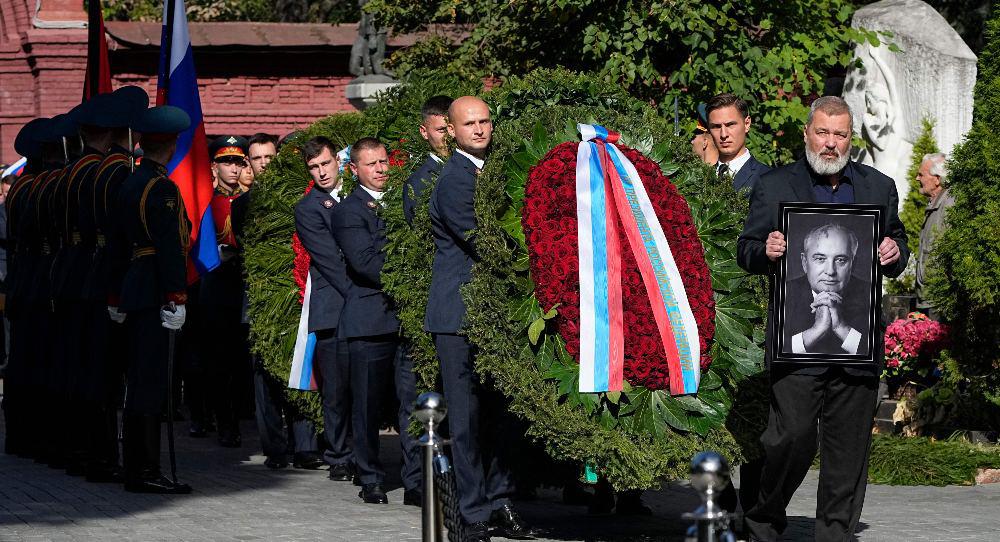
The hope and ambiguities that Gorbachev inspired were present during his funeral on September 3. Thousands lined up quietly to pay their respects to a leader some were too young to remember.
Not Vladimir Putin. He was too busy. Despite how Putin has turned Russia increasingly into an authoritarian state—on September 5, a court meted out a twenty-two-year prison sentence to former journalist, Ivan Safronov—hope for change lingers.
The changes brought about by the transformation of countries across Eastern Europe have been rocky and often controversial. But they were essentially about freedom and democracy.
Yet looking at Hungary and Poland today, the governing Fidesz and Law and Justice respectively seem intent on rolling back the gains of 1989. The rule of law—the fight for which was paramount back then—is being blatantly challenged and undermined.
The EU and NATO, the two organizations that opened their doors to their East European counterparts and helped make Europe “whole and free” cannot afford to take the transformations of the 1990s for granted.
The EU in particular needs to consolidate these transformations by robustly defending the system of democratic values upon which the bloc is built. It is these values that East Europeans long dreamt about or struggled for. It is what Ukrainians are fighting for, against Russia’s determination to reverse that country’s transformation. Most East Europeans understand what is at stake.

Nonresident Senior Fellow, Carnegie Europe
Judy Dempsey is a nonresident senior fellow at Carnegie Europe
Recent Work
Judy Dempsey
Judy Dempsey
Carnegie does not take institutional positions on public policy issues; the views represented herein are those of the author(s) and do not necessarily reflect the views of Carnegie, its staff, or its trustees.

Before the next wave of EU enlargement takes place, the union needs to grapple with thorny questions of how power is distributed among its members.


Emil Sondaj Hansen, Ditte Brasso Sørensen

A summer of escalation in the Black Sea has hurt Ukraine economically and is exacerbating world food security. A truce is needed—as is a broader reframing of Europe’s Ukraine strategy.

Thomas de Waal

Are Germany’s economic, industrial, and political struggles becoming a liability for the EU’s ability to rise to the geopolitical moment?

Rym Momtaz, ed.

European Commission President Ursula von der Leyen is about to give her annual address on the state of the EU. Here’s what she won’t—but should—say.
Rym Momtaz

The aftermath of the Ceuta crisis shows Europe has drawn the wrong lessons. Rather than doubling down on failed migration policies, the EU needs to address the underlying roots of such episodes.

Richard Youngs