

Commentary
Russia is testing the waters of NATO’s mutual defense clause. What do strikes in Romanian territorial waters mean for the alliance’s posture toward Moscow?
Dimitar Bechev
{
  "authors": [
    "Monika Sus"
  ],
  "type": "commentary",
  "blog": "Strategic Europe",
  "centerAffiliationAll": "",
  "centers": [
    "Carnegie Endowment for International Peace",
    "Carnegie Europe"
  ],
  "englishNewsletterAll": "",
  "nonEnglishNewsletterAll": "",
  "primaryCenter": "Carnegie Europe",
  "programAffiliation": "",
  "programs": [],
  "projects": [],
  "regions": [
    "Central Europe",
    "Europe",
    "Eastern Europe"
  ],
  "topics": [
    "Domestic Politics",
    "Democracy",
    "EU"
  ]
}
Source: Getty
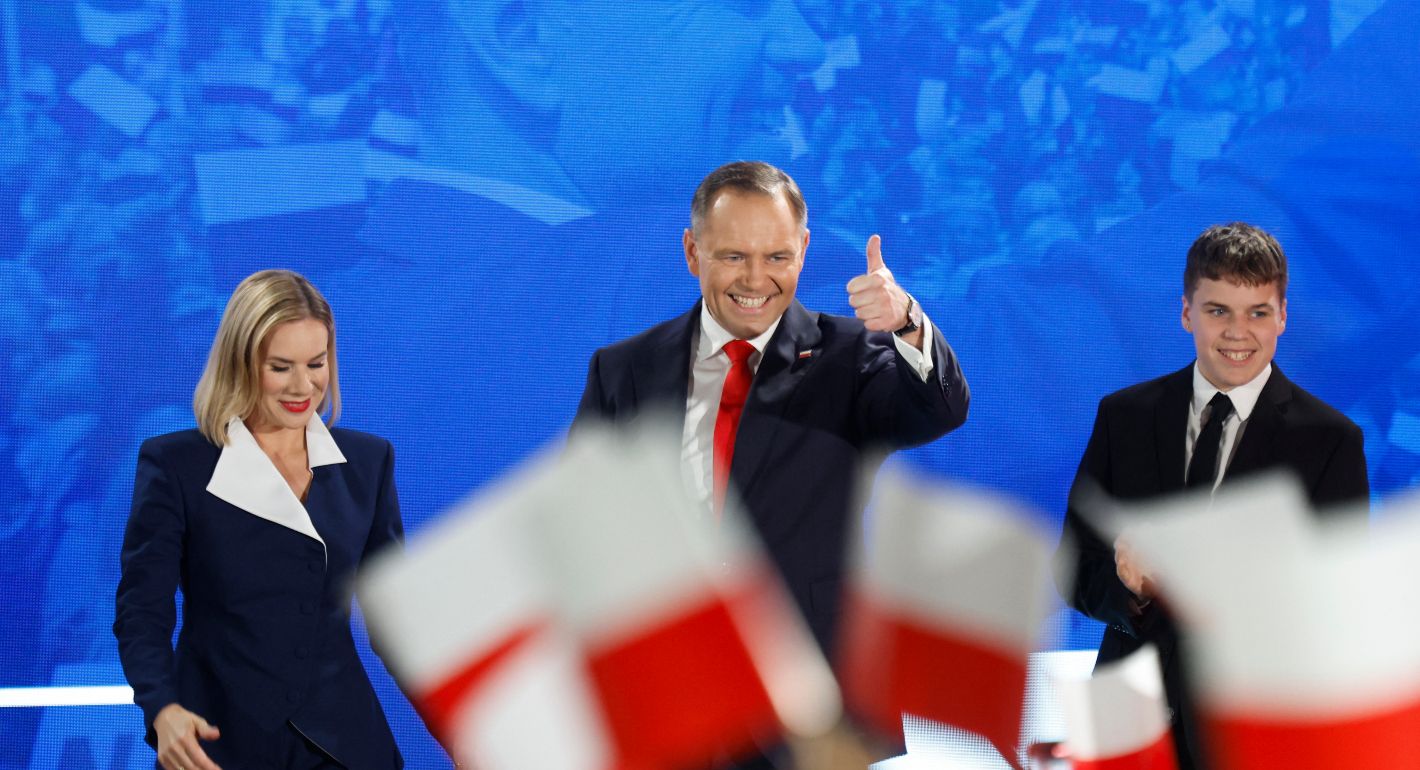
The election of populist Karol Nawrocki as Poland’s president poses challenges to the country’s reform agenda and deeper EU integration. Yet, the narrow result underscores that Poland still has a strong, resilient pro-European democratic core.
The progressive European camp has failed in what was arguably the continent’s most consequential election of the year. Despite successfully thwarting the populist EU skeptics in Moldova and Romania, they lost Poland, and the consequences are hard to overstate.
In a nail-biting finish, populist candidate Karol Nawrocki, backed by the far-right Law and Justice (PiS) party, narrowly defeated liberal Warsaw Mayor Rafał Trzaskowski backed by the ruling centrist Civic Coalition (KO), clinching 50.89 percent of the vote.
Most of the blame lies at the feet of the liberal coalition led by Prime Minister Donald Tusk. It successfully worked on restoring liberal democracy and returning Warsaw to the heart of Europe’s geopolitical awakening to face the heightened Russian threat. However, it fell short of convincing low-educated voters, mostly in smaller towns and rural areas, as well as a significant number of young men, to embrace their pro-European and liberal agenda.
Nawrocki, a largely unknown figure without prior political or international experience, delivered a more compelling narrative, centered on sovereignty and the defense of Polish traditions against urban liberal elites and progressive social movements. Although he is an unproven political quantity, his campaign rhetoric and affiliation with PiS, whose eight years in power deeply polarized Polish society and strained relations with the EU, signal potential turbulence ahead.
His presidency is poised to both obstruct the liberal coalition’s already fragile reform agenda and to hinder the EU’s geopolitical and defense awakening. Though the prime minister is in charge of setting foreign, defense, and economic policies, the president has veto power over key legislation, including the national budget and security and defense appointments. As a key member of the EU and NATO, Poland’s political deadlock will impact the EU’s ability to face the Russian threat, Chinese competition, as well as the turmoil with the Trump administration.
Domestically, it is likely Nawrocki will block progressive initiatives, especially on LGBTQ+ rights and abortion. He is also expected to veto efforts to restore judicial independence. While judicial reform is one of the areas of broad agreement among the coalition government partners, the social issues have proven too contentious.
The Tusk government now faces a more uphill battle as it will attempt to hold on to power in the 2027 parliamentary elections. The fact that it has not managed to bring forward laws on legal reform or social matters disappointed many progressive voters, who had expected meaningful change. Despite Nawrocki’s likely resistance, Tusk must clearly signal that his coalition has a roadmap to push forward—even if symbolically—on its promised reforms.
The liberal bloc also needs to find a way to win over young men and residents of rural areas and small towns. To do so, it must address everyday concerns like job security, housing, and cultural insecurity, and prove that liberal democracy can deliver tangible results for all—not just for urban elites.
That task just became harder: Nawrocki’s victory and his MAGA-inspired agenda have energized the PiS camp, which naturally appeals to these segments of the electorate. Also, the far-right Konfederacja political alliance—led by Sławomir Mentzen who played a key role in attracting young voters to Nawrocki in the runoff—is expected to be a strong force in the 2027 general elections, appealing to both the youth and disillusioned mainstream voters.
Regionally, Nawrocki is expected to challenge the European agenda by reinforcing nationalist narratives and amplifying skepticism toward deeper EU integration. Although the Polish government formally sets EU policy, limiting the president’s direct power, he still retains the ability to shape public discourse and pressure policymakers.
While Nawrocki may not formally align with Hungarian Prime Minister Viktor Orbán’s populist camp, given substantial differences on Russia, his rhetoric is likely to support its goals indirectly. Given his ideological proximity to MAGA-style conservatism, he will be an obstacle for the government on migration and rule of law issues.
Under Tusk, Poland emerged as a vocal advocate for strengthening the EU’s defense industrial base. Nawrocki’s resistance to deeper European integration and his strong pro-U.S. stance likely mean he will oppose Poland’s role in strengthening Europe’s strategic autonomy and defense cooperation. While the president cannot directly block the government’s EU policy, Nawrocki is expected to instrumentalize these issues domestically, highlighting risks to national sovereignty and Poland’s America-first approach.
Nevertheless, Nawrocki is expected to support Poland’s robust military posture, including elevated defense spending and military modernization, but his election raises serious questions about the country’s broader foreign and security policy orientation. His close alignment with the United States suggests continued strong support for NATO. However, his public opposition to Ukraine’s membership marks a break with Poland’s consistent stance. This could potentially weaken frontline allies, who have so far viewed Ukraine’s NATO bid as a long-term strategic priority.
At the same time, he will likely support military aid for Ukraine. He holds no sympathy for Russian President Vladimir Putin and recognizes that Ukraine’s victory is vital to Poland’s interests. As a result, it will be difficult for him to align with Washington if U.S. President Donald Trump pursues a reset with Moscow. However, as Nawrocki will try to pave the way for a PiS victory in the 2027 general elections, he will likely respond to concerns of the right-wing electorate about the financial strain on public services and social welfare caused by hosting Ukrainian migrants, challenging the government’s policies.
Despite these challenges, Europe should not dismiss Poland as regressive or lacking in democratic values. Many Western European democracies face similar challenges, having to resist right-wing populism, and no one questions the strength of their democratic systems. These elections were lost by the narrowest of margins. Nearly half of Polish voters remain pro-European, liberal citizens of Europe—many of whom view the Tusk government as insufficiently progressive. They too are an integral part of the country.
Monika Sus is a professor at the Institute for Political Studies, Polish Academy of Sciences, Warsaw.

Monika Sus
Professor, Institute for Political Studies, Polish Academy of Sciences
Monika Sus is a professor at the Institute for Political Studies, Polish Academy of Sciences, Warsaw.
Carnegie does not take institutional positions on public policy issues; the views represented herein are those of the author(s) and do not necessarily reflect the views of Carnegie, its staff, or its trustees.

Russia is testing the waters of NATO’s mutual defense clause. What do strikes in Romanian territorial waters mean for the alliance’s posture toward Moscow?

Dimitar Bechev

With its public finances in shambles, the far right polling at 35 percent ahead of the 2027 presidential election, and a growing protest movement, is France’s crisis a threat to the EU’s geopolitical awakening?

Rym Momtaz, ed.

Ahead of a tough winter for Ukraine, Donald Trump’s swing back toward Russia bodes ill. But instead of panicking, Kyiv’s European allies are focusing on action.
Rym Momtaz

While the EU and European governments are embracing the much-lauded middle-power moment, this entails three difficult conundrums.

Richard Youngs

Much has been said of the changes Brussels is trying to make to the EU enlargement process. Here’s why gradual integration might—or might not—be the answer.
Dimitar Bechev