

Commentary
The EU can impose sanctions but struggles to enforce them without the United States. With Washington increasingly disinterested in backing European interests, the bloc must now fend for itself.
Nicu Popescu, Tiago Antunes
{
  "authors": [
    "Oana Popescu-Zamfir"
  ],
  "type": "commentary",
  "blog": "Strategic Europe",
  "centerAffiliationAll": "",
  "centers": [
    "Carnegie Endowment for International Peace",
    "Carnegie Europe"
  ],
  "collections": [
    "EU Integration and Enlargement"
  ],
  "englishNewsletterAll": "",
  "nonEnglishNewsletterAll": "",
  "primaryCenter": "Carnegie Europe",
  "programAffiliation": "",
  "programs": [],
  "projects": [],
  "regions": [
    "Moldova",
    "Europe",
    "Russia"
  ],
  "topics": [
    "Democracy",
    "EU",
    "Domestic Politics"
  ]
}
Source: Getty
Moldova’s upcoming parliamentary election will mark the next face-off between Brussels and Moscow in the EU’s neighborhood. If Chișinău holds the pro-EU line, it will show that even a small democracy can move forward under extraordinary pressure.
In Moldova’s upcoming parliamentary election on September 28, the fight will take place on two simultaneous levels: geopolitical and domestic.
It is undoubtedly on the frontline of a larger geopolitical confrontation between the EU and Russia over influence in the region. Moscow has devoted sustained efforts to derail Chișinău’s EU path, and it has made Moldova a template for its asymmetrical advantage over the union. In the short run, Russia doesn’t need to engineer a sweeping victory. Its coalition control strategy aims to produce a fractured parliament or a weakened pro-European coalition. That would suffice to stall reforms, paralyze governance, and keep Moldova trapped in a cycle of vulnerability.
All Moscow needs is for its allies to enter parliament and have access to ministries of interior, justice, or economy to slow EU benchmarks, reopen dependence on Gazprom, and shield corrupt elites from prosecution. While Moldova would still appear democratic and EU funds would continue flowing, the state could be hollowed out from the inside. And the EU has not come up with an effective counterstrategy.
But it would be erroneous to make it all about foreign interference and shortchange Moldovans’ agency. The irony is that Moldova’s ruling pro-EU Party of Action and Solidarity (PAS) has learned to anticipate and counter Russia’s moves better than almost any peer in the region. But it is struggling to effectively engage the pro-democracy swing voters, address their concerns, and demonstrate tangible benefits from Europe.
Despite the high stakes of this election, the percentage of those declaring themselves undecided—40 percent—is proof of this. The effective countering of Moscow’s narratives must be matched with policies and messaging that resonate with Moldovan voters.
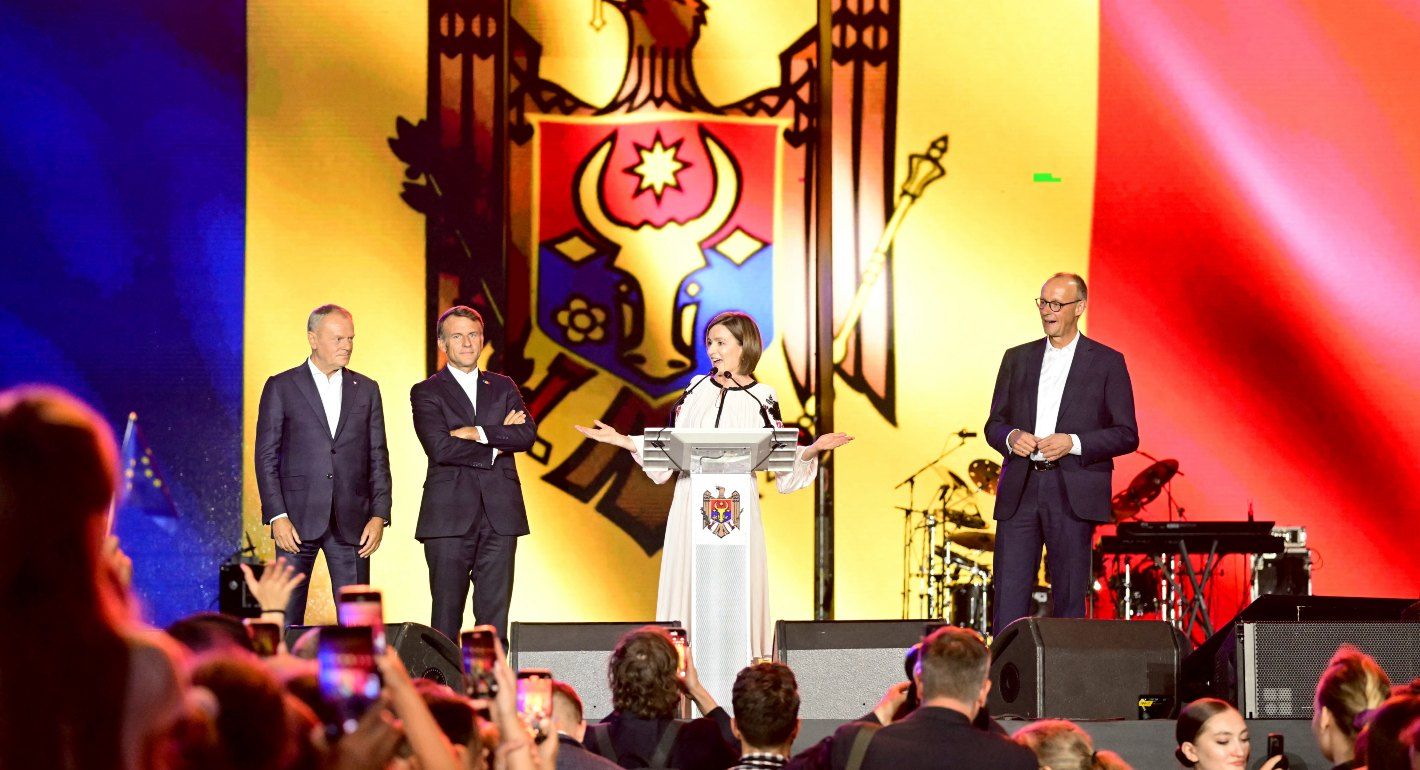
High-level visits by French President Emmanuel Macron, Polish Prime Minister Donald Tusk, and others testify to Western support for Moldova’s European future; but it is the task of genuine pro-European parties to convince their constituencies of the added value of this choice. PAS must also stop leaning on the expectation that even if it falls short of a majority, redistribution of votes will secure control. Moldova’s electoral arithmetic is unforgiving, and public discontent is real.
Moscow has devised a well-rehearsed playbook to exploit it. Russian proxies funnel illicit finance, spread disinformation on Telegram and TikTok, and mobilize clerical and regional networks to paint Europe as a threat to identity and prosperity. Each spike in gas prices, each blackout, each rumor about Brussels’s dictates is weaponized into a narrative that Moldova is better off bound to Moscow.
So far, the administration of Moldovan President Maia Sandu and PAS has proven remarkably effective at containing these hybrid threats. Security services foiled plots to import provocateurs in 2023 and 2024. Disinformation spikes around the 2024 referendum on EU integration were countered by coordinated prebunking campaigns. Investigations linked over 130,000 attempted vote purchases to networks affiliated with fugitive oligarch Ilan Shor, demonstrating both the scale of the threat and the vigilance of Moldovan authorities.
But that’s not enough to remove the real challenges that parts of the electorate are facing. Rural Moldovans worry about bills and harvests. Urban youth complain about unemployment, corruption, and low incomes, while the elderly suffer poverty because of small pensions. Fear of war stands at the bottom of the list, after all these other priority concerns.
The stakes are considerable. If PAS retains a majority, Moldova can continue the painstaking reforms required for EU accession. However, if PAS loses its majority, coalition arithmetic could produce a government paralyzed by obstruction, or worse, one forced to share power with Russian-aligned actors. The room for compromise and coalition-building with other palatable political allies is limited. Such an outcome would stall the country’s reforms and embolden Moscow to replicate the playbook elsewhere.
For the EU, the message is equally urgent. Brussels has a habit of withdrawing when governments become less committed or outright hostile—as in Georgia—or pandering to authoritarians that pay lip service to the union—as in Serbia—leaving behind societies that yearn for a democratic path. The bloc cannot afford to abandon Moldova’s largely pro-European population if the country’s politics become messy.
The face-off with Russia is set to last across the EU’s neighborhood and in some member states, and the EU has remained behind the curve.
The United States, the EU, and Canada have sanctioned figures behind the disinformation campaigns, notably Shor and his network. Yet the Russian interference ecosystem remains a step ahead—more agile, reactive, and quick to adapt, in time for Moldova’s electoral calendar.
Brussels could make two changes that would have much impact. First, the EU must change its unanimity voting rules, which are being subverted by countries like Hungary for ulterior motives. Budapest’s opposition to Ukraine’s entry in the EU has taken hostage Moldova’s accession track, especially since decoupling the two countries would send a negative political message. Second, the EU should front-load tangible benefits for the population of candidate countries in the early phases of the accession process. The union should redesign its assistance programs so they support the actual reliable allies of EU integration: the populations of these countries, not necessarily their temporary governments.
The elections are about more than Moldova. If they produce a fractured, contested outcome, the EU’s enlargement policy takes a hit, Ukraine’s western flank becomes less secure, and Moscow scores a symbolic victory across the Black Sea region. Conversely, if Moldova holds the line—with credible elections, a broadly trusted outcome, and a government still committed to reforms—it will show that even a small, vulnerable democracy can move forward under extraordinary pressure.
Russia is betting that Moldova will lose, not because of tanks or troops, but because of apathy at home. Chișinău hopes that its EU partners will help it not only to prevent a defeat at the hands of Russia, as has been the experience of neighboring Ukraine, but also to prevail over Moscow and its proxies.
Oana Popescu-Zamfir is the director of the GlobalFocus Center in Bucharest, Romania.

Oana Popescu-Zamfir
Director, GlobalFocus Center
Oana Popescu-Zamfir is the director of the GlobalFocus Center, where she coordinates the organization’s Democratic Resilience Program.

The EU can impose sanctions but struggles to enforce them without the United States. With Washington increasingly disinterested in backing European interests, the bloc must now fend for itself.


Nicu Popescu, Tiago Antunes

Russia is testing the waters of NATO’s mutual defense clause. What do strikes in Romanian territorial waters mean for the alliance’s posture toward Moscow?

Dimitar Bechev

With its public finances in shambles, the far right polling at 35 percent ahead of the 2027 presidential election, and a growing protest movement, is France’s crisis a threat to the EU’s geopolitical awakening?

Rym Momtaz, ed.

Ahead of a tough winter for Ukraine, Donald Trump’s swing back toward Russia bodes ill. But instead of panicking, Kyiv’s European allies are focusing on action.
Rym Momtaz

While the EU and European governments are embracing the much-lauded middle-power moment, this entails three difficult conundrums.

Richard Youngs