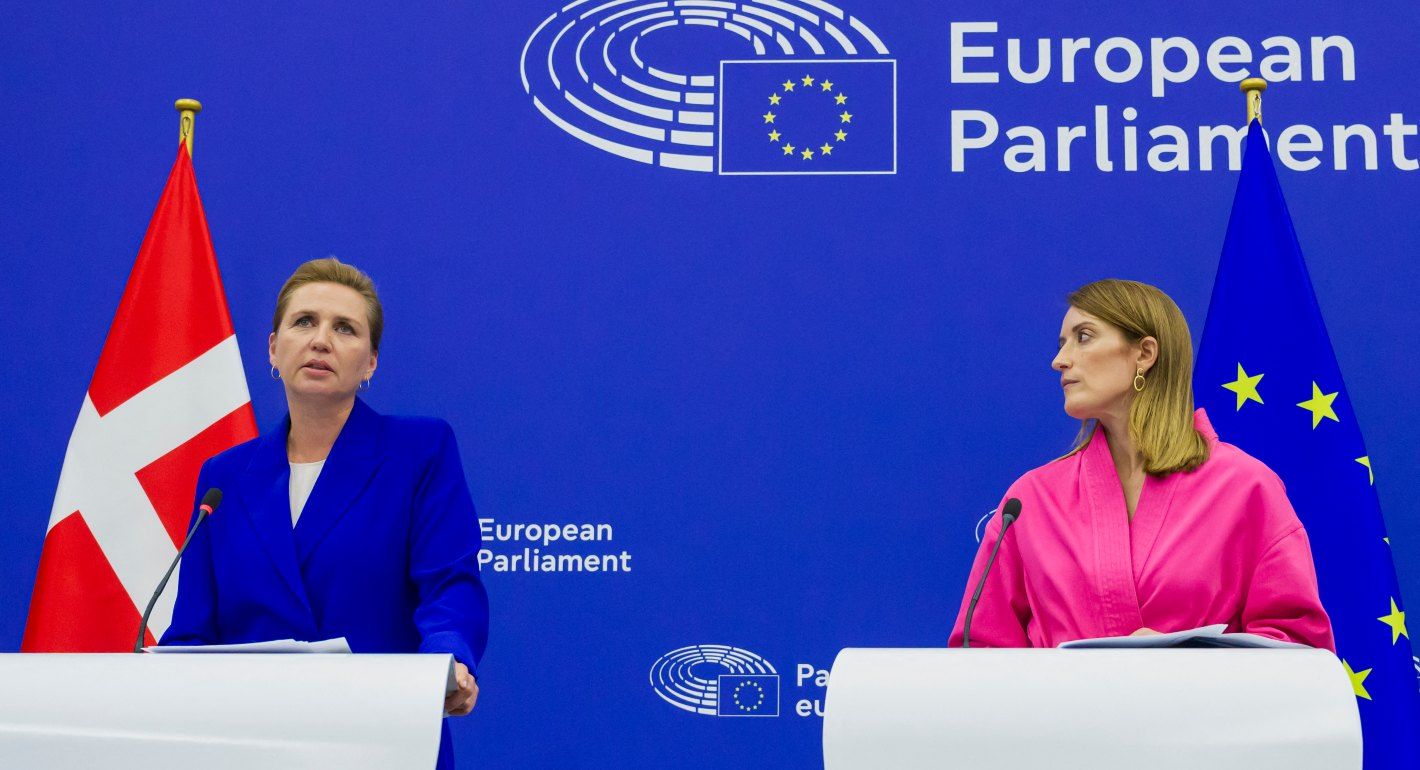
Just two days into the Danish presidency of the Council of the EU, the European Commission released its proposal to reduce the EU’s greenhouse gas emissions by 90 percent by 2040.
While Danish Prime Minister Mette Frederiksen has sought to manage expectations and declared that there will be no signature project of the Danish presidency, getting commitments that preserve the European climate transition goals would be a significant geopolitical achievement.
With global turmoil, the U.S. President Donald Trump administration’s spoiling of the climate transition agenda, and increasing European domestic tensions crystallizing in part against the costs of the climate transition, the context isn’t helping. But if the EU were to cede its global leadership role on climate, it would be ceding one of its few levers to set itself apart from the United States as a different kind of global player.
An unambitious EU target would also provide a convenient excuse for major global emitters—like China or India—to underdeliver on their own targets, severely complicating the world’s efforts to contain the negative repercussions of climate change that are becoming a daily occurrence.
The EU has already missed the February deadline for submitting its 2035 target to the UN, as part of its nationally determined contribution. The final deadline is September 25. This gives the Danish presidency only a few weeks to land an agreement before the expected vote of the EU environment ministers on September 18.
Only six countries—Denmark, Finland, Luxembourg, the Netherlands, Slovenia, and Spain—strongly support the target of 90 percent. On the other hand, the Czech Republic, Italy, and Poland have voiced strong opposition. Others are willing to accept the 90 percent target in exchange for flexible accommodations. Pragmatism therefore seems to be the only way to unite a fractured council around an ambitious EU target to bring to the world at COP30.
The proposed target introduces flexibility by allowing 3 percent of reductions to be achieved through carbon credits. These allow member states that achieve emissions reductions elsewhere in the world, to include them in the count towards the EU target.
The 2040 target’s use of carbon credits is emblematic of a new paradigm in European climate action. Climate alone is no longer enough. Climate action needs to be embedded in concerns of security, competitiveness, and innovation.
Wopke Hoekstra, the EU climate chief, seems to want to bring European Commission President Ursula von der Leyen’s geopolitical ambition for the commission into the EU’s international climate policy. He envisions the carbon credits as a way of “building bridges” with partners in Africa and Latin America. Carbon credit projects often have social and economic benefits that help local communities in which the projects are based.
With the carbon credits, Hoekstra thereby opens the door to new alliances. The increased investment into carbon markets may also spur on technological innovation in carbon capture and storage, bioenergy, and direct air capture both in Europe and abroad.
NGOs and civil society have argued that outsourcing the emission reductions removes responsibility from the member states, highlighting the well documented controversies within carbon markets. But Hoekstra has dismissed these concerns, arguing that there will be strong impact assessments ensuring that the carbon credits used to achieve the targets will be robust and their origin and use will be verified, so that their achieved emission reductions are thoroughly proven. Additionally, the EU’s 2030 and 2050 targets will have to be achieved through domestic action only, as the carbon credits are not part of these targets. More importantly, with international carbon credits, the EU may help fix some of the transparency issues by bringing credibility to the nascent market.
What’s more, critics need to explain how an ambitious target without the flexibility offered by carbon credits would be politically feasible in this particular political moment. The 2040 proposal comes at a time of intense climate backlash in a continent characterized by high energy prices, farmers’ protests, and tight budgets squeezed by increased defense spending.
It now falls to Denmark, the first country to endorse the 90 percent target, to tread this fine balance between climate ambition and pragmatism. It must also mitigate and navigate the damage done by the Trump administration to international climate policy. In early August, the U.S. administration declared that it would not “hesitate to retaliate” against countries voting for an agreement at the International Maritime Organization for reducing emissions from shipping. Similar moves are likely to happen as we approach COP30.
In a sign of Denmark’s balancing act, it signed an agreement on climate cooperation with California on the same day that Trump ordered the Danish offshore wind developer, Ørsted, to halt its work on the $1.5 billion project off Rhode Island. Notably, it was the Danish Ambassador to the United States Jesper Møller Sørensen—rather than the Foreign Minister Lars Løkke Rasmussen—who signed the agreement with California Governor Gavin Newsom. This suggests that the Danes are treading carefully, trying not to provoke the administration’s ire against the backdrop of the crisis over Greenland. Similar pragmatism must be expected from Climate Minister Lars Aagard, as he leads the EU delegation in the negotiations for COP30 and must navigate possible confrontations with Washington.
It is clear, that the 2040 target is much more than simply a number. It will define the EU’s climate action—and either enhance or undermine its geopolitical weight for the decade to come. A decade, it seems, where the EU needs to fill the American vacuum in global climate politics, at a time where domestic ambition is shrinking. This moment calls for new pragmatic solutions that combine concerns of security, industry, and innovation with climate action.
Emil Sondaj Hansen is an observer of European climate and energy policy. He was the Crown Prince Frederik Fellow at the Harvard Kennedy School, and previously led the climate and energy portfolio in the political department of the Royal Danish Embassy in Berlin.