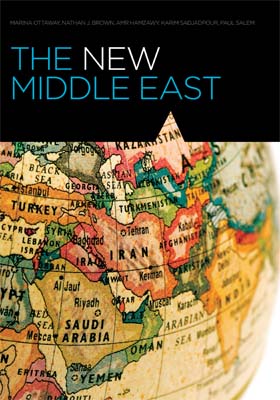
Confrontational U.S. policy that tried to create a “New Middle East,” but ignored the realities of the region has instead exacerbated existing conflicts and created new problems. To restore its credibility and promote positive transformation, the United States needs to abandon the illusion that it can reshape the region to suit its interests.
"Easily read in a single sitting, The New Middle East deserves more than one reading." —Foreign Affairs
Confrontational U.S. policy that tried to create a “New Middle East,” but ignored the realities of the region has instead exacerbated existing conflicts and created new problems, argues a new report from the Carnegie Endowment. To restore its credibility and promote positive transformation, the United States needs to abandon the illusion that it can reshape the region to suit its interests.
In The New Middle East, Carnegie Middle East experts Marina Ottaway, Nathan J. Brown, Amr Hamzawy, Karim Sadjadpour, and Paul Salem examine the new realities of the region by focusing on three critical clusters of countries—Iran–Iraq, Lebanon–Syria, Palestine–Israel, and on the three most pressing issues—nuclear proliferation, sectarianism, and the challenge of political reform—to provide a new direction for U.S. policy that engages all regional actors patiently and consistently on major conflicts to develop compromise solutions.
Recommendations for U.S. policy: • Given its current military commitments in Iraq and Afghanistan, the United States cannot impose a new order on the Middle East through confrontation, but must work with regional actors that are seeking to restore a balance of power in the region.
• Iran: Given that Iran is integral to several issues of critical importance to U.S. and EU foreign policy—namely Iraq, nonproliferation, energy security, terrorism, and Arab-Israeli peace—avoiding dialogue with Iran is not an option and confronting it militarily would only worsen what the West seeks to improve. Iran arguably has more common interests with the United States in Iraq than any of Iraq’s other neighbors. Shared interests should lead both countries to look to Iraq as a forum to build confidence, with the intention of gradually expanding the discussion to include the nuclear issue.
• Iraq: A political solution in Iraq cannot be achieved under the current policy based on a U.S. model of what Iraq should be, rather than what it is. To move forward, the United States must acknowledge that current efforts have failed, put Iraq’s political leaders on notice that the United States will not support them indefinitely, and engage with all of Iraq’s political factions.
• Israel and Palestine: The United States needs to recognize that time is running out on a two-state solution. Progress is impossible unless Hamas is brought back into the process and viable Palestinian leadership is restored.
• Lebanon and Syria: The Bush administration narrative that sees Lebanon as the battleground between democracy and autocracy must be replaced by a more accurate perception of a deeply divided country where all factions invite outside intervention. The United States needs to consolidate the gains of the Syrian withdrawal from Lebanon by encouraging compromise, the election of a new president, the drafting of a new election law, and the holding of elections on schedule in the spring of 2009.
• Democracy: The credibility of U.S. democracy promotion efforts has been severely undermined by the dangerous mix of grandiose rhetoric and inconsistent policies. A new policy must be based on a clear understanding of the possible consequences of democratization and a willingness to accept democratic outcomes even when not optimal from an American perspective. It must also focus on the countries where some progress is most likely.
“The United States needs a new approach to this part of the world, based less on confrontation and more on diplomacy, less on ideology and more on reality, and on a narrower definition of U.S. interests. Most of the problems discussed in this report cannot be solved, nor can they be bypassed, by creating a new Middle East, as the Bush administration tried to do. Some of the region’s problems can be alleviated through wise policy; others can at best be contained. Still others will have to be accepted for many years as part of a new Middle East landscape that has changed, but not for the better,” the authors conclude.
Click on the icon above for the full text of this Carnegie report.
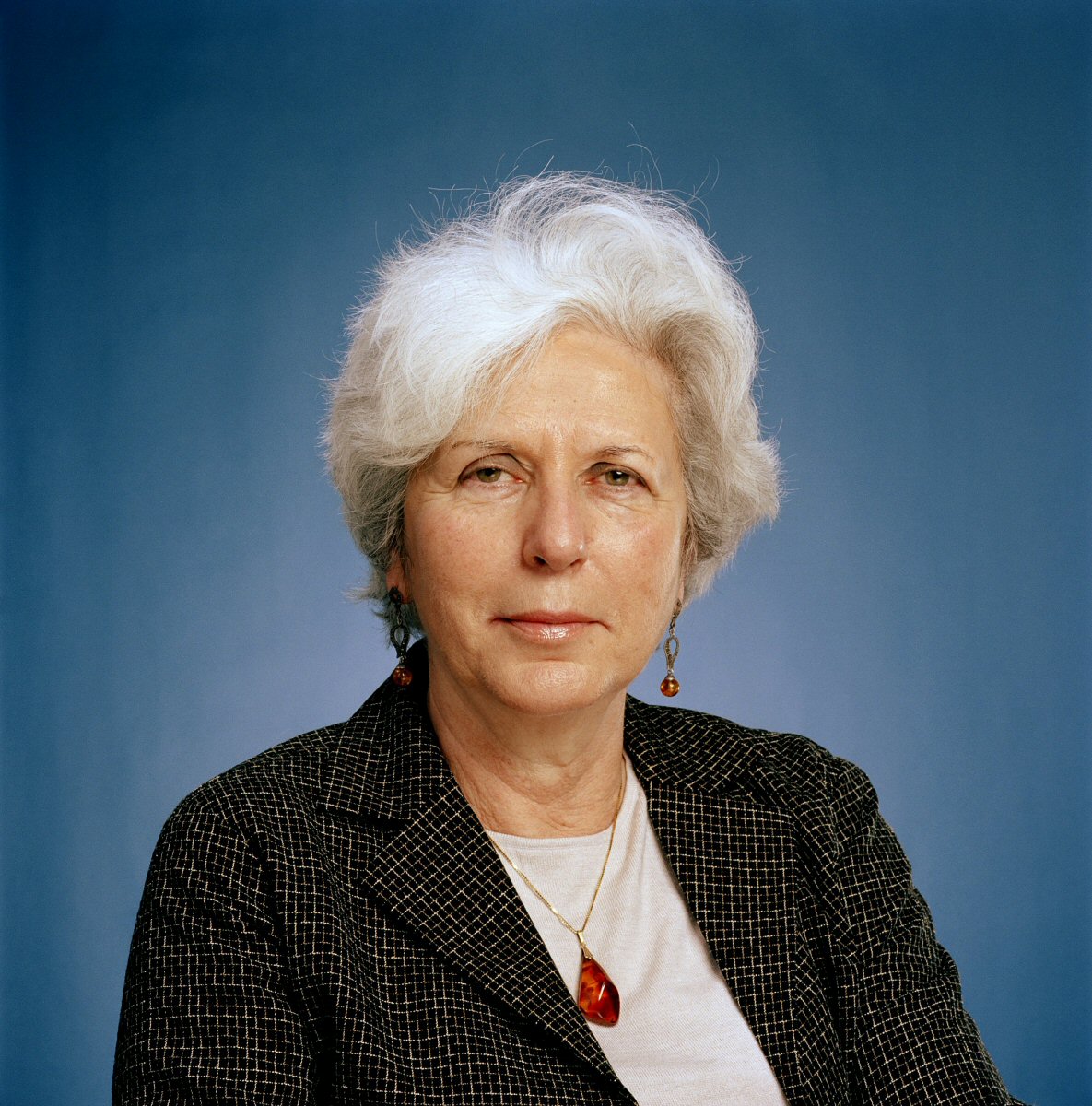
About the Authors Marina Ottaway is a senior associate in the Democracy and Rule of Law Program and director of the Carnegie Middle East Program. Her most recent book, Beyond the Façade: Political Reform in the Arab World (edited with Julia Choucair-Vizoso), was published in January 2008.
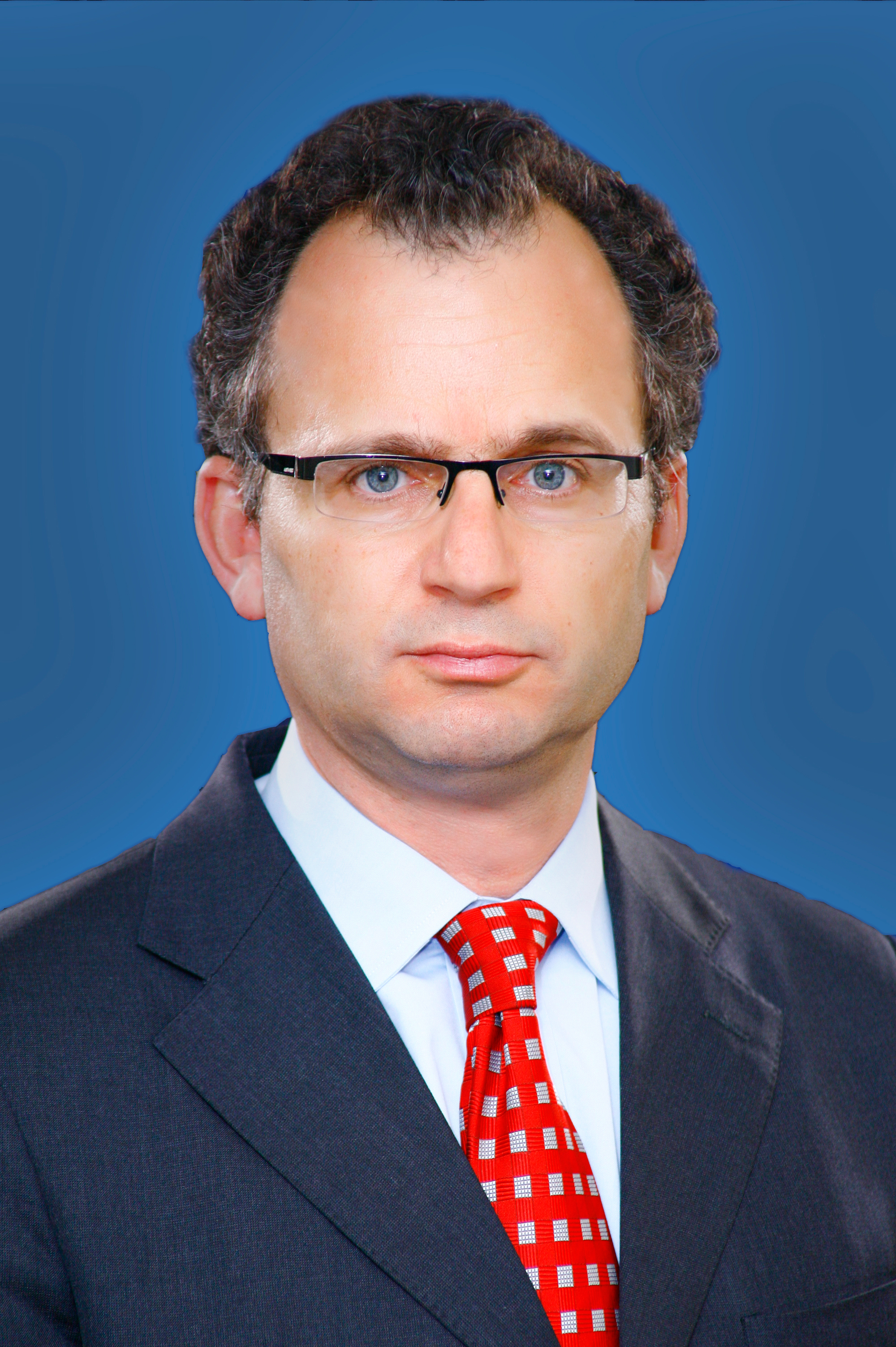
Nathan J. Brown is director of the Institute for Middle East Studies at George Washington University, a nonresident senior associate at the Carnegie Endowment, and a distinguished scholar and author of four well-received books on Arab politics.
Amr Hamzawy is a senior associate at the Carnegie Endowment and a noted Egyptian political scientist who previously taught at Cairo University and the Free University of Berlin. His most recent book, Human Right in the Arab World: Independent Voices (edited with Anthony Chase), was published in 2007.
Karim Sadjadpour is an associate at the Carnegie Endowment. Earlier, he was the chief Iran analyst at the International Crisis Group.
Paul Salem is the director of the Carnegie Middle East Center. Prior to this appointment Salem was the general director at The Fares Foundation and from 1989 to 1999 he founded and directed the Lebanese Center for Policy Studies, Lebanon’s leading public policy think tank.
Before joining the Endowment, Ottaway carried out research in Africa and in the Middle East for many years and taught at the University of Addis Ababa, the University of Zambia, the American University in Cairo, and the University of the Witwatersrand in South Africa.
Nathan J. Brown, a professor of political science and international affairs at George Washington University, is a distinguished scholar and author of nine books on Arab politics and governance, as well as editor of five books.
Amr Hamzawy is a senior fellow and the director of the Carnegie Middle East Program. His research and writings focus on Egypt’s and other middle powers’ involvement in regional security in the Middle East, particularly through collective diplomacy and multilateral conflict resolution
Karim Sadjadpour is a senior fellow at the Carnegie Endowment for International Peace, where he focuses on Iran and U.S. foreign policy toward the Middle East.
Carnegie India does not take institutional positions on public policy issues; the views represented herein are those of the author(s) and do not necessarily reflect the views of Carnegie, its staff, or its trustees.
In any defense establishment, change is an ongoing process. However, despite the best of intentions, existing bureaucracies, bound by habit and years of socialization, have their limits in implementing transformative change.
After the chill in ties between 2020 and 2024 that brought India–China relations to their lowest point in several decades, the two countries have engaged each other afresh. This paper argues that there are predominantly four imperatives guiding India’s approach to China, and they exist in an order of priority.
This piece argues that India’s central challenge is not managing a single flashpoint but resolving the underlying tension between expansion and institutional coherency of the BRICS grouping.
A partnership between India, a country of subcontinental size, and Africa, a continent of fifty-four countries, may seem asymmetric until one notes that both are home to nearly the same number of people—1.4 billion. This essay spells out the existing challenges to the partnership, its optimal potential, and the possible pathways to realize it over the next quarter-century.
The India–EU Free Trade Agreement (FTA) is shaping up to be one of the most consequential trade negotiations, both economically and strategically. But, what’s in the agreement, what’s missing, and what will determine its success in the years ahead