

Paper
Amr Hamzawy, Sarah Yerkes, Kathryn Selfe
{
  "authors": [
    "Amr Hamzawy"
  ],
  "type": "commentary",
  "blog": "Diwan",
  "centerAffiliationAll": "dc",
  "centers": [
    "Carnegie Endowment for International Peace",
    "Malcolm H. Kerr Carnegie Middle East Center"
  ],
  "collections": [
    "Arab Awakening",
    "Arab Spring 2.0"
  ],
  "englishNewsletterAll": "menaTransitions",
  "nonEnglishNewsletterAll": "",
  "primaryCenter": "Malcolm H. Kerr Carnegie Middle East Center",
  "programAffiliation": "MEP",
  "programs": [
    "Middle East"
  ],
  "projects": [],
  "regions": [
    "Middle East",
    "North Africa",
    "Sudan",
    "Egypt",
    "Libya",
    "Algeria",
    "Tunisia",
    "Iraq",
    "Lebanon",
    "Syria",
    "Bahrain",
    "Yemen",
    "Levant",
    "Maghreb"
  ],
  "topics": [
    "Political Reform",
    "Civil Society"
  ]
}
Source: Getty
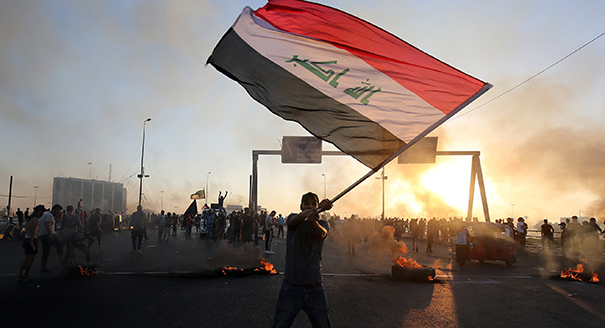
A new wave of Arab uprisings suggests that the authoritarian bargain of the past may be collapsing.
While thousands of Algerian citizens have continued to protest peacefully for the 40th consecutive week, demanding an accountable government and an end to corruption, streets in Iraq and Lebanon have turned into places of mass protests and ongoing confrontations between angry citizens and their governments.
These events were preceded in recent months by a popular uprising in Sudan, which led to the ousting of longstanding dictator ‘Omar al-Bashir and installed a new government based on a power-sharing agreement between the military and civilians. Meanwhile, in other Arab countries such as Jordan and Egypt citizens have staged minor protests to voice economic, social, and political demands.
That Arabs are once again taking to the streets has pushed to the fore the question of whether we are witnessing a second wave of the 2011 uprisings. At the time, citizens in Tunisia, Egypt, Libya, Syria, Yemen, and Bahrain mobilized to remove autocrats and demand democratic change and accountable governments. However, apart from Tunisia’s success in building a constitutional and political framework for a democratic transition amid rising economic difficulties, all other Arab countries either entered into civil war and state destruction—as in Libya, Syria, and Yemen—or slid back into repressive rule after a brief political opening—as in Egypt and Bahrain.
The meager results of the 2011 uprising gradually silenced popular calls for democratic change and accountable government. By 2013 majorities in the Arab world, collectively demobilized from protesting or disenchanted because of civil wars and repression, seemed again willing to accept their governments’ autocratic bargain: food and security in return for submission to unaccountable rulers. In the past this was effective in curtailing protests and delegitimizing peaceful political demands as harbingers of chaos and destruction.
To ensure that the 2011 uprisings are not repeated, Arab governments, with the exception of Tunisia, have passed draconian laws limiting citizens’ freedoms. They have extended the reach of the security services to keep opposition groups and pro-democracy activists in check. Furthermore, Arab governments have allocated more and more of the scarce resources in their countries to regime loyalists in the upper echelons of corrupt state bureaucracies and to crony business communities. They have also used their vast media arsenals to create personality cults around the rulers—whether presidents, kings, or crown princes—who have been portrayed as their nations’ sole saviors.
Yet, toward the end of 2018 and throughout the last months of 2019 Arab governments unexpectedly started to face popular challenges to their hopes for a Pax Autokratia. In countries that were not part of the 2011 uprisings, citizens have marched in the streets demanding political change. In Sudan, Algeria, Iraq, and Lebanon, the protests have been fueled by economic hardship and widely shared negative perceptions of governments’ commitment to improving living standards and ending corruption.
All four countries are listed in the Corruption Perceptions Index of Transparency International as endemically corrupt. Public opinion polls conducted in 2018 by Princeton University’s Arab Barometer have documented that economic development, combating corruption, and bettering the quality of public services are the most pressing issues for solid majorities in these countries. This is true for 79 percent of the Sudanese population, 81 percent in Algeria, 56 percent in Iraq, and 73 percent in Lebanon. Government institutions have lost citizens’ trust. According to the Arab Barometer, 70 percent of Sudanese do not trust their government, while the figure is 90 percent in Algeria, 87 percent in Iraq, and 81 percent in Lebanon.
Demands for political change in Sudan and Algeria have focused on ending the reign of military-controlled governments that have presided over deteriorating economies, staggering corruption, and poor public services, as well as human rights abuses. The demands for change in Iraq and Lebanon have aimed at transcending sectarian politics. Championed by students and young activists, mass protests in Iraq and Lebanon have made the removal of sectarian elites their top priority. These elites have ruled Iraq since 2003 and for decades have dominated Lebanese politics in ways that have stripped the representative democratic frameworks in the two countries of any liberal substance. Sectarian politics have systematically undermined the rule of law, enabled endemic corruption, and allowed the rise of militarized militias that operate outside legal frameworks to permanently threaten citizens and repress opponents.
Citizens in Sudan, Algeria, Iraq, and Lebanon have identified unaccountable rulers and sectarian politicians as the root cause of economic hardships and corruption. Above all, the protests across the Arab world have been collective denunciations of the autocratic bargain. Majorities in the four countries—as well as in other countries according to the Arab Barometer—are no longer ready to trade dignity, freedom, and human rights for food and security.
It remains unclear whether the protests will bring down the Arab Pax Autokratia. Unaccountable rulers and sectarian politicians are not prepared to give up power without a fight, or to give in to protesters’ demands. Their domination has been long embedded in brutal security services, corrupt state bureaucracies, crony businessmen, controlled media outlets, and sectarian and clientelistic networks. Their resolve to use unconstrained violence and limitless repression to keep the autocratic bargain alive should not be doubted.
Indeed, hundreds fell victim to government violence in Sudan and more than 300 Iraqi protesters have been killed in recent weeks. It will take time for the pro-democracy groups in Sudan and Algeria, like the post-sectarian movements in Iraq and Lebanon, to remove their unaccountable rulers from power and unravel their webs of domination. This will require sustained protests, which will go hand in hand with the further deterioration in prevailing living conditions. These are the tiring imperatives of any democratic change, which can demobilize majorities as they did during the 2011 uprisings, with the notable exception of Tunisia.
Whether majorities in 2019 will show more resilience and avoid being entrapped in government violence by sticking to peaceful protests is uncertain. But, given the success of the Sudanese in imposing a democratic power-sharing agreement on the military, 40 weeks of demonstrations in Algeria, and the second month of nonviolent mass protests in Iraq and Lebanon, there are reasons for hope.

Director, Middle East Program
Amr Hamzawy is a senior fellow and the director of the Carnegie Middle East Program. His research and writings focus on governance in the Middle East and North Africa, social vulnerability, and the different roles of governments and civil societies in the region.
Recent Work
Amr Hamzawy, Sarah Yerkes, Kathryn Selfe
Amr Hamzawy, Sarah Yerkes
Carnegie does not take institutional positions on public policy issues; the views represented herein are those of the author(s) and do not necessarily reflect the views of Carnegie, its staff, or its trustees.
As Iran defends its interests in the region and its regime’s survival, it may push Hezbollah into the abyss.

Michael Young
The recent African Cup of Nations tournament in Morocco touched on issues that largely transcended the sport.


Issam Kayssi, Yasmine Zarhloule
The organization is under U.S. sanctions, caught between a need to change and a refusal to do so.
Mohamad Fawaz
A recent offensive by Damascus and the Kurds’ abandonment by Arab allies have left a sense of betrayal.
Wladimir van Wilgenburg
Israeli-Lebanese talks have stalled, and the reason is that the United States and Israel want to impose normalization.
Michael Young