

Article
Armenak Tokmajyan, Laith Qerbaa
{
  "authors": [
    "Armenak Tokmajyan"
  ],
  "type": "commentary",
  "blog": "Diwan",
  "centerAffiliationAll": "",
  "centers": [
    "Carnegie Endowment for International Peace",
    "Malcolm H. Kerr Carnegie Middle East Center"
  ],
  "englishNewsletterAll": "",
  "nonEnglishNewsletterAll": "",
  "primaryCenter": "Malcolm H. Kerr Carnegie Middle East Center",
  "programAffiliation": "",
  "programs": [],
  "projects": [],
  "regions": [
    "Levant",
    "Iran",
    "Azerbaijan",
    "Armenia",
    "Israel",
    "United States",
    "Türkiye",
    "Caucasus",
    "Russia",
    "Syria"
  ],
  "topics": [
    "Foreign Policy"
  ]
}
Source: Getty
The country’s leadership is increasingly uneasy about multiple challenges from the Levant to the South Caucasus.
These are turbulent times for Iran’s regime, with protests at home on a scale not seen since 2022, compounded by President Donald Trump’s threats to come to the rescue of protestors attacked by the regime. His administration has also just abducted President Nicolas Maduro of Venezuela and his wife, an episode that has echoed in Tehran. The Iranian regime may yet overcome its domestic challenges, however what is more daunting are the geopolitical shifts and emerging security orders in its immediate surroundings, particularly in the Levant and the South Caucasus. These may prove to be even harder to reverse.
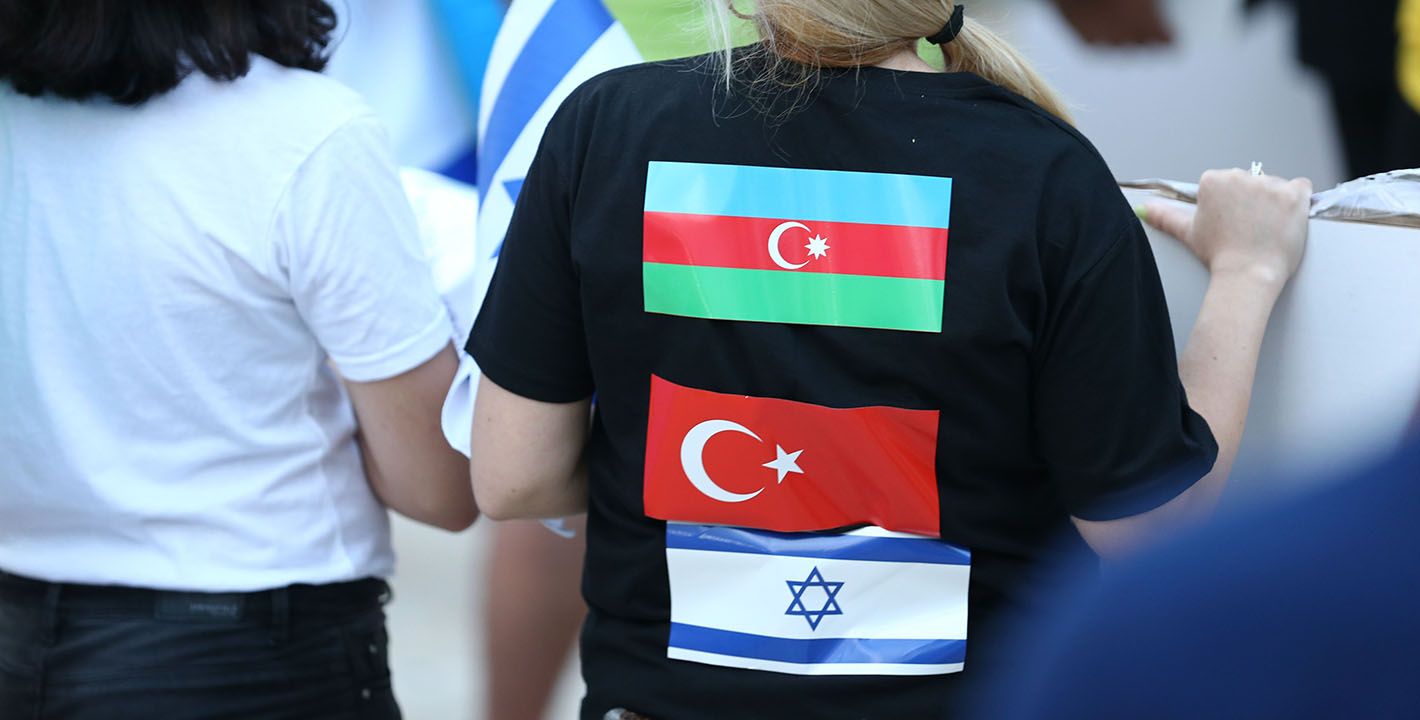
Years from now, autumn 2023 may look like a geopolitical winter for Iran. To Iran’s north, Azerbaijan’s September 2023 takeover of the entire territory of Nagorny Karabakh and the expulsion of its Armenian population and Russian peacekeepers brought in a new regional order in the South Caucasus that unsettles Tehran. In Gaza, Hamas’ October 7 attack set in motion dynamics that would undermine Iran’s dominance in the Levant. Worse for Iran, those arenas had become increasingly intertwined over the past decade. This resulted not only from Türkiye’s and Russia’s growing footprint in both areas, but also from the fact that they were bound by Israel’s drive to degrade Iranian influence. More recently, Trump’s negotiators—Tom Barrack, Steve Witkoff, and Jared Kushner—have sought to shore up new orders in the Levant and South Caucasus, in which weakening Iran is a top priority.
Russia, Iran, and Türkiye have long straddled the Middle East and South Caucasus, but they have played more assertive roles in each since the Arab uprisings of 2010–2011 and the Second Karabakh War in 2020. Moscow also emerged as a key player in the Levant’s and Libya’s security orders, stepping on Türkiye’s toes. The latter, in turn, pushed back in Libya, Syria, and Azerbaijan, where it helped Baku during the Second Karabakh War, inserting itself into what had long been Russia’s and Iran’s backyard. Similarly, Israel, by providing military technology to Azerbaijan in its successful war against the Karabakh separatists and Armenia in 2020, won a strategic ally on the Iranian border.
While such developments, especially Israel-Azerbaijan ties, bothered Iran, it did not pose an existential threat. In autumn 2023, however, events began to move very quickly. In the Levant, the seismic events after October 7 triggered an Israeli response that has reshaped the Middle East. The security order that emerged, against the backdrop of Hamas’s and Hezbollah’s defeats and Syrian president Bashar al-Assad’s downfall, undermined Iranian domination that had taken hold after the Arab uprisings. Israel replaced Iran’s “ring of fire” with a ring of de facto buffer zones in Gaza, Lebanon, and Syria. In the June 2025 war, it bombed Iran directly, and continues to operate against Iranian interests across the region.
If Israel is the blunt instrument of this transformation, the United States is the godfather of the emerging order. Washington has always been a key player in the Levant. Yet as Russia and Iran entrenched themselves in Syria after 2016, the Americans often acted more as spoilers, blocking Assad’s rehabilitation by imposing sanctions on the Syrian regime and obstructing normalization. Today, Trump’s circle of envoys has moved to center stage, steering the evolving situation in a broadly pro-American, anti-Iran direction. This process is still being consolidated and could yet falter. But on one point all the major regional actors seem to agree: there will be no return to Iranian domination.
In the South Caucasus, cracks in the security order appeared in 2020. From 1990 until 2020, frozen conflicts and Russia’s role as arbiter had set the rules of the game on Iran’s northern border, especially in Karabakh. Western and Turkish influence existed, but Moscow still called the shots. Iran had good relations with Armenia, but limited leverage of its own in the region. It was content that the Russian-dominated status quo and Russian influence were not directed against Iran. That changed after Azerbaijan’s victory in the Second Karabakh War, which left a vulnerable Armenian enclave in Karabakh. Turkish influence increased after that conflict, but Russia, which had brokered the ceasefire between Armenia and Azerbaijan, not only retained the diplomatic initiative but also fulfilled a long-desired wish to deploy its own peacekeepers—some 2,000 of them—in Karabakh.
This changed in September 2023. With Russia distracted by the war in Ukraine, Azerbaijan seized what remained of the Karabakh enclave, expelled its Armenian population, and sidelined the Russian peacekeeping mission. Baku has emerged as a regional middle power, backed by Türkiye and Israel, as Western and Turkish influence in the South Caucasus grows at Russia’s expense. For Tehran, this creates a very disturbing situation, characterized by a more assertive Azerbaijan, Israeli meddling, increased Western regional engagement on the political, military, and economic levels, especially with Armenia. Yerevan is not hostile to Iran, yet it has welcomed greater Western engagement as it courts new partners, including the United States, the European Union, France, and India. The region’s political fluidity does give Iran some room to maneuver, because much of this push also targets Russia, making the two occasional partners of convenience. Still, anti-Iran activity in the South Caucasus since 2020 has remained especially high.
One link between the South Caucasus and the Levant, and the broader anti-Iran direction in the region, is the role of Trump’s dealmakers. Witkoff and Barrack, the same figures working on the Middle East, have also been engaged in Armenia-Azerbaijan relations, effectively sidelining Russia’s mediation and alarming Iran. On August 8, the Armenian and Azerbaijani presidents met in Washington, where they reached understandings to cooperate on energy, artificial intelligence, and a proposed 42-kilometer route linking Azerbaijan to Nakhichevan via Armenia, a dispute that had been left unresolved since 2020. Trump endorsed a vague framework and the route was even named after him—the Trump Route for International Peace and Prosperity, or TRIPP. Few details have been disclosed, but Tehran is unhappy, fearing that the route could entrench a U.S. presence on its northern border.
The trouble with emerging security orders is that they are just that: emerging, and not yet fully consolidated. In the South Caucasus the contest is still under way, and neither Russia nor Iran will easily surrender its influence. In the Levant, weak states, the fragility of Syria and Lebanon in particular, could still create openings for Iran to regain some of what it has lost. However, Israel’s determination and the regional consensus to contain Iran don’t leave Tehran with much room to be optimistic.

Nonresident Scholar Malcolm H. Kerr Carnegie Middle East Center
Armenak Tokmajyan is a nonresident scholar at the Malcolm H. Kerr Carnegie Middle East Center in Beirut. His research focuses on borders and conflict, Syrian refugees, and state-society relations in Syria.
Recent Work
Armenak Tokmajyan, Laith Qerbaa
Armenak Tokmajyan
Carnegie does not take institutional positions on public policy issues; the views represented herein are those of the author(s) and do not necessarily reflect the views of Carnegie, its staff, or its trustees.
Reconciliation councils are emerging throughout the country to mediate in intracommunal disputes, many from the war years.
Natacha Danon

In an interview, Rozina Ali discusses her new book on the rise and manifestations of Islamophobia in the United States.

Michael Young
As the U.S.-led Coalition withdraws, the Kurds’ reliance on Baghdad, and on themselves, will only increase.
Wladimir van Wilgenburg

In an interview, Ian Lustick and Eli Clifton discuss their new book on why a prominent ally has so much influence in America.
Michael Young

As the U.S. stumbles in its war with Iran, we are likely to see an acceleration of its disengagement from the region.
Michael Young