

Commentary
Thomas de Waal
{
  "authors": [
    "Thomas de Waal"
  ],
  "type": "other",
  "centerAffiliationAll": "dc",
  "centers": [
    "Carnegie Endowment for International Peace",
    "Carnegie Europe",
    "Carnegie Russia Eurasia Center"
  ],
  "collections": [
    "Turkey’s Transformation"
  ],
  "englishNewsletterAll": "ctw",
  "nonEnglishNewsletterAll": "",
  "primaryCenter": "Carnegie Europe",
  "programAffiliation": "russia",
  "programs": [
    "Russia and Eurasia",
    "Middle East"
  ],
  "projects": [],
  "regions": [
    "Middle East",
    "Russia",
    "Europe",
    "Türkiye",
    "Eastern Europe",
    "Caucasus",
    "Armenia"
  ],
  "topics": [
    "Political Reform",
    "Security"
  ]
}
Source: Getty
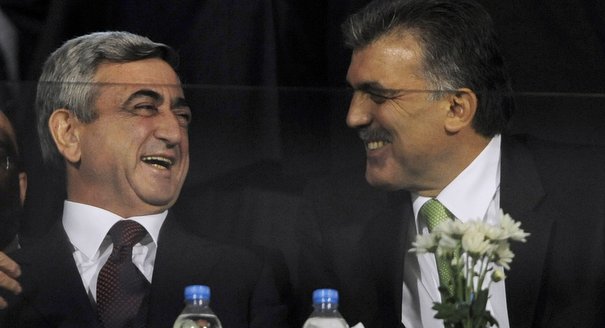
While there is virtually no hope that the 2009 Armenian–Turkish Protocols will be ratified soon, both parties should take steps to rebuild confidence and affirm their faith in the process.
One year ago, Armenia and Turkey began a historic rapprochement and signed two protocols on normalizing their relations. Unfortunately, the process stalled in April. In an updated policy brief, Thomas de Waal argues that the protocols—the most positive initiative in the South Caucasus for many years—must be kept alive as the process still has the potential to transform the region.
“If the process is to get back on track, all involved parties, including the United States, should set their sights on longer-term goals several years hence and ‘make haste slowly’ toward them,” de Waal writes. ”The centenary of the Armenian tragedy in 2015 is a good reference point by which to set the goal of full Armenian-Turkish normalization.”

Senior Fellow, Carnegie Europe
Thomas de Waal is a senior fellow at Carnegie Europe, specializing in Eastern Europe and the Caucasus.
Recent Work
Thomas de Waal
Thomas de Waal
Carnegie does not take institutional positions on public policy issues; the views represented herein are those of the author(s) and do not necessarily reflect the views of Carnegie, its staff, or its trustees.

As the U.S. stumbles in its war with Iran, we are likely to see an acceleration of its disengagement from the region.

Michael Young

Huawei pushed hard to enter the Egyptian data centers market, until the Americans made a better offer.

Angie Omar

The accord represents a pivotal moment in the region to avert a security vacuum in the Gulf.


Azeema Cheema, Mohanad Hage Ali

In an interview, Jason Burke discusses his sweeping account of the “revolutionists” who so shaped the 1970s and early 1980s.
Michael Young
There is a disturbing structural parallel between the old global energy economy and the new green transition.
Angie Omar