

Commentary
Dmitri Trenin
{
  "authors": [
    "Dmitri Trenin"
  ],
  "type": "legacyinthemedia",
  "centerAffiliationAll": "",
  "centers": [
    "Carnegie Endowment for International Peace",
    "Carnegie Europe",
    "Carnegie Russia Eurasia Center"
  ],
  "collections": [],
  "englishNewsletterAll": "",
  "nonEnglishNewsletterAll": "",
  "primaryCenter": "Carnegie Russia Eurasia Center",
  "programAffiliation": "",
  "programs": [],
  "projects": [],
  "regions": [
    "Caucasus",
    "Russia",
    "Western Europe",
    "Europe"
  ],
  "topics": [
    "Security",
    "Foreign Policy"
  ]
}
Source: Getty
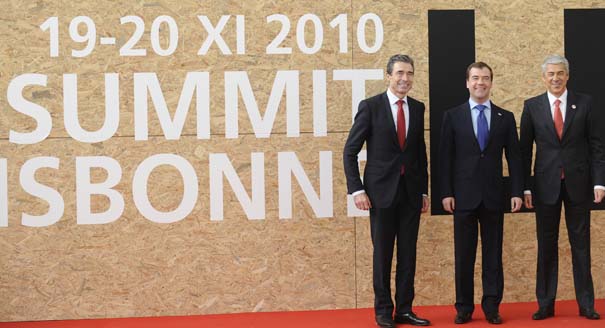
The results of the NATO summit in Lisbon, aimed at promoting cooperation between NATO and Russia, are a strong and useful platform for the continued transformation of the Russian-Western strategic relationship.
Source: The Moscow Times

It is good that NATO does not regard itself as Russia’s adversary. But the real issue is whether some of its members still regard Russia as a potential threat to themselves, and whether Russia considers the United States as a long-term security risk. There is still much to be done to remove both concerns. On the Russia-Central Europe track, the current reconciliation with Poland, which Medvedev will be visiting soon, needs to proceed deeper, toward becoming good neighbors. Reconciliation policies also need to expand to include the Baltic states. It is Moscow’s responsibility as well to rid itself of elements of the old Soviet stereotypes of NATO that still remain.
On the U.S.-Russia track, much of the responsibility lies with Washington. NATO leaders have appreciated the importance of the U.S. Senate’s ratification of New START. Senate Republicans, ever proud of being staunch defenders of national security, are now running the risk of casting a wholly different image, of a group that puts its partisan interest above that of the nation. Not a good bumper sticker for the 2012 elections. While New START’s fate is being decided, however, the reset should not be placed on pause. There is much that Washington and Moscow can achieve together along a broad front covered by a bilateral presidential commission.
Missile defense, of course, stands out among the areas of cooperation between the United States, NATO and Russia. If successful, this cooperation will do more to transform the strategic relationship than any other project. If cooperation fails in that area, a new round of adversity is likely. Therefore, it is important to get the terms of partnership right. Neither a joint dual-key system nor a NATO-integrated one with Russia as an add-on will do. A more creative approach is needed. Elements of missile defense, such as launch monitoring and threat assessment, should be integrated, while firing systems and should remain a national responsibility for Russia or an alliance responsibility for NATO. In any event, it would not be a great idea for the United States to try to shoot down an Iranian missile above Russian territory.
In respect to hardware, Russia’s cooperation on weapon systems with European NATO countries is an excellent way to develop state-of-the-art weapons and save money during a time when defense budgets are being slashed across the board. This could also help Russia get better weapon systems as it embarks on a major rearmament drive. At the same time, it would also instill more confidence in Russia’s neighbors that they have nothing to fear from these weapons.
For this cooperation to be smooth and sustainable, Russia and NATO members need people to directly engage with one another. Creating a Russia-NATO partnership college to learn the habits and practices of cooperation would be one good place to start. In terms of software, as Russia has proceeded with military reform, it needs to learn more about how the world’s leading defense institutions are dealing with the challenges of the 21st century. Sending bright and ambitious young officers to study abroad and then fully using their expertise in remaking the Russian military is one way of accomplishing this. Inviting some of the world’s best military brains to lecture at the academy of the General Staff is another good idea.
We should not be under any illusion as to where Russia and NATO are today. They have just stepped away from the brink. Only 2 ½ years ago, the two sides were on a collision course. NATO’s 2008 Bucharest summit set loose a train of events — above all, the alliance’s commitment to offer membership acceptance plan status to Georgia and Ukraine — that led to the war between Russia and Georgia. The situation resulting from that war is still unresolved, as are other frozen conflicts.
To be sure, the warm relations and constructive level of cooperation between Russia and NATO relations has a lot to do with Ukrainian President Viktor Yanukovych’s embrace of the country’s “non-bloc” status, and with U.S. President Barack Obama’s move to reset relations with Moscow. For the first time since the mid-1990s, NATO’s further enlargement to the east is not really on the agenda anymore, although not everyone in NATO and Georgia are pleased about this.
For the happy hour in Russia-NATO relations to evolve into a long-term happy relationship, the Euro-Atlantic territory needs to be turned into a single, undivided space. Formal treaties are important but not enough. More openness and cooperation on the ground are needed. Missile defense can be a game changer — or, failing that, a game breaker. For new, bold initiatives and declarations to have any meaning, they need to be backed up by concrete action.
As the Russians are reaching out, the people of Poland and the Baltic states also need to dismantle the psychological defenses that they have built up against the Russians. It is a two-way street. There should be a commitment to solve the frozen conflicts, starting with Transdnestr. In addition, a peace settlement between Russia and Georgia would allow stable peace to finally break out in all of Europe. This in turn would allow Russia to abolish its Western front and focus on its historical task of making itself an advanced economy and a great nation. Lisbon was a step in the right direction, with many more steps yet to be made.
Former Director, Carnegie Moscow Center
Trenin was director of the Carnegie Moscow Center from 2008 to early 2022.
Recent Work
Dmitri Trenin
Dmitri Trenin
Carnegie does not take institutional positions on public policy issues; the views represented herein are those of the author(s) and do not necessarily reflect the views of Carnegie, its staff, or its trustees.

In an interview, Ian Lustick and Eli Clifton discuss their new book on why a prominent ally has so much influence in America.

Michael Young

By failing to address Palestinian representation, the current process is bound to lead to just another temporary arrangement.

Nathan J. Brown
In an interview, Sergei Melkonian discusses Armenia’s and Azerbaijan’s careful balancing act among the United States, Israel, and Iran.

Armenak Tokmajyan

Just look at Iraq in 1991.

Marwan Muasher

A coalition of states is seeking to avert a U.S. attack, and Israel is in the forefront of their mind.
Michael Young