

Commentary
Dmitri Trenin
{
  "authors": [
    "Dmitri Trenin"
  ],
  "type": "legacyinthemedia",
  "centerAffiliationAll": "",
  "centers": [
    "Carnegie Endowment for International Peace",
    "Carnegie Russia Eurasia Center"
  ],
  "collections": [],
  "englishNewsletterAll": "",
  "nonEnglishNewsletterAll": "",
  "primaryCenter": "Carnegie Russia Eurasia Center",
  "programAffiliation": "",
  "programs": [],
  "projects": [],
  "regions": [
    "Caucasus",
    "Russia"
  ],
  "topics": [
    "Political Reform",
    "Foreign Policy"
  ]
}
Source: Getty
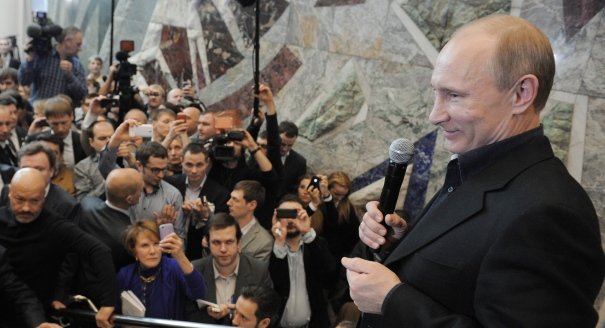
While Vladimir Putin’s election to the presidency should not change the course of Russia’s foreign policy, his fate will largely depend on his government’s socio-economic and political performance.
Source: New York Times

As president, his fate will largely depend on his government’s socio-economic and political performance. Thus, he will not want trouble with the United States. He can't be expected to offer Washington too many concessions on contentious issues, but he can be relied on to honor Russia’s commitments under the Afghanistan transit agreement.
There is also some room for cooperation on Syria and Iran, as long as the United States does not resort to force against Damascus and Tehran. In an even more positive vein, Putin may open up Russia, including its energy sector, to U.S. investments. If that happens, the U.S.-Russian relationship will begin maturing beyond the traditional politico-military sphere.There are risks, however. Putin’s victory at the polls is not being seen as either free or fair by many in the Russian opposition, including the protest movement. This has a bearing on the future president’s legitimacy, both at home and abroad. If the U.S. public is led to believe that Putin is, in fact, less than a fully legitimate head of Russia, this will constrain the Obama administration’s outreach to him, and to his government. This, in turn, would only confirm Putin’s belief that the United States is planning a regime change in Russia, and the reset will be reset.
Should — God forbid — the so far peaceful protests in Moscow degenerate into violent clashes, the relationship would deteriorate way beyond where it was in the wake of the 2008 Russia-Georgia war. This will not be a good thing for Russia, for its modernization agenda will be in jeopardy. Isolated in the West, Moscow would need to look to China for secondhand technology.
Former Director, Carnegie Moscow Center
Trenin was director of the Carnegie Moscow Center from 2008 to early 2022.
Recent Work
Dmitri Trenin
Dmitri Trenin
Carnegie does not take institutional positions on public policy issues; the views represented herein are those of the author(s) and do not necessarily reflect the views of Carnegie, its staff, or its trustees.

In an interview, Ian Lustick and Eli Clifton discuss their new book on why a prominent ally has so much influence in America.

Michael Young

By failing to address Palestinian representation, the current process is bound to lead to just another temporary arrangement.

Nathan J. Brown
In an interview, Sergei Melkonian discusses Armenia’s and Azerbaijan’s careful balancing act among the United States, Israel, and Iran.

Armenak Tokmajyan

Just look at Iraq in 1991.

Marwan Muasher

A coalition of states is seeking to avert a U.S. attack, and Israel is in the forefront of their mind.
Michael Young