

Article
C. Raja Mohan, Darshana M. Baruah
{
  "authors": [
    "C. Raja Mohan"
  ],
  "type": "legacyinthemedia",
  "centerAffiliationAll": "dc",
  "centers": [
    "Carnegie Endowment for International Peace",
    "Carnegie India"
  ],
  "collections": [],
  "englishNewsletterAll": "ctw",
  "nonEnglishNewsletterAll": "",
  "primaryCenter": "Carnegie India",
  "programAffiliation": "SAP",
  "programs": [
    "South Asia"
  ],
  "projects": [],
  "regions": [
    "Asia",
    "South Asia",
    "India",
    "East Asia",
    "China"
  ],
  "topics": [
    "Foreign Policy",
    "Security",
    "Military"
  ]
}
Source: Getty
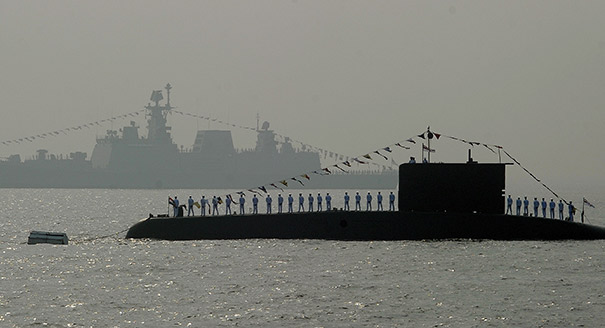
The Chinese navy first showed its flag in the Indian Ocean nearly three decades ago, when it began to make ship visits to Sri Lanka and Pakistan.
Source: Indian Express
Reports that the docking of a Chinese submarine at Karachi last month has surprised New Delhi are distressing. One would have thought Delhi would have anticipated the development after it sighted Chinese submarines in Sri Lanka’s waters last year. Despite the growing strategic importance of the Indian Ocean in China’s maritime strategy, Delhi’s defence bureaucracy seems to continue to wring its hands rather than act.
The Chinese navy first showed its flag in the Indian Ocean nearly three decades ago, when it began to make ship visits to Sri Lanka and Pakistan. Since then, the frequency and intensity of Chinese naval presence in the Indian Ocean has grown. The Chinese navy’s continuous anti-piracy operations in the Arabian Sea since the end of 2008 have showcased Beijing’s growing naval capabilities as well as the political will to operate in waters far from its shores. Defending China’s growing overseas interests has become a major priority for the PLA.
China has also begun to debate the challenges of acquiring military and naval bases in other countries, especially in the Indian Ocean. As part of its “going out” strategy, the PLA navy has begun to build strategic partnerships in the Indian Ocean, cultivate access arrangements with critically located countries, export ships and submarines, and intensify its defence diplomacy in the littoral.The idea of a Chinese network of naval facilities and bases in the Indian Ocean, or a “string of pearls”, is often invoked by those in Delhi who fear Beijing’s hostile intentions. Others taking a more benign view of China’s policies ridicule the idea.
Ignoring the alarmists and apologists, Delhi must take a more realistic view of China’s long-term role in the Indian Ocean. China has ambitions to become a great maritime power. It is building the capabilities and devising policies to become one. A rising China is bound to establish a sustainable naval presence in the Indian Ocean. The question is not whether, but when and how.
There is nothing illegal about China’s aspirations. Beijing is following the footsteps of all previous great powers — Portugal, the Netherlands, France, Britain and the US — that established a naval presence in the Indian Ocean over the last five centuries. One factor, however, constrains Chinese military presence in the Indian Ocean.
It is the tyranny of geography. Long distances from China’s eastern seaboard make an effective presence in the Indian Ocean difficult for China without strong local partners. Although China is exploring special maritime relationships with many nations across the Indian Ocean, Pakistan remains the most likely place where its navy may drop anchor for the long term.
The stable all-weather partnership built up over the last many decades, Pakistan’s critical location in the Arabian Sea next to the Gulf, and Islamabad’s growing economic reliance on China, appear to have set the stage for an expansive naval partnership.
India paid a high price for failing to anticipate the Sino-Pak nuclear nexus in the 1970s and 1980s. It is erring again by neglecting the potential for a maritime alliance between China and Pakistan that could severely constrain India’s freedom of action in the Indian Ocean.
The problem is not China’s naval ambition, but the ministry of defence’s reluctance to craft a vigorous response. For his part, Prime Minister Narendra Modi has underlined the importance of working with other powers in strengthening India’s critical role in the Indian Ocean. But the defence ministry seems unable or unwilling to translate that vision into policy. Consider, for example, its hesitation to hold trilateral and quadrilateral naval exercises in the Indian Ocean with its maritime partners — the US, Japan and Australia. While Beijing pays no heed to India’s concerns in pursuing its maritime interests, the MoD cites Chinese sensitivities to limit India’s naval engagement with America and Japan. One would think diplomacy is the MEA’s business and that the MoD’s is to strengthen Delhi’s naval partnerships, probe China’s maritime vulnerabilities and build on India’s geographic advantages in the littoral. The NDA may have replaced the UPA in South Block, but strategic paralysis — the legacy of A.K. Antony’s eight long years as defence minister — seems to endure.
This article was originally published in the Indian Express.
Former Nonresident Senior Fellow, Carnegie India
A leading analyst of India’s foreign policy, Mohan is also an expert on South Asian security, great-power relations in Asia, and arms control.
Recent Work

C. Raja Mohan, Darshana M. Baruah


Alexander Gabuev, Paul Haenle, C. Raja Mohan, …
Carnegie does not take institutional positions on public policy issues; the views represented herein are those of the author(s) and do not necessarily reflect the views of Carnegie, its staff, or its trustees.

Just look at Iraq in 1991.

Marwan Muasher

A coalition of states is seeking to avert a U.S. attack, and Israel is in the forefront of their mind.

Michael Young

Baku may allow radical nationalists to publicly discuss “reunification” with Azeri Iranians, but the president and key officials prefer not to comment publicly on the protests in Iran.

Bashir Kitachaev

The country’s leadership is increasingly uneasy about multiple challenges from the Levant to the South Caucasus.

Armenak Tokmajyan
The countries of the region have engaged in sustained competition that has tested their capacities and limitations, while resisting domination by rivals. Can a more stable order emerge from this maelstrom, and what would it require?


Hamza Meddeb, Mohamed Ali Adraoui